

Artist Phuong Binh
(Baonghean) - Once, I unexpectedly came across the verses of my friend, the poet Binh Nguyen Trang: “Women returning from some past life / in the human world / in the universe / in the light of love / and suffering / Women dancing / depressed / lonely / joyful / overwhelmed with emotions… Phuong Binh paints / Hands lost to heaven…”. I asked if she was referring to the world of women in the paintings of the talented woman from Nghe An named Phuong Binh. She replied: “Who else could it be!”
 |
| Artist Phuong Binh |
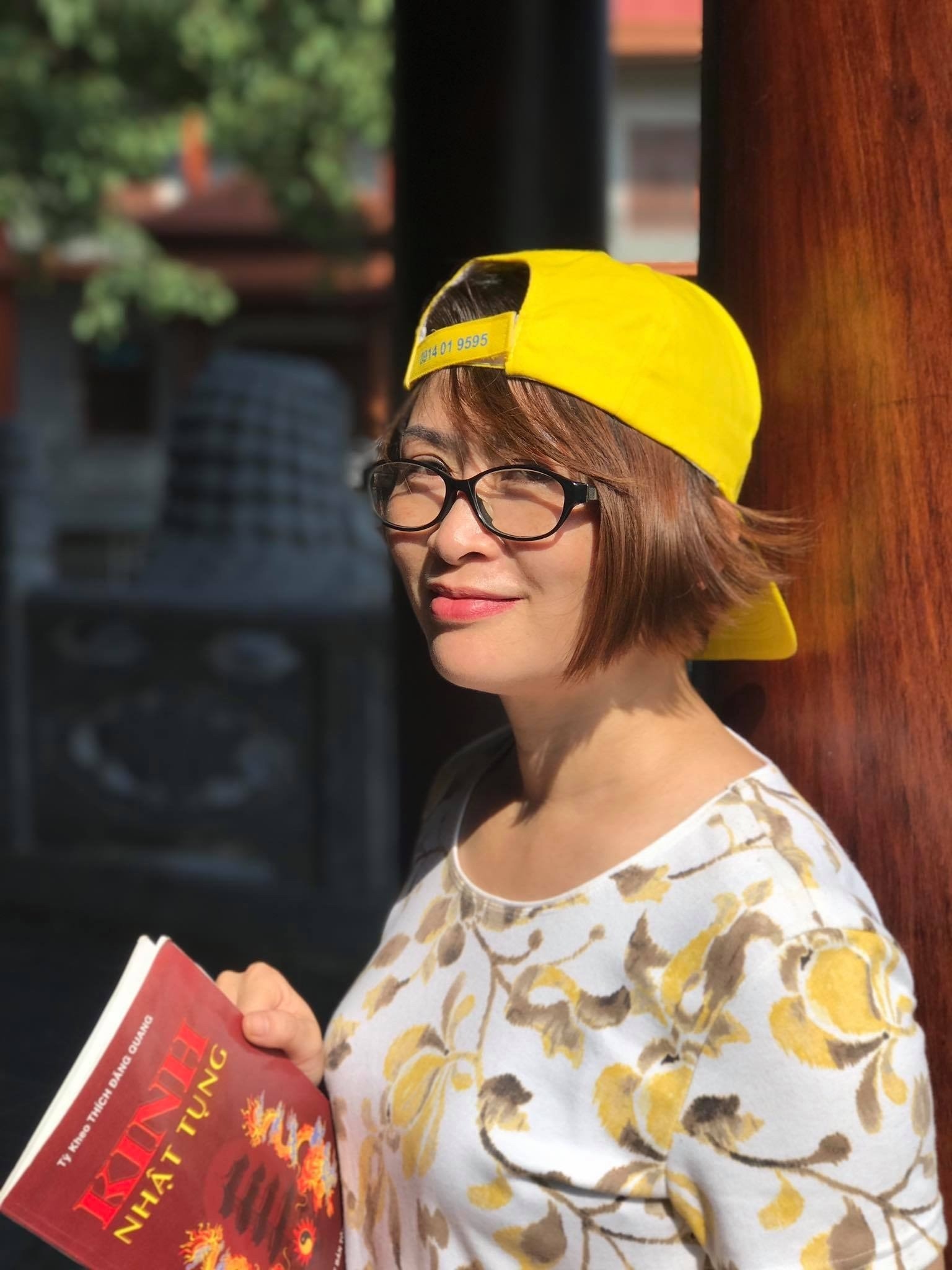
The name Ngo Phuong Binh has haunted me for quite some time. Not only because artists from Nghe An province still mention her name at gatherings, but also because in recent years she has become a phenomenon in the art world, associated with the nickname: "painting as if possessed." People say that she can paint without regard for time or space. Sometimes, when she runs out of paper and is in a painting frenzy, she even writes on a receipt. Phuong Binh's paintings have reached thousands. People talk about her, not only for her talent but also for her complexities. As for me, I have always pictured a woman who loves painting as a way to live, to cope with life. A woman burdened with aspirations and loneliness, who wants to let them escape only by sitting before paper, canvas, pen, and paint…
And I met her one spring morning in Hanoi, when the morning dew had dried and the air had become gently cool. I went to Lang Pagoda, where she was instructing students in drawing exercises. She greeted me with a smile like that of someone I'd known for many years, and her voice, with its rich Nghe An accent, was strangely warm and approachable. She said that she had only officially moved to Hanoi a few years ago. I was captivated by her gentle, mature, and elegant beauty. It turned out that Ngo Phuong Binh was the cousin of Miss Vietnam Ngo Phuong Lan. Born in 1974 in Dien Hanh (Dien Chau), Phuong Binh studied at the Nghe An College of Culture and Arts, majoring in Painting, from the age of 12. As the daughter of the late musician Tung Vinh, from a young age she was strongly encouraged by her parents and everyone else to pursue a career in art. She studied drawing, dancing, playing musical instruments, and even embroidery and sewing, but ultimately (and very early on) she chose painting. The colors captivated her, and the feeling of expressing herself on paper and canvas through alluring lines appealed to her. When mentioning composer Tung Vinh, her voice softened slightly: "My father was wonderful. Thanks to his encouragement, I have been able to confidently move forward on my path."
After graduating from the Nghe An School of Culture and Arts, Phuong Binh continued her studies at the Hanoi College of Music and Fine Arts Education. In 1999, she returned to her hometown and became an art teacher at a high school. Perhaps Phuong Binh would have had a more peaceful and quiet life if she had remained a high school teacher in her hometown. But sometimes, "one doesn't choose the smooth path, but the rough one," and perhaps those rough paths were waiting for talented people. Phuong Binh chose a bolder, more adventurous path, pursuing her passion for painting to the very end. (Just like her painting style, a relative of hers told me: "It's strange, when Phuong Binh paints a portrait of someone, she always seems to choose them from the roughest angle.") In 2003, she went to Hanoi to study at the Vietnam Fine Arts University and later pursued a master's degree there.
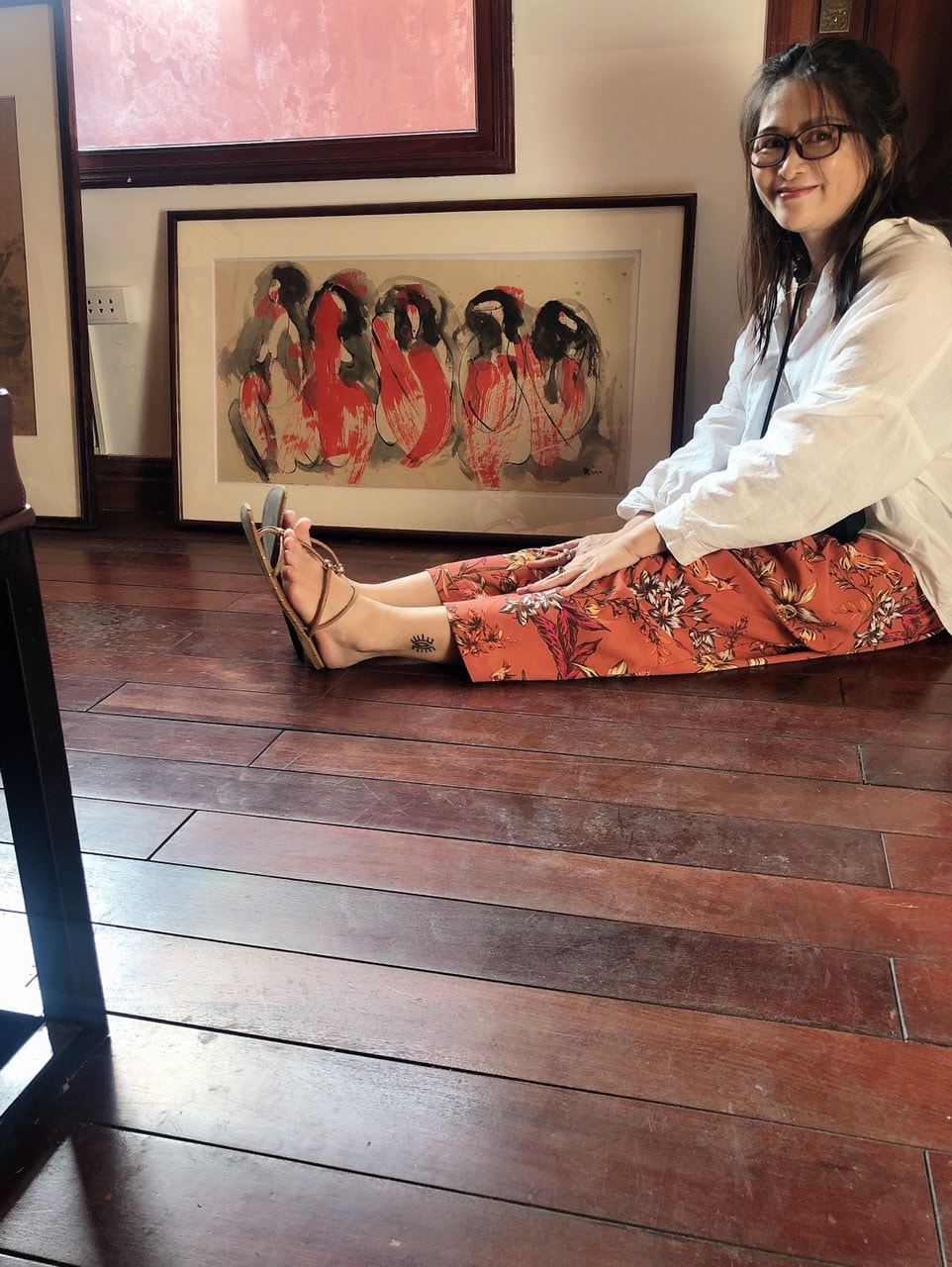 |
Currently, Phuong Binh is a lecturer in Fine Arts at the Faculty of Architecture, Nguyen Trai University. “I love my job, I love the school I chose to stay at,” shared artist Phuong Binh. She also said that her homeland is the most wonderful place, but because of life, she had to leave it. People have to accept that they can't “get” much, and that they have to pay a price for success and aspirations. But she is fortunate to have come to and also deeply loves Hanoi. In many of her paintings, the Cua Hoi and Dien Chau beaches appear as beautiful memories for Phuong Binh. “I believe that when painting something, the artist must truly immerse themselves in it,” Phuong Binh said, “My hometown is near the Cua Hoi and Dien Chau beaches. I've been to Cua Lo many times, so there was a period when I often painted the sea and boats.” But when she came to the capital city, she also found many inspirations for her paintings. She loves Hanoi, loves its streets, loves the autumn nights filled with the fragrant scent of milk, loves her small room, where after each teaching session she returns and quietly sits down beside her easel.
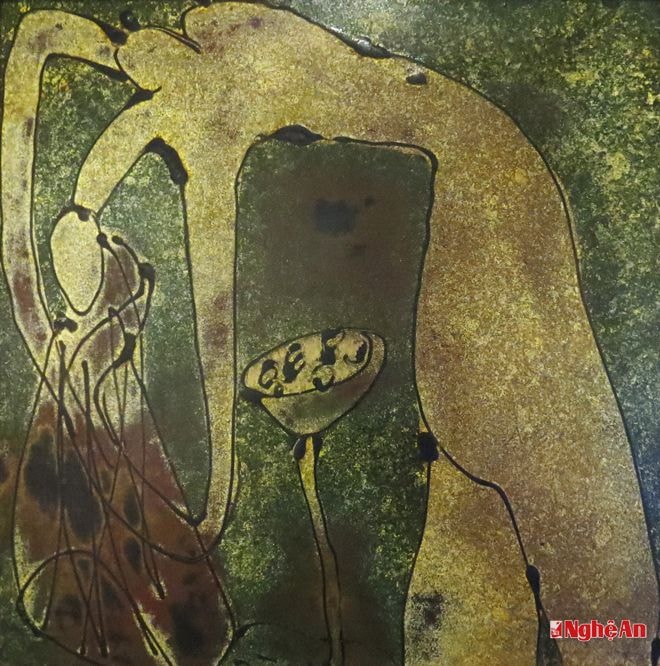 |
| The artwork "You and the Lotus". |
Then Phuong Binh invited me to her room. It was a small apartment on the second floor of an old apartment building. The artist smiled, saying that she was "allergic" to elevators. Perhaps, after teaching hours, after wandering with friends through the streets of Hanoi, she liked to return to this warm room, liked to walk up the old staircases of the building, touch the handrails that had faded with time, and greet and smile warmly at the familiar parking attendant… Perhaps, after those moments of living for herself, Phuong Binh's happiness was talking to her son – her closest friend, the only one who had been with her through all the ups and downs, her faith and hope. The boy is now grown up, about to graduate from university, but he is unusually attached to his mother. Besides art, he is her emotional support. Phuong Binh clings to him to live steadily, to believe in herself and strive forward, even though life is sometimes unpredictable and complicated…
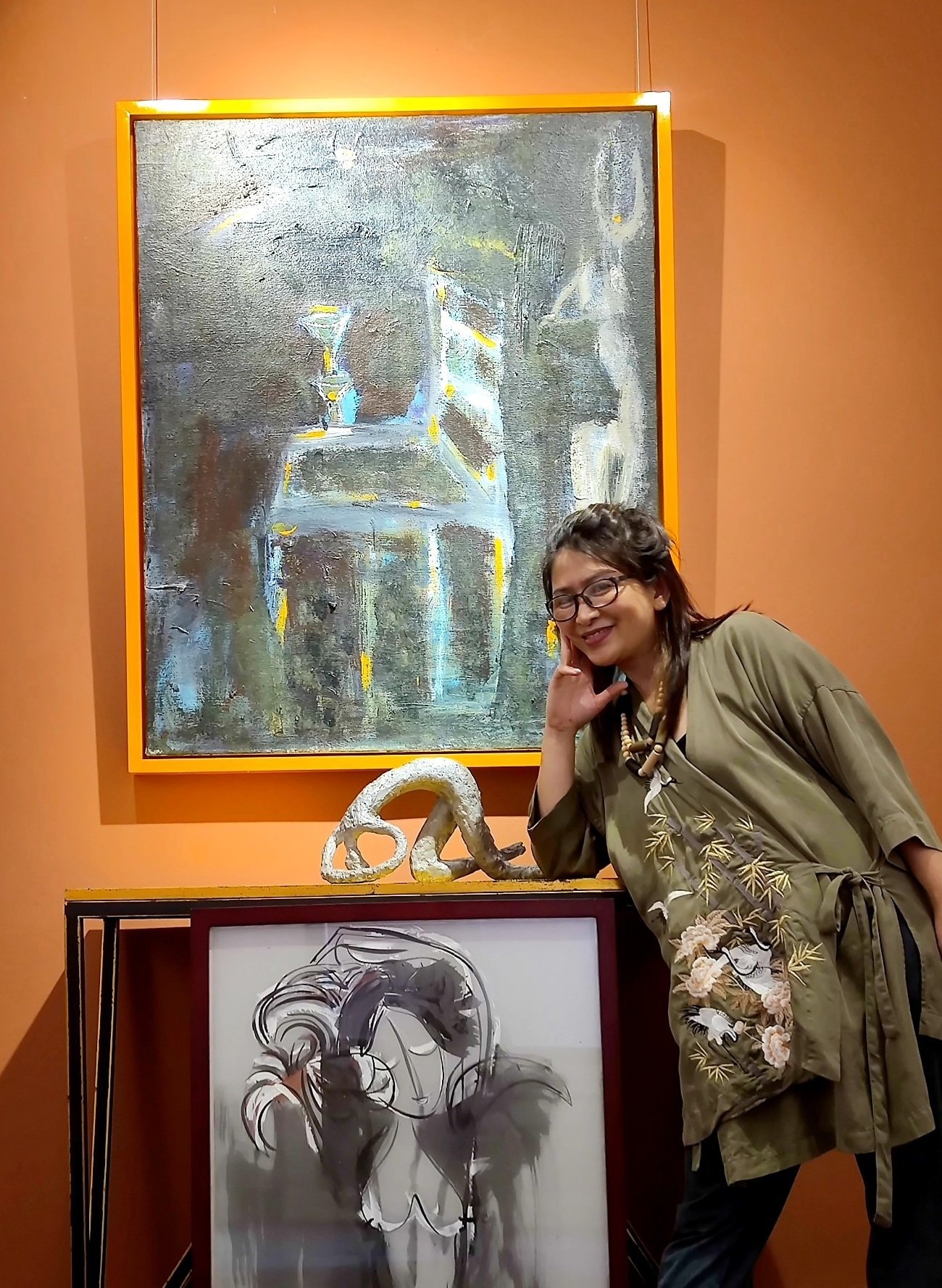
In her paintings, she recounts all those stories—the joys, sorrows, loneliness, and love of life. But unlike others, artist Phuong Binh has her own way of storytelling. She tells stories through the female body. As if by fate, Phuong Binh always paints nudes. Initially, she painted in oil, lacquer, and silk, but when she started with traditional Vietnamese dó paper, she knew she couldn't stop. Dó paper paintings limit the diversity of shades and lines; they require everything to be concise. But that limitation is also the advantage of dó paper, if the artist is talented. By chance, Phuong Binh tried dó paper and she fell in love with it, as if she was born to be connected with it. Moreover, although she studied art and learned to paint nudes, this subject came to her as if by destiny, as if it couldn't be otherwise. Phuong Binh simply says about this: "I don't understand why."
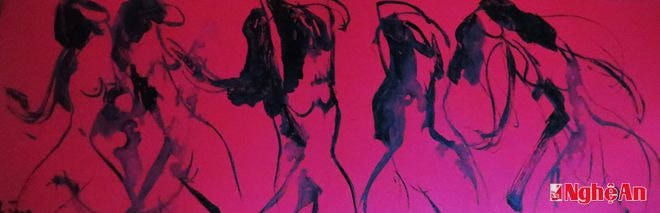 |
| The artwork is "Dancing Women". |
The nude women are dancing as if in a joyful song, leaning over lotus flowers or sitting with their hair in their hands… All sorts of poses and positions… Sometimes you don't even know what they're doing, or see their faces clearly, only a sadness, a loneliness, or a joy is reflected on the paper. The women in Phuong Binh's paintings seem to fade away. Only the rain of their lives remains, always present, sometimes warm, sometimes cold, sometimes weak, sometimes strong, but always beautiful and melodious. "I paint nudes as if I were painting myself," the artist said. Her confession startled me.
 |
Ultimately, art is an expression. Perhaps that's why Phuong Binh wants to express her emotions through nudity? The woman within Phuong Binh is singing. She has poured that song into her paintings, pouring in joy, sorrow, bitterness, hardship, worries, happiness, and excitement… Phuong Binh's nude paintings are therefore not vulgar; they are overflowing with emotion, elegant and magnificent, warm and intimate.
Phuong Binh can paint at any time. Even when sitting with friends, she feels as if her fingers have been forgotten, and that urges her to quickly return to her small room to paint. She doesn't cling to ideas, or rather, ideas come unexpectedly with each brushstroke; thus, women return and dance in Phuong Binh's paintings. Looking at her paintings, one sees that the poet Binh Nguyen Trang accurately "painted" the world of women under Phuong Binh's skillful hands in her poem "The Returning Women." And this same poet said: Phuong Binh's soulmates are the women in her paintings, and for Phuong Binh, there are no limits to art.
Phuong Binh said the woman was truly beautiful. This is clearly evident in her paintings. Long hair, the smudges of Chinese ink on the rice paper making the hair seem to fade. Sensual curves, postures as if dancing or singing… Sometimes a woman writhing beside lotuses, as if displaying their beauty together. Soft, sweet, proud – that is the woman in Phuong Binh's paintings.
I was fortunate enough to watch her paint. In just a few minutes, a painting was completed on traditional Vietnamese paper, with masterful brushstrokes. While she was painting, Phuong Binh was completely absorbed. People say that when she paints, she seems "possessed," "bewitched," but I don't like using those words to describe it. I only know that before me at that moment was a woman in a state of ecstasy. Tears rolled down her cheeks, and that woman joyfully immersed herself in the rain of her life.
Some say that when Phương Bình paints nudes, she seems to shed her skin, using a different perspective to depict the woman within herself. But I don't think so. On the contrary, I think that when she paints nudes, Phương Bình returns to her true self. That's when she's most feminine, most in pain, happiest, loneliest, and most primal. She gazes at herself, reflects on herself, questions herself, and answers the questions of her life. I think at that moment she is more herself than ever. I think at that moment she is completely a woman returning to herself.
After saying goodbye to artist Phuong Binh, I gazed at her hands for a long time. The hands of a woman burdened with worries, the hands of a woman who is the pillar of the family, the hands that paint aspirations, the hands that paint loneliness… And wasn't it true that those "hands that wandered to paradise" spoke to me about myself?