
10 outstanding archaeological discoveries of 2014
A 4,000-year-old shipwreck in Türkiye and 40,000-year-old cave paintings in Asia are two of the most notable archaeological discoveries of the year.
A 4,000-year-old shipwreck in Türkiye and 40,000-year-old cave paintings in Asia are two of the most notable archaeological discoveries of the year.
The oldest shipwreck
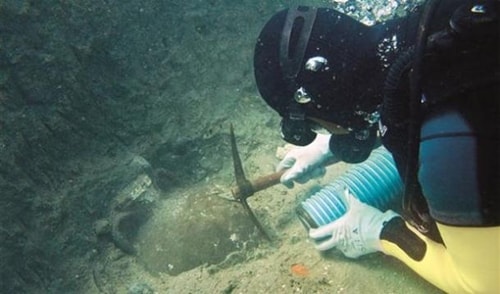 |
During excavations at Urla port, an underwater archaeological site in Türkiye, scientists discovered a sunken ship dating back 4,000 years. This is the oldest known shipwreck in the Mediterranean and the world.
Cave paintings in Asia
Over 100 drawings of human hands and animals have been discovered in caves on Sulawesi Island, Indonesia, dating back 40,000 years.
The largest ancient stone block ever carved by humans.
A research team from the German Archaeological Institute found the largest ancient stone block ever discovered at a limestone quarry in Baalbek, Lebanon. This area was once known as Heliopolis – the city of sunshine during the Roman era. The block is partially buried underground. The monolithic stone measures 19.6 meters long, 6 meters wide, and at least 5.5 meters high, weighing an estimated 1,650 tons. It served as the foundation for a temple dedicated to the god Jupiter.
Carvings on a 500,000-year-old mollusk shell.
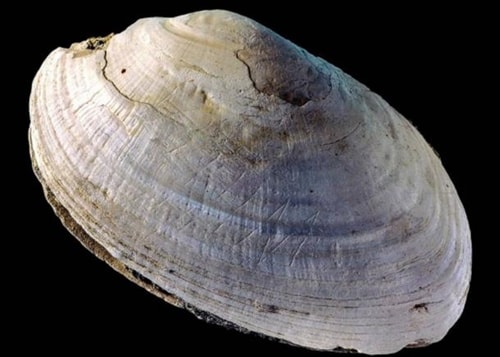 |
A mollusk shell found on the island of Java, Indonesia, dates back 430,000 to 540,000 years and contains carvings of Homo erectus, the ancestor of modern humans, who appeared approximately 1.9 million years ago and became extinct 150,000 years ago. This discovery challenges the preconceived notion that modern humans, Homo sapiens, were the first to create abstract sketches and written forms of communication.
Neanderthals may have interbred with human ancestors.
Scientists analyzed the oldest DNA of modern humans, Homo sapiens, taken from a 45,000-year-old femur bone found in 2008 on the banks of the Irtysh River, near the settlement of Ust'-Ishim, Siberia. According to the research, the bone sample contained 2% Neanderthal DNA, the same percentage as modern Europeans. This suggests that interbreeding between Neanderthals and modern humans may have occurred approximately 50,000 to 60,000 years ago.
New pharaoh discovered in Egypt.
Egyptian archaeologists discovered the burial place and remains of a pharaoh in southern Abydos, Sohag province, in January. The pharaoh, who ruled Egypt 3,600 years ago, was named Seneb Kay (Senebkey). He was found in a wooden sarcophagus inside a heavily damaged, roofless stone tomb. His name had never appeared in ancient Egyptian history. The research team discovered his name thanks to hieroglyphs on an oval-shaped ring inscribed with the king's name and title.
The Mayan city in the jungle
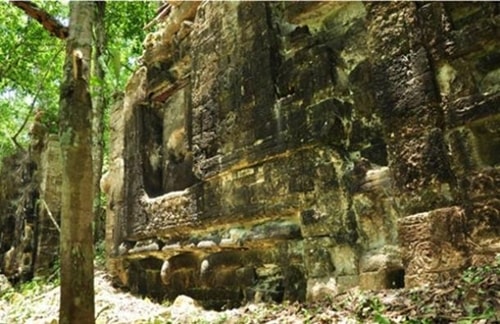 |
The remains of two ancient Mayan cities, including a gateway shaped like a monster's mouth, a ruined pyramid temple, and palace ruins, were unearthed in a dense jungle in the central Yucatan Peninsula, southeast of Campeche state, Mexico. These two cities continue to raise new questions about the cultural diversity of the Maya people.
Ancient Greek tomb
Greek archaeologists have discovered an ancient tomb on Kasta Hill, in the Amphipolis region, 600 km north of Athens. The tomb dates back to the time of Alexander the Great, around the 4th century BC. The entrance to the tomb is guarded by two marble sphinx statues, missing their heads and wings, but both have been restored. The tomb holds secrets that have been hidden for 2,300 years.
Architecture surrounding the ancient Stonehenge site.
While mapping the landscape hidden beneath the surface of the ancient Stonehenge site, archaeologists discovered burial mounds, churches, tombs, pits, and other structures never before seen. This discovery significantly altered the view that Stonehenge was the single, primary landmark of the region.
Mysterious trenches in the Amazon rainforest
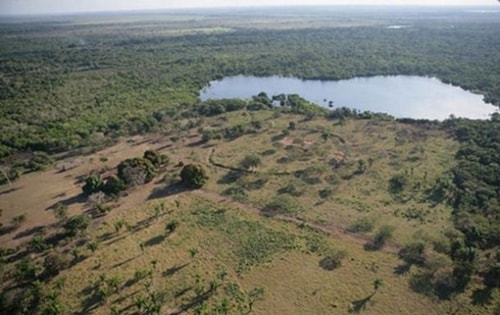 |
Archaeologists have previously discovered many mysterious lines and geometric shapes carved into the Amazon landscape dating back thousands of years. However, the latest research suggests they appeared much earlier. John Francis Carson from the University of Reading, UK, and his research team analyzed sediment cores containing ancient pollen grains and charcoal dating back 6,000 years. The results showed that the sediments did not originate from a tropical rainforest ecosystem. Around 2,000-3,000 years ago, the landscape resembled the African savanna. Excavations must have been carried out before the transition from savanna to tropical rainforest occurred.
According to VnExpress