

Restoring the mammoth's DNA
(Baonghean) - Could the extinct mammoth reappear on Earth? This question no longer seems so far-fetched, as a group of scientists published in the journal Current Biology that they have almost completed the process of reconstructing the genome of an animal that disappeared from Earth 4000 years ago.
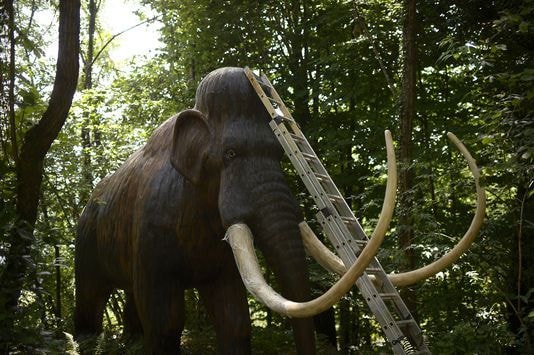 |
| A mammoth model in Karpin Abentura park in Bilbao, Spain. Photo: Reuters. |
According to scientists, this reconstruction process is much more accurate than the experiment conducted in 2008. Scientists estimate the accuracy of the genome reconstruction to be up to 80%. The experiment was conducted using two specimens of mammoths that lived 40,000 years ago, discovered in northern Siberia and on Wrangel Island in the Arctic Ocean.
Many believe this breakthrough could create a mammoth – a species of elephant known for its long tusks and thick fur. Dalen, from the Swedish Natural History Museum and a member of the research team, commented, “The idea of reviving a mammoth and observing how it reacts and moves would be fascinating.”
However, scientists assure that the goal of the research is not to revive this once-extinct species of elephant. Reviving it would raise ethical concerns for researchers. Creating a mammoth would require sacrificing the life of an elephant carrying a genetically modified mammoth embryo. Scientists say this could cause pain to the female elephant, and such an action could not be justified ethically.
Furthermore, researcher Beth Shapiro of the University of California, Santa Cruz, added that elephants are highly social creatures, and she believes mammoths are no exception. Therefore, creating a single mammoth would mean it would live in isolation in the Arctic, but creating more mammoths would not benefit humanity. Thus, undertaking this project seems to raise ethical concerns.
Researcher Hendrik Poinar of McMaster University in Canada also agrees that creating mammoths and then confining them to a zoo "is really not a good idea." Therefore, Poinar suggests that researchers should simply re-establish the structural sequence of mammoth DNA and use that as a blueprint to continue their work.
Chu Thanh
According to Le Monde
| RELATED NEWS |
|---|