

Switching to drought-resistant crops: An urgent requirement.
(Baonghean) - As of June 15th, the entire province has only sown and planted over 46,000 out of 56,000 hectares of summer-autumn rice. With increasingly complex weather conditions, changing the crop structure, in addition to improving economic efficiency per unit area, is also an urgent requirement to combat drought.
To date, Do Luong district has planted 5,500 hectares of summer-autumn rice, of which 400 hectares are at risk of dying due to water shortage. In recent years, to cope with climate change, the district has implemented crop restructuring in some areas, such as switching to growing corn and beans, or in some downstream areas in Dai Son, Tru Son, and Giang Son communes, switching to growing grass for livestock. As a locality with a relatively developed livestock industry, Do Luong has the advantage of gradually converting unsustainable crop production areas to growing grass for livestock, especially in the communes at both ends of the district.
Currently, over 150 hectares of main-season rice fields, previously planted with embryo-grown rice varieties, have been completely converted to growing grass for livestock and short-term industrial crops, yielding high economic efficiency and safety. From the beginning of the season, in addition to implementing measures to quickly sow and plant summer-autumn rice in areas with reliable water sources, the district has also directed communes to review and balance water resources to switch to growing cash crops in areas without reliable water. “Currently, given the difficult water situation, we are directing a review and developing plans to convert to suitable crops that still provide considerable economic value,” said Mr. Tran Doan Hung, Head of the District Agriculture Department.
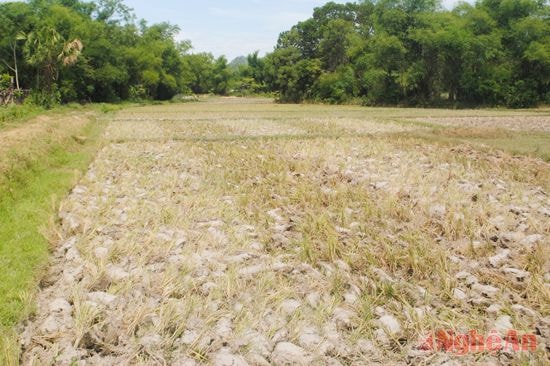 |
| The land has been plowed but there is no water for planting in Chau Quang (Quy Hop). |
However, in reality, not every locality has the same advantages in restructuring drought-resistant crops as Do Luong. The land in Nghia Tho commune (Nghia Dan district) is mainly hilly and mountainous. The entire commune has over 70 hectares of land for two rice crops and 30 hectares dedicated solely to the main rice crop, with no area for the summer-autumn rice crop due to the lack of water supply. Mr. Le Ngoc Uyen, Chairman of the People's Committee of Nghia Tho commune, said: "The water source for production in the commune mainly comes from the Khe Lung, Khe Cai, and Lang Man dams, all small reservoirs managed by the local authorities. To date, all reservoirs have fallen below the dead water level, and if there is no rain by the end of June or beginning of July, many areas of the main rice crop will also be uncultivable."
Over the years, facing a constant water shortage, the commune has strived to encourage residents to diversify their crops. Three years ago, nearly 8 hectares of rice paddies in Men and Tan Tho hamlets, which were entirely dependent on rainwater and yielded only 1.4-1.5 quintals per sao (approximately 1000 square meters), were converted to sugarcane cultivation, yielding higher economic returns. From 2013 to the present, 30 hectares of sugarcane on high hills, with yields of only over 45 tons per hectare, have been converted to acacia plantations. Notably, nearly 80 hectares near streams and reservoirs have been converted to growing corn for the TH Dairy Farm, green squash, and watermelons, generating significant economic benefits.
However, this conversion is not feasible in all areas due to the fragmented and small size of the rice fields, making mechanization impossible. Furthermore, the land is dry and barren, leaving only the option of waiting for rain to plant rice or converting to other crops. Ms. Nguyen Thi Hoai (Hamlet 3) expressed her concern: "My family has over 2 sao (approximately 2,000 square meters) of rice fields. In previous years, we would have finished planting by this time, but this year the drought is severe. There were a few light rains recently, and the fields only started to dry out slightly, but there's still no water for planting. If the rain comes too late, we'll have to see what the commune advises on how to switch to other crops, because leaving the fields fallow would be a great loss."
Nghia Dan district faces many difficulties in restructuring crop patterns, especially in drought-resistant areas. The area of double-cropping rice land is mostly fragmented and small, ranging from 50-70m2, with red soil mixed with limestone, dry and hard. In recent years, despite numerous conversion solutions implemented by the district, the results have been very modest. According to the district's plan, Nghia Dan will plant 2,500 hectares of rice this summer-autumn season, including 1,500 hectares of summer-autumn rice. Although there have been scattered rains in the past few days, as of June 16th, only 50 hectares have been planted in the communes of Nghia Loc, Nghia Hoi, Nghia Khanh, etc., thanks to water from Song Sao and Khe Da reservoirs. According to Mr. Truong Minh Hoai, Deputy Head of the District Agriculture Department, localities plan to plant short-day rice varieties, but it is still unlikely they will be able to complete the planting in time. “We know that sticking with rice cultivation is difficult, but the transition is even harder. The land is fragmented and barren, making mechanization difficult. Some areas of land used for a single rice crop have been piloted for several years, but switching to corn cultivation is very difficult because the fields are small, and after harvesting the corn, the dry, hard soil requires manual plowing to remove the roots, which is very labor-intensive. Furthermore, in many areas, people still want to cling to rice cultivation. For example, in Nghia Lam, nearly 40 hectares of rice fields suffer crop failures and low yields every year, but the people still try to cultivate them,” Mr. Truong Minh Hoai shared.
Currently, water levels in reservoirs, rivers, and streams have dropped sharply, with reservoirs only at 20-25% of their designed capacity. The low river levels have rendered pumping stations along the Lam River inoperable. According to plan, Nghe An province was supposed to plant 56,000 hectares of summer-autumn rice; however, as of June 15th, only 46,381 hectares had been planted. Of this, 4,650 hectares are at risk of crop failure if the drought continues for the next 4-6 days, including 1,200 hectares in Yen Thanh, 1,500 hectares in Nam Dan, and 500 hectares in Quynh Luu. Thus, nearly 10,000 hectares of summer-autumn rice remain unplanted, including over 2,000 hectares affected by flooding, while the planting season is virtually over. Given this situation, in addition to irrigation solutions, changing the crop structure and crop patterns has become a mandatory requirement.
Over the years, the issue of crop restructuring has been raised, and localities have implemented quite positive solutions to both increase income per unit area and cope with climate change. To "live with drought," crop restructuring is essential, especially converting areas of rice land that frequently suffer from water shortages and low yields to drought-resistant dryland crops such as corn and peanuts. Furthermore, for areas undergoing restructuring, priority should be given to selecting rice varieties suitable for summer-autumn production. This should prioritize varieties with short growing periods but also high yields.
For flood-prone areas, it is necessary to use extremely short-duration varieties (under 90 days) such as the P6 mutant, prioritizing safety over yield and quality. "The crop structure must be rationally arranged. According to the industry's directive, only areas with completely reliable irrigation water should be used for planting summer-autumn rice. Areas with water but more unreliable water supply will switch to producing autumn rice to take advantage of rainwater when the rice is flowering, while prioritizing the use of short-duration varieties. Areas with insufficient or no irrigation water must switch entirely to cash crops, with a priority on corn, as it is a suitable, relatively safe, and easily marketable crop."
The Director of the Department of Agriculture and Rural Development, Mr. Ho Ngoc Sy, shared: "We have accomplished quite a lot; however, the issue of crop restructuring has not been implemented synchronously, according to a specific plan in each locality. To do this well, the first thing is that each district and commune must review the drought-affected area and the actual conditions regarding soil quality and water resources to provide guidance and arrange suitable crops so that people can confidently switch. At the same time, we must prepare sufficient supplies, seeds, and technical guidance on cultivation for the farmers."
Text and photos:Phu Huong