

The "low point" for the agricultural sector.
To achieve the government's expected growth rate of 3.4% and value added of approximately 3%, Minister of Agriculture and Rural Development Cao Duc Phat stated that the focus will be on developing production and increasing the output of goods with good market demand.
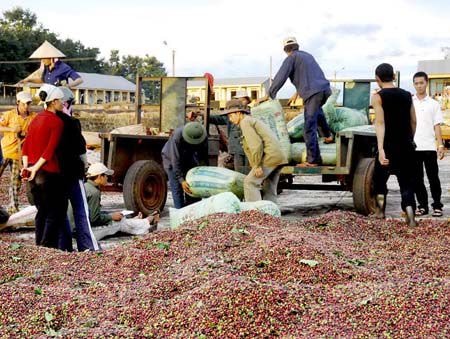 |
| In the first six months of 2015, coffee export revenue decreased. |
The painting is dimly lit.
After a year of great success, the first six months of 2015 marked a "low point" for the agricultural sector, with a series of unwelcome news: many key agricultural products faced difficulties in export, and export revenue decreased significantly for rice, seafood, coffee, etc. Seasonal products such as dragon fruit, watermelon, and purple onions also struggled as the consumer market faced difficulties, leaving farmers devastated by losses. Their sale relied on appealing to people's compassion, through charitable transportation initiatives organized by various organizations and individuals.
According to data from the General Statistics Office, the GDP growth rate of the agriculture, forestry, and fisheries sector in the first six months of 2015 reached 2.36%, lower than the same period in 2014 (2.9%), with the total production value of the sector estimated at 489,000 billion VND.
Difficulties in the consumer market and exchange rate fluctuations have resulted in agricultural export turnover falling short of expectations. To date, 5 out of 12 commodities still have declining export prices and turnover, namely tea, rubber, rice, coffee, and seafood. Total export turnover for the first six months is estimated at US$14.42 billion, a decrease of 2.8% compared to the same period in 2014 (with a decrease of as much as 13.2% in the first quarter of 2015 alone).
It is evident that, despite the recent efforts by relevant agencies and businesses to actively seek and expand markets (some fruits like lychees, longans, and mangoes have penetrated demanding markets such as the US, EU, and Australia), the majority of our agricultural products still depend on the Chinese market (85% of exported cassava chips depend on this market, compared to 35% for rice and 40% for rubber). Minister Cao Duc Phat assessed that this is a large market with consumer preferences similar to Vietnam's, so it is necessary to capitalize on that advantage. To mitigate risks, our relevant agencies have also worked with China to gradually resolve difficulties.
Never before has the drought been so severe in the central and Central Highlands provinces. “This year’s drought is devastating, especially in Ninh Thuan and Khanh Hoa, the worst in 40 years. Currently, reservoirs in Ninh Thuan are basically empty, with capacities below 10%; in Khanh Hoa, reservoirs have only about 17% capacity. For the summer-autumn crop, it is estimated that Ninh Thuan will have up to 10,229 hectares unusable for production, and Khanh Hoa will have 10,400 hectares,” said Mr. Nguyen Van Tinh, Deputy Director General of the General Department of Irrigation. Perhaps this is one of the reasons why crop production is the sector with the lowest growth rate at 1.08%, a decrease of more than half compared to the same period in 2014. Since this sector accounts for the highest proportion (50.7%), it is not surprising that the overall growth rate of the sector has been dragged down so low.
According to experts, this decline is the clearest manifestation of the limitations and weaknesses of agriculture based on fragmented household economies, lacking linkages, and with low productivity and quality. In the context of increasingly fierce competition, it will be difficult to withstand. The formation and development of new production organization methods and production relations in agriculture are still slow; the quality and competitiveness of many agricultural products are low.
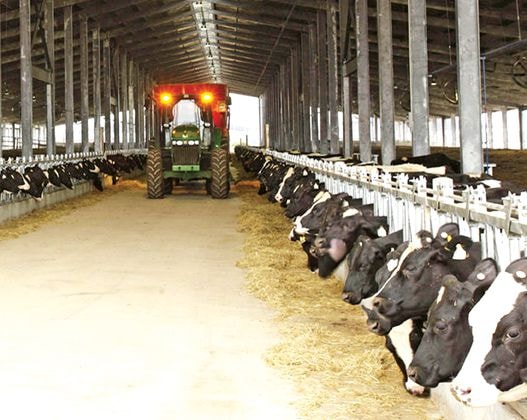 |
| One positive sign for agricultural growth is the accelerating growth rate of the forestry and livestock sectors. |
A positive sign for agricultural growth is the accelerated growth rate of the forestry and livestock sectors. In particular, the livestock sector has seen active participation from many large enterprises, initially creating a shift in the restructuring process. Mr. Hoang Thanh Van, Director of the Department of Livestock, stated: “Recently, many enterprises have registered to invest in the livestock sector with large committed capital, with some enterprises committing to invest $1 billion from now until 2020.”
According to Mr. Van, large enterprises are currently focusing mainly on beef and dairy cattle farming. This reflects a positive development trend for the industry. Furthermore, thanks to the effective control of animal diseases, the absence of major outbreaks, and the relatively stable prices of animal feed and livestock products, ensuring profitability, livestock farming is developing well.
“We must maintain the growth rate of the past six months, but we must strive to increase it by an additional 10,000 billion VND. The total value added of the entire industry in the first six months of this year was approximately 12,000 billion VND. In the remaining months of the year, the industry must generate an additional 22,000 billion VND to achieve a growth rate of 3.4% in total output and approximately 3% in value added, as expected by the Government,” Minister of Agriculture and Rural Development Cao Duc Phat instructed.
Meanwhile, the forestry sector also achieved an extremely impressive growth rate of 8.3%, the best growth rate in many years. Mr. Nguyen Ba Ngai, Deputy Director General of the General Department of Forestry, said: “Favorable weather conditions coupled with good preparation of seedlings and fieldwork have resulted in higher forest planting results compared to the same period last year. By June, the cumulative area of newly planted forests reached 85,000 hectares, an increase of 19%; the area of planted forests under care reached 360,000 hectares, an increase of 16.2%; the area of forests under regeneration reached 604,700 hectares; the area of forests under contracted protection reached 4,805.2 thousand hectares, equivalent to the same period last year; the estimated timber production reached 3,470 thousand cubic meters, an increase of 11.7%.”
The fisheries sector presents a contrast between fishing and aquaculture. Favorable weather and fishing grounds, coupled with relatively stable raw seafood prices, have encouraged fishermen to increase their offshore fishing activities. Production in the first six months is estimated at 1.496 million tons, a 4.4% increase compared to the same period in 2014. Meanwhile, aquaculture production, facing unusually hot weather and market difficulties, has decreased compared to the same period, with shrimp production reaching 236,000 tons, a 2.5% decrease.
Mr. Pham Anh Tuan, Deputy Director General of the General Department of Fisheries, said: “Currently, the weather in the farming areas is more favorable, encouraging farmers to raise whiteleg shrimp and tiger shrimp in the last months of the year. Especially with the rice-shrimp farming model, covering an area of up to 200,000 hectares, we can completely increase tiger shrimp productivity, thereby creating momentum for the industry's growth.”
Administrative procedure reform to attract business investment.
This is one of the key solutions that Minister Cao Duc Phat has proposed for the coming period to encourage businesses to invest in agriculture and rural areas, thereby accelerating the restructuring of the sector.
The Minister added that the ministry will require its subordinate units to synchronously implement measures to improve the business environment, creating conditions for businesses to seek investment opportunities in the agricultural sector; promote the development of value chains of key agricultural products; review, simplify, and even eliminate cumbersome and unnecessary administrative procedures; and apply information technology to provide online public services to minimize the effort, time, and money of businesses. “To boost processing and increase the added value of agricultural products, there is no other way than to have the participation of businesses; this is also a key point of the industry restructuring program. In the regular government meeting, the Prime Minister personally requested me to direct relevant agencies to build a stronger policy system with more incentives to attract more businesses to invest in agriculture,” Mr. Phat said.
It is known that recently, the agricultural sector has actively reviewed administrative procedures that cause inconvenience to businesses and people, as well as inappropriate fees and charges, in order to adjust, eliminate, or propose their elimination. The time for plant quarantine has also been shortened from 24 hours previously to 10 hours; the Ministry of Agriculture and Rural Development has proposed to the Ministry of Finance to remove 31 types of fees and 14 charges.
According to information from Minister Cao Duc Phat, the Minister of Finance also strongly agrees with this policy and is currently compiling opinions to consider amending, supplementing, or completely abolishing Circular No. 04/2012/TT-BTC of this ministry regulating the collection, payment, management, and use of fees and charges in veterinary work.
Regarding immediate solutions to achieve the industry's growth targets, Minister Phat stated that in the last six months of 2015, efforts will be focused on boosting production of goods with good market demand, supporting farmers in applying advanced techniques to improve product quality; continuing to seek and expand markets; and addressing technical barriers and administrative procedures that hinder the export process, discussions and work will be held with each market to resolve them.
For areas severely affected by drought where production is impossible (covering over 50,000 hectares), the Ministry directs local authorities to encourage and mobilize farmers to switch to drought-resistant dryland crops such as corn, peanuts, and beans (on average, 1 hectare of rice requires 10,000 cubic meters of water to ensure development, while corn only needs 2,000-3,000 cubic meters); and to apply water-saving irrigation methods.
The agricultural sector is revealing weaknesses stemming from its fragmented and small-scale nature. Therefore, in addition to increasing production volume, the issue of quality also needs to be considered and implemented systematically. The development of agriculture should also be viewed in the context of other sectors such as finance, banking, and transportation, so that they can support each other's growth. Currently, the agricultural sector is struggling to survive on its own, while other sectors do not see agriculture as fertile ground, still viewing it as a place fraught with difficulties and risks.
According to Kinhtenongthon