

Solutions for restoring tea growing areas.
(Baonghean) - According to the Department of Agriculture and Rural Development, the recent severe drought has caused leaf burn on over 2,260 hectares of tea plantations, resulting in losses of 30-70%; nearly 850 hectares of tea plantations have been completely wiped out. Currently, people and local authorities are implementing various measures to restore the tea growing areas.
Visiting Thanh Huong commune, we found that the sprinkler irrigation system is highly effective in combating drought for tea plants. Although this system is not yet widely used, surveys from households applying this method show that the tea plants thrive. Further investigation revealed that this sprinkler irrigation system consists of three main parts: an automatic sprinkler nozzle that can rotate 360 degrees with a diameter of approximately 6 meters, a system of pipes to carry water from the source, and a pump to stimulate water flow. Because water is directly delivered to the sprinkler nozzles via pipes, water loss is minimized, maintaining consistent moisture for plant growth. Currently, each hamlet in the commune has between 4 and 6 households using this system. Mr. Nguyen Van Thin from Hamlet 12 said: “Taking advantage of the water source from Dun Lake, located 200m from the tea hill, my family installed this automatic irrigation system at a total cost of 20 million VND. With 10 hours of spraying per day, the entire planted area is kept moist, so the tea plants grow very well. The monthly electricity cost only ranges from 300,000 to 400,000 VND. The machinery and pipes can be used for a long time; with good maintenance, they can last up to 20 years.” Currently, Thanh Huong commune has a total tea planting area of 180 hectares, of which more than 50 hectares are in the basic construction phase. The recent drought caused damage to nearly 37 hectares. However, according to Mr. Nguyen Van Tu, Chairman of the People's Committee of the commune, if people utilize water from Hoc Dau, Thap But, and Vu Tho lakes to expand the automatic irrigation system, it can ensure that the tea plants grow well even during the dry season.
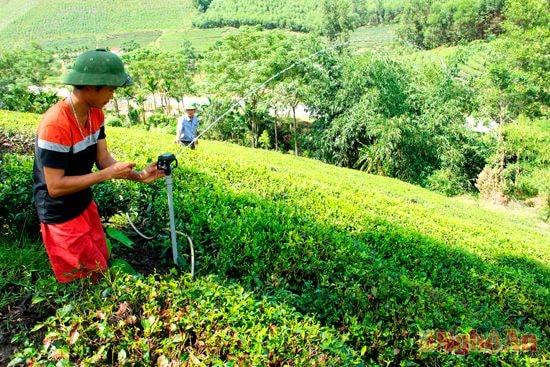 |
| Residents of Thanh Huong commune (Thanh Chuong district) are installing an irrigation system for their tea plantations. |
Although sprinkler irrigation systems have proven effective in combating drought for tea plants, not every family has the means to install them. With a total area of over 4,500 hectares, the recent prolonged heatwave has damaged more than 1,200 hectares of tea plantations, causing hardship for many tea-growing households in Thanh Chuong district. Thanh Mai, Thanh Tung, Thanh An, Thanh Thinh… are among the communes where over 70% of tea plants have been destroyed by the heat. In response to this situation, the district and commune authorities, along with tea farmers, are urgently working to find timely solutions. Mr. Le Dinh Thanh, Head of the District's Agriculture Department, said: "Currently, the district is encouraging farmers to utilize water resources from 7 large reservoirs and more than 200 other reservoirs in the district to irrigate tea plants. At the same time, we are limiting tea harvesting during dry periods and adjusting the length of the buds during harvesting to avoid damaging the plants. Furthermore, in the next season, the district encourages people to intercrop with legumes to regenerate the soil and provide shade for the tea plants."
In Anh Son district, over 300 hectares of tea plantations have been affected by drought. Due to the complex hilly terrain, the drought is quite severe, with reservoirs and dams running dry, while the irrigation system remains limited. In Phuc Son commune, out of 240 hectares of tea plantations, more than 40 hectares are newly planted, and the heat has damaged 25 hectares. According to Mr. Nguyen Van Trang, Chairman of the People's Committee of the commune: "To promptly address the problem of tea plants dying due to the heatwave, many households have had to drill wells right on the tea hills to supply water to the newly planted areas. However, with a depth of 40m to 70m to reach the water source, the cost is nearly 15 million VND, so only a few households have undertaken this. As for tea varieties to rescue and replant after the drought, the commune encourages people to mainly plant two varieties, LPD1 and LPD2. Although the yield and quality of tea from these two varieties are not as high as the PH1 variety, their drought resistance is quite good, so people have widely used them."
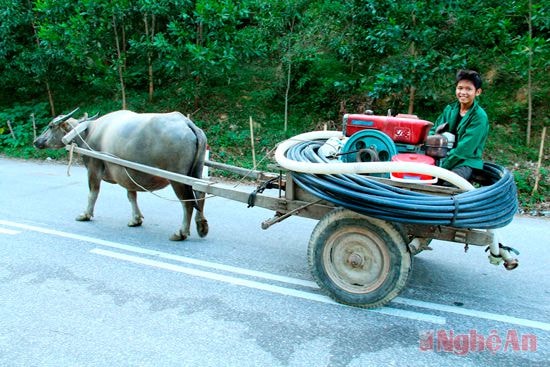 |
| Farmers in Thanh Thuy (Thanh Chuong) are investing in high-capacity pumps to irrigate their tea plantations. |
In Hung Son commune, residents said that replanting will be carried out in September of the lunar calendar, when the weather is suitable for the development of seedlings. Mr. Dau Van Nghia, head of Hamlet 5, shared: “After this year's drought, the people have learned from some mistakes that reduced the drought resistance of tea plants, such as planting the tea seedlings too shallow, causing the roots to spread shallowly on the surface of the ground instead of penetrating deep into the soil to absorb water. On the other hand, the western slopes of the hills always experience much higher temperatures than the eastern slopes. Therefore, in the future, when replanting or planting new tea plants, the hamlet will instruct the people to learn from this experience.”
According to the Department of Agriculture and Rural Development, 2,260 hectares of tea plantations have suffered leaf burn and need restoration. After the rain, farmers should care for the tea plants with appropriate methods to help them recover. According to Mr. Nguyen Dinh Huong, Deputy Head of the Crop Production Department - Department of Agriculture and Rural Development: Variety is a very important factor in drought resistance for tea. Areas planted with drought-resistant varieties such as LDP1 and LDP2 are less affected by the drought. The agricultural sector advises farmers: For areas with leaf burn and damage ranging from 30-70%, care should be provided, and seedlings should be prepared for replanting after the rain to ensure the correct planting density with the newly planted tea area; for commercial tea plantations, weeding and fertilizing should be done after the rain to help the tea recover and develop. However, nearly 850 hectares of tea plantations with over 70% leaf burn must be destroyed and replanted. Currently, the province has proposed that the Government provide support in the form of disaster relief. However, in the long term, sustainable irrigation solutions are needed to combat drought in tea cultivation. In addition, consideration should be given to planting shade trees and researching low-nutrient-consuming plants suitable for mulching to protect against drought. The use of tea harvesting machines also needs to be approached cautiously, as, despite its advantages, it reduces the tea plant's drought resistance.
Thanh Quynh - Phu Huong