

Can spraying cockroach killer near the kitchen cause a fire or explosion?
Recently, information has been circulating online about a case where a wife died from burns after spraying cockroach killer while cooking on a gas stove.
The following message is circulating online: "If you are cooking with gas, please read this to avoid unnecessary and dangerous accidents for yourself, your family, friends, and loved ones."
Two weeks ago, a fire and explosion accident occurred, resulting in the wife suffering severe burns and dying while cooking. The husband was also hospitalized with serious burns after trying to save his wife.
What happened?
The wife was cooking rice on a gas stove. Suddenly, she saw a cockroach crawling towards the sink, right next to the burning gas stove. She immediately grabbed a can of mosquito and cockroach spray and sprayed it directly at the cockroach crawling near the burning stove.
There was a huge explosion, and the wife became a human torch, suffering 65% burns to her entire body.
The husband heard the explosion, ran in to try to put out the fire and save his wife, but his clothes caught fire and he suffered burns. He is currently still in the hospital and is unaware that his beloved wife has passed away.
Be careful when using mosquito, cockroach, and ant sprays like "Raid," "Mortein," and "Sheltos," as they contain highly volatile and flammable solvents.
These aerosolized nanoparticles spread very quickly, and a single spark is enough to ignite this flammable mixture using the oxygen in the air.
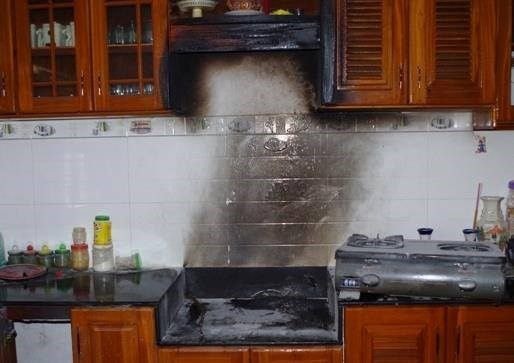 |
| Images of fires caused by insecticide spraying have been shared online. |
In an interview with us, Associate Professor Tran Hong Con, from the Department of Chemistry, Faculty of Natural Sciences, Vietnam National University, Hanoi, stated that insecticides for cockroaches, mosquitoes, and flies are flammable solvents because the compounds in these solutions are usually formulated with organic solvents, making them easily combustible.
These are usually synthetic chemicals belonging to the pyrethroid group such as tetramethrin, cypermethrin, iminoprothrin… or the carbamate group such as propoxur…
Historically, experts have advised against using cockroach and fly sprays because they can easily cause fires, much like a circus performer blowing fire from kerosene.
Furthermore, Associate Professor Côn also warned that not only are insecticidal sprays flammable, but they also pose many potential poisoning risks to users. While their purpose is to kill insects, these sprays can also affect humans, pets, and the environment. The sprays can pollute water sources and kill aquatic animals.
The most dangerous effect is its potential to cause acute poisoning in humans if the victim is exposed to a significant amount of the drug in a short period of time. Pyrethroid components can cause reactions in the human body such as central nervous system depression, decreased consciousness, coma, hypotension, and skin itching.
Dr. Nguyen Thong, Head of the Burn Department at Xanh Pon General Hospital, said he has not encountered any cases of burns related to insect repellent sprays, but users should be cautious about the flammable nature of the solvents in these sprays.
To use cockroach spray safely, users should carefully read the instructions on the can. Keep the spray out of reach of children, away from food and pets, do not turn the can upside down, wash your hands thoroughly after each use, do not break or throw the can into fire even when empty, and do not throw the can into rivers, streams, or public water sources.
According to Zing.vn