

The wonders of cave tourism
(Baonghean) - According to statistics compiled by scholar Tran Kim Don in his work "Geography of Nghe An Province" published in 2009: With the main distribution of limestone mountainous terrain in the districts of Quy Chau, Quy Hop, Tan Ky, Con Cuong, Anh Son, and scattered parts in Yen Thanh and Quynh Luu, Nghe An currently has 61 beautiful caves serving civilian and military purposes, including Tham Bua, Tham Om (Quy Chau), Poong cave (Quy Hop), Mat Trang cave (Bai Son, Do Luong), Thung Khien (Tan Hop, Tan Ky)... Each cave possesses its own unique beauty.
Dragon Mountain Cave (Quynh Nghia commune, Quynh Luu district), located next to Quynh Nghia beach, embodies the unique and captivating beauty and romance of masterful architecture, combining "rock, wind, and waves." All the cave entrances lead directly to the sea, leading people to liken Dragon Mountain Cave to the mouth of a petrified dragon sucking in the ocean water.
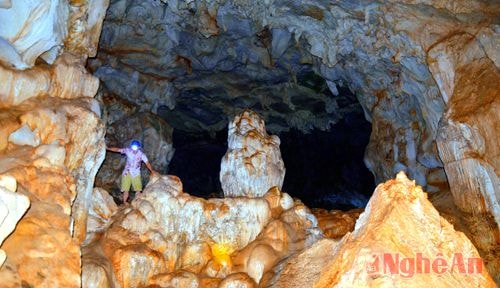 |
| Elephant Rock Cave - Tuong Son (Anh Son); |
In front of Dragon Mountain Cave is a white sand beach with clear, cool blue water. Inside the cave, there is a skylight providing ample ventilation, allowing visitors to admire the "bizarre" stalactite system, with its myriad shapes and sparkling colors. The rocks, wind, and sea waves have arranged the stalactites here to create fascinating patterns, unique shapes, and reliefs, all according to a unique artistic "intention" bestowed by nature. Come to Dragon Mountain Cave to experience thrills, enjoy fresh seafood and seaweed, and even catch and prepare them right on the spot.
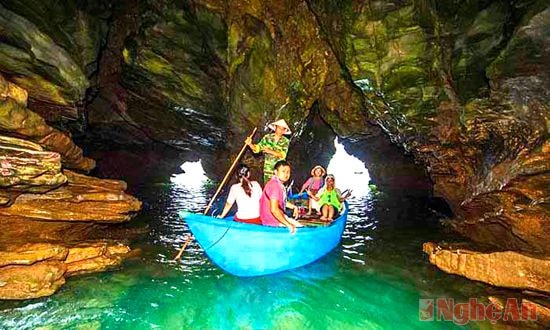 |
| Dragon Mountain Cave - Quynh Nghia (Quynh Luu); |
Also possessing captivating beauty, the cave complexes in western Nghe An are magnificent scenic spots, but what sets them apart is that these caves all bear the warmth and imprint of prehistoric people. One such example is Bua Cave, classified as a national scenic site by the Ministry of Culture and Information. The spacious cave is located on Pha En Mountain, Chau Tien commune, Quy Chau district. The stalactites inside are formed in a very strange way, with many vivid shapes such as an old man playing a flute, a set of gongs, an ancient tree, a rice container, a princess's bed, a water basin, terraced fields, Buddha statues, birds, frogs, and stone breasts… In addition, there are many tools used by the Thai ethnic group such as sickles and scythes. Each sparkling drop of water dripping from the stalactites seems to recount countless legends.
Hang Bua possesses a beauty steeped in legend and myth, a space imbued with the depth of culture and festivals, and solemn rituals deeply rooted in ethnic traditions. According to historical records, Emperor Bao Dai, the last emperor of the Nguyen dynasty, once visited Hang Bua. Every year, on the 21st, 22nd, and 23rd of the first lunar month, the Hang Bua Festival takes place. The festival attracts a large number of people from the ethnic minority communities of Quy Chau, Que Phong, and Quy Hop districts, with unique activities such as mountain beauty contests, bamboo pole dancing, flute playing, crossbow shooting, and traditional ball throwing, always creating a joyful and vibrant atmosphere.
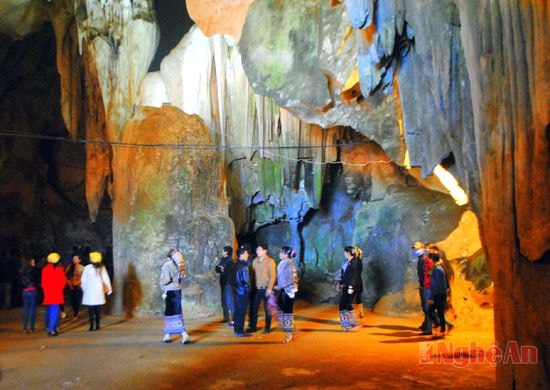 |
| Visiting Bua - Chau Tien (Quy Chau); |
Not far from Tham Bua are Tham Om and Tham Chang (Chau Thuan commune) - these two caves are among the most important archaeological sites in Vietnam, where the first fossilized teeth of hominids were discovered, along with rudimentary stone tools and many other rare artifacts. This proves the continuous existence of humans in the Chau Thuan area from the Old Stone Age (25,000 years ago) to the present day. Currently, Tham Om is a scenic spot attracting many domestic and international tourists for sightseeing and research. The cave is high and airy. The deeper you go, the wider the cave becomes, dividing into many branches and passages, creating a labyrinth. The cave ceiling is covered with countless stalactites, surrounded by layers of red and yellow sediment, creating a majestic and mystical beauty. Further inside, there are quite a few underground and open streams flowing through, creating smooth, flat sandy areas. Besides that, Quy Chau also has many other beautiful caves such as Co Ngun Cave and Bat Cave in Chau Binh commune. It can be said that all the caves in Quy Chau and the 16 large and small caves in Que Phong district are stunning and mysterious, leaving visitors mesmerized after just one visit.
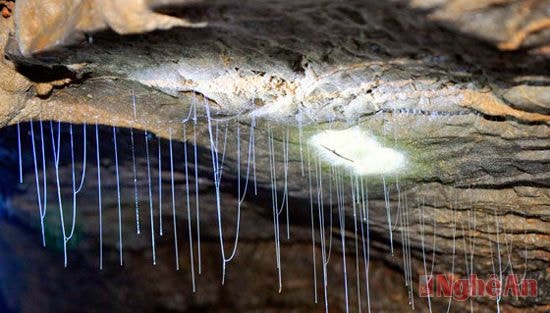 |
| Visiting Nàng Màn - Yên Khê (Con Cuông). |
Additionally, there are fascinating cave complexes in the districts along National Highway 7: Thung Bo Rock (Hoa Son commune, Anh Son district) with many undeciphered symbols carved into the rock and at least four human figures carved with rather simple strokes; Elephant Rock Cave in Tuong Son commune (Anh Son) with large, towering rock pillars overflowing the cave with numerous stalactites, stalagmites, terraced fields, and animal figures; a newly discovered cave complex over 1.6 km long in the Thung Khien mountain area of Dong Van commune, Tan Ky district, with countless stalactites in myriad shapes; and the stunning Tham Nang Man cave in Yen Khe commune, Con Cuong district, with its legendary forbidden love story.
Traveling upstream along the Nam Non River, visitors will arrive at the Tham Lan cave system in My Ly commune, Ky Son district. This cave is associated with a love story between a beautiful Thai girl and a young man from the Heavenly Kingdom. Tham Lan, in the Thai language, means "cave of ten thousand people," signifying its spaciousness. Stepping inside is like entering a unique world of sparkling stalactites and mosses. In summer, the air inside the cave is fresh and cool; in winter, it is warm with a hazy mist. Given its captivating beauty, Ky Son district is collaborating with various organizations and businesses to develop a tourism route connecting the region to Muong Xen town, into the Muong Long valley (which has a climate similar to Sapa), to visit "Tham Dan" (a type of cave) and take boat trips on the Ban Ve hydroelectric reservoir upstream of the Nam Non River.
According to research by the Institute of Archaeology under the Vietnam Academy of Social Sciences, Nghe An province has enormous archaeological potential. Initial survey results from 20 caves in four districts show that the system of archaeological sites in Nghe An holds a significant position in the historical development of the nation and has great value for the development of local tourism. Nghe An's caves bear the imprint of our ancestors – while lacking the conditions to organize a cave festival like the one in Quang Binh, perhaps a comprehensive plan for the cave complex is needed to enrich tourist destinations, generate economic benefits, and simultaneously preserve and promote the archaeological and scenic values of the province.
Thanh Son