

Mysterious sinkholes in the limestone mountains of Peru
This mysterious series of sinkholes was once believed to be a coded message sent to God.
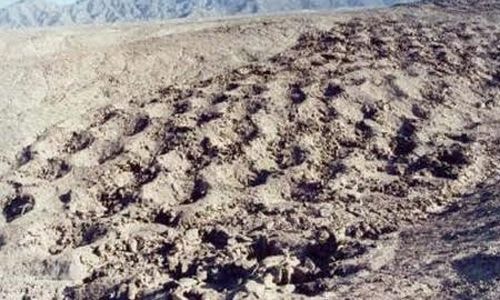 |
| The mysterious sinkholes located in the Pisco Valley, Peru, remain a mystery to scientists. Photo: Ancient Origins |
Located in the same area as the famous Nazca Lines, 7,000 holes carved into the limestone in the Pisco Valley, Peru, form a 1.6 km long strip of holes that has attracted many theories surrounding its appearance.
Many believe the pits were used by ancient people to store grain, hold water, or function as a defense system for local tribes. Others believe they are vertical burial mounds in a mass grave, or even a coded message sent to God.
Strangely, archaeologists have yet to find any artifacts to prove these theories. There are no human remains, bone fragments, broken pottery, or textiles around the area, only a series of silent pits that hold many unanswered questions.
In an article in Ancient Origins, archaeologist William James Veall states that the series of pits possesses remarkable characteristics. Approximately 7,000 pits are carved into the bedrock in rows that can be up to 20 meters wide, with each row containing about 9-12 pits. The pits, averaging about half a meter in diameter, are arranged horizontally in almost perfectly straight lines, while others are staggered. Similar to the Nazca Drawings, the unique and calculated shape of the series of pits can only be fully appreciated when viewed from aerial photographs.
The shapes of each pit also varied. Some pits had a brick-like structure and could be 2-3 meters deep. Others were quite shallow, with wide edges and usually no more than 30 centimeters deep. At the southernmost end of the mysterious chain of pits were two pits up to 24 meters in diameter, filled with rubble. This led Veall to believe that at least half a dozen pits of similar size might exist a short distance away.
Veall first learned about the mysterious sinkholes not long after he discovered the sacred temple complex called The Temple of Sacred Lamb atop the Andes mountains in 2008. The archaeologist believes that whoever built this massive temple complex chose the Pisco River Valley as a natural route from the Pacific coast to this hidden sacred site high in the mountains.
Veall's curiosity was piqued when he read a local report claiming that a giant bull-headed effigy "has stood here forever," found atop a high cliff overlooking the sea, just 20 kilometers east of the town of Pisco. Meanwhile, the mysterious chain of pits lay precisely on the Pisco Valley road leading into inland Peru. These clues were closely linked, something Veall hadn't initially realized.
Initially, Veall immediately linked the craters to the desertification that threatened the Nazca plateau around 690. The Chincha region, part of the Atacama Desert, undoubtedly experienced similar droughts to Nazca due to a lack of consistent water supply. In Chincha, strong high-latitude storms were rare, and scattered light rains provided only short-lived water.
Therefore, a system for collecting, filtering, storing, and supplying water to meet long-term domestic and agricultural needs is absolutely essential. The original capacity of the aquifer system, which is over 1.6 km long, and its rate of loss remain unknown. It is estimated that if each aquifer holds an average of 5 liters of water, this chain of 7,000 aquifers could hold approximately 35,000 liters. However, until a hydrological survey is conducted, we cannot know whether the 24-meter-diameter aquifer at the southernmost end of the chain will function as a dam or simply as a reservoir called Puquio, characteristic of the extensive water supply system across the Rio Grande region of the Nazca Basin.
According to scientist Veall, several important questions related to the water supply capacity of the mysterious sinkhole are resolved by this hypothesis.
To function as an effective storage/filtration system, the pits needed to be regularly cleaned of surface debris, which is why scientists were unable to find any archaeological evidence. For this reason, a large workforce of local laborers was recruited to supervise construction and maintain the site.
Veall concluded that the Humay area in the Pisco Valley, where the series of sinkholes is located, may have been a resting place for sailors returning from or beginning ocean voyages, where they could replenish their freshwater supplies for the next leg of their journey. It also served as a distribution point for the domestic and agricultural needs of the local population. With a large number of ruins located not far east of the mysterious sinkholes, Veall suspected Humay was a bustling stopover point for an ancient civilization.
According to Veall, the Pisco Valley was one of the main trade routes into and out of inland Peru from the Pacific Ocean, which led to the construction of a massive inland water purification system near the Pacific. The bull-headed effigy at the valley's entrance was not only a welcoming and auspicious image for merchants returning from or arriving from the Mediterranean, but it was also likely a distinctive symbol marking the "New Kingdom" of the Phoenicians, similar to Tel Dan and Bethel in Israel.
Many questions revolve around when and why the water supply system ceased functioning, if Veall's hypothesis is correct. Veall believes this will be a challenging project for students of hydrology and ancient geology.
Although Veall hypothesized that the mysterious series of pits was a system for filtering, storing, and supplying water, he has yet to explain why they were crafted with such meticulous detail. If they were simply for water storage, the pits could have been placed in any order, in parallel rows, or in a simple, random shape. With a series of pits stretching 1.6 km, Veall believes there is a hidden logic behind their intricate design.
According to VnExpress