

Reviving the silk farming industry.
(Baonghean) - No one knows exactly when the mulberry cultivation and silkworm rearing industry in Dien Kim (Dien Chau) began, but according to the memories of the elderly, vast green mulberry fields have existed since ancient times. At that time, the Tan Tien Cooperative built a silk reeling and weaving factory with a processing capacity of over 200 tons of cocoons; cooperative members enthusiastically competed in labor on the land dedicated to mulberry cultivation...
Recalling the prosperous period of the craft, Mrs. Nguyen Thi Lan (75 years old) from Xuan Chau hamlet said: “During peak periods from February to October in the lunar calendar, every house in Dien Kim was bustling with the sounds of spinning silk and turning cocoons. Within the family, grandparents, parents, and children were all assigned tasks appropriately, creating a closed production cycle, from picking mulberry leaves, raising silkworms, shelling cocoons to selling the products. Thanks to this, the lives of the people in Dien Kim were prosperous and fulfilling.”
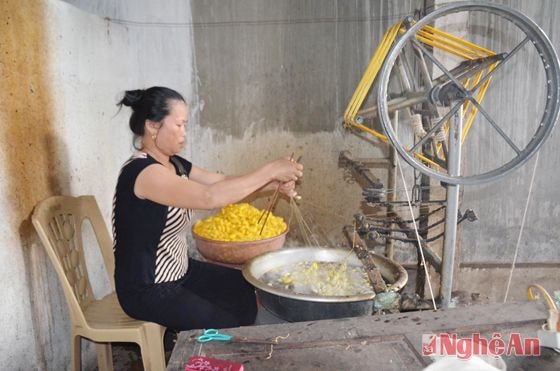 |
| The silk farming industry in Dien Kim commune (Dien Chau district). |
However, due to outdated cooperative management methods from the subsidy era and backward silk reeling techniques, the products faced difficulties in consumption. In 1992, the Tan Tien Cooperative had to be dissolved, and the silkworm farming industry was only maintained in a few hamlets such as Kim Lien, Tien Tien, and Thai Thinh, with fewer than 20 participating households. After nearly 10 years of raising silkworms and spinning cocoons (in 2001), the old profession was revived with an investment project and recognized by the province as a mulberry and silkworm farming village. But in 2005, the village once again struggled when dozens of hectares of mulberry trees were eroded by seawater due to typhoon No. 5, coupled with nearly 100 hectares of land being transferred to a shrimp farming project on sandy soil, causing many households to once again abandon the profession, leaving only 15 hectares of mulberry trees...
After many ups and downs, by the end of 2011, when the commune leaders introduced a new mulberry variety (VH 13) to replace 25 hectares of the old, degenerated Ha Bac mulberry variety; and especially thanks to the mulberry and silkworm value chain development project supported by the Vietnam Handicraft Export Association (VietCRAFT) and the Vietnam Institute for Rural Industry Research and Development (VIRI), the Dien Kim mulberry and silkworm farming village was revived... From only a few dozen households practicing the craft in 2007, by 2013 this number had increased to 70 households with an area of over 40 hectares. And by early 2015, there were more than 100 households raising silkworms, including 10 households investing in silk reeling and cocoon spinning machines; the total annual production of the commune reached nearly 15 tons of cocoons; the average income of mulberry and silkworm farming households reached 20 million VND/year. Some households earn over 40 million VND per year from both silkworm farming and silk reeling, such as the family of Ms. Nguyen Thi Mo in Xuan Chau hamlet, who cultivates 10 acres of mulberry trees and raises 11 batches of silkworms per year; and Mr. Pham Van Thang in Thai Thinh hamlet, who cultivates more than 9 acres of mulberry trees and raises 9-10 batches of silkworms per year...
As one of the households with the largest mulberry plantation area in the commune (10 sao), Mr. Nguyen Van Hanh in Xuan Chau hamlet happily shared: "My family has been involved in silkworm farming since 1986. Even during years when cocoon prices dropped, we still tried to maintain a plot of land for mulberry cultivation to sustain the profession, hoping for its revival someday. We are very happy that in the last three years, cocoon prices have started to increase, and the market is stable, so the area of our mulberry plantation has gradually increased. Last time, I raised 4 cycles of eggs and got 48 kg of cocoons, which, at 70,000 VND/kg, brought in over 3 million VND. This time, I raised 5 cycles, and I estimate I should get about 65 kg of cocoons... Besides selling cocoons, we also harvest a significant amount of silkworm manure, a byproduct that is very good for agricultural production."
Besides expanding the area for mulberry cultivation, proper care to ensure abundant leaves and high yields is crucial. According to many farmers, in the past, cultivation relied mainly on experience, resulting in unstable growth and development of mulberry trees. In some seasons, large areas of mulberry trees were infected with diseases, fungi, and leaf curl, leading to insufficient food for silkworms. However, nowadays, people have focused on learning and applying scientific and technical methods, from pest and disease control and fertilization to hygiene practices for the mulberry rooms and equipment.
According to Mr. Nguyen Van Truong, Chairman of the Fatherland Front Committee of Dien Kim commune, with positive signs in the mulberry market throughout the province, and in line with the commune's policy of restoring and developing the traditional mulberry cultivation and silkworm farming industry, the 20th Party Congress of the commune issued a Resolution to restore and develop mulberry cultivation and silkworm farming to create jobs for women with immediate solutions: Following the land conversion according to Directive 08, the commune implemented zoning and planning for concentrated mulberry cultivation areas; at the same time, it converted low-yield arable land to mulberry cultivation and expanded the area to 65 hectares.
The plan encourages households to grow mulberry trees and raise silkworms to increase their family income, and motivates those who do not raise silkworms to convert their land to mulberry cultivation for those in need, creating contiguous plots. The goal is to establish a silkworm cooperative in the four villages with this craft: Xuan Chau, Tien Tien, Dai Thanh, and Thai Thinh. Currently, four households in the commune specialize in purchasing silkworm cocoons and silk for export to Laos, China, and northern provinces, which somewhat reassures the villagers about market demand. The key to increasing the economic efficiency of the Dien Kim silkworm industry is for people to boldly invest in the new VH13 mulberry variety to replace the local variety (because the new variety yields 450-500 kg of leaves per sao, more than twice as much as the old variety), and to apply scientific and technical methods to increase breeding capacity and cocoon quality.
The revival of mulberry cultivation and silkworm rearing in Dien Kim not only signifies the restoration of a traditional craft village but also represents a suitable economic development for households in the locality, providing a relatively high income compared to the average income in rural areas. However, to develop mulberry cultivation, silkworm rearing, and silk reeling in a sustainable manner, local authorities need to pay attention to and support the construction of electricity lines and irrigation canals to serve the mulberry trees. At the same time, they should encourage and provide support mechanisms to create favorable conditions for silk reeling facilities to invest in technological innovation and improve product quality to increase the competitiveness of their products in the market.
Text and photos:Ngoc Anh