

Will Vietnam participate in aircraft manufacturing?
Airbus stated that the construction of a new production center is part of the program to introduce the A380 aircraft to Vietnam Airlines.
Mr. Tom Enders, Chairman of Airbus Group, recently sent a letter to Prime Minister Nguyen Tan Dung, Minister of Transport Dinh La Thang, and Chairman of the Board of Directors of Vietnam Airlines Corporation Pham Viet Thanh, outlining a relatively comprehensive plan to support Vietnam in expanding its aviation industry.
According to News reports, Tom Enders said that Airbus is very willing to consider establishing a manufacturing center in Vietnam, together with one of the Group's major industrial partners.
"This newly established company will be the only one in Southeast Asia specializing in the production of electric seatbelt systems installed on Airbus's best-selling A320 aircraft," revealed Tom Enders.
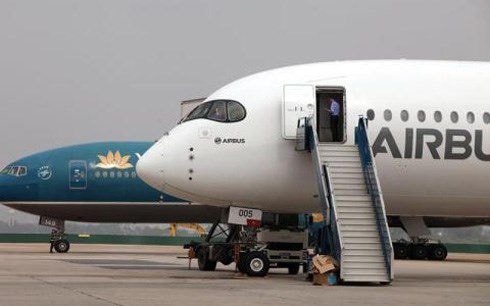 |
Airbus aircraft currently account for up to 70% of the fleet of all airlines in Vietnam. |
Airbus is ready to hold discussions with relevant authorities in Vietnam to assess key financial, socio-economic parameters, and evaluate a suitable business plan.
The head of Airbus also stated that they are ready to transfer the production of advanced composite components for the A330 and A350 XWB aircraft to Vietnam. According to Airbus's calculations, this operation will bring Nikkiso Vietnam an additional $120 million in revenue over the next 10 years.
Accordingly, Nikkiso Vietnam – a company with 100% Japanese investment – will manufacture composite wing struts for aircraft and Sharklet wingtip device shields.
Currently, several foreign direct investment (FDI) companies in Vietnam are manufacturing aircraft components for Airbus's direct competitors, the largest of which is MHI Aerospace Vietnam. Specifically, this subsidiary of Mitsubishi (Japan) is assembling passenger cabin doors for Boeing 777 aircraft and secondary flaps for Boeing 737 aircraft.
According to the Vietnam Civil Aviation Authority, in addition to participating more deeply in the world's largest commercial aircraft manufacturing chain, if the agreements with Airbus come into effect, Vietnam will have the opportunity to improve its scientific and industrial capabilities in aviation. Thus, Vietnam can absolutely dream of manufacturing its own aircraft after the disappointment of failing to produce "made in Vietnam" automobiles.
Dr. Nguyen Ngoc Son, a lecturer at Ton Duc Thang University, believes that the goal of building a modern automotive industry and making it a strength of Vietnam has been discussed for the past 20 years. However, like many other industries, this dream has yet to be realized in Vietnam due to limited resources, lagging behind in technology, business strategy, and the low skill level of the workforce.
Similarly, Associate Professor Pham Ngoc Tuan, lecturer at the Faculty of Mechanical Engineering, Ho Chi Minh City University of Technology, and Vice President of the Ho Chi Minh City Mechanical Engineering Association, also stated that, looking back over the past 20 years, the Vietnamese automotive industry has virtually nothing except a few assembly businesses; it remains largely unchanged from 20 years ago. Professor Tuan believes there is a reality that few are willing to acknowledge: the Vietnamese automotive industry is clinically dead; it has the criteria to "die," but it hasn't yet succumbed.
According to VOV
| RELATED NEWS |
|---|