
Some solutions for treating salt toxicity in rice plants.
Symptoms of salt poisoning
Preventing salt poisoning should be done right from the beginning of the season, as rice seedlings are very sensitive to salinity.
Current salt-tolerant rice varieties can generally withstand salinity levels of around 3-4‰, with some varieties tolerating higher levels, such as Mot Bui Do, which can tolerate 6‰ (this refers to soil salinity). Therefore, even if freshwater is infiltrated by saltwater, it will not significantly affect the rice plants as long as the rice field is not allowed to dry out. It is necessary to maintain a freshwater level of 3-5cm on the field surface. If the field dries out, the water evaporates, causing saltwater to rise through capillary action, gradually increasing soil salinity and leading to salt toxicity in the rice plants.
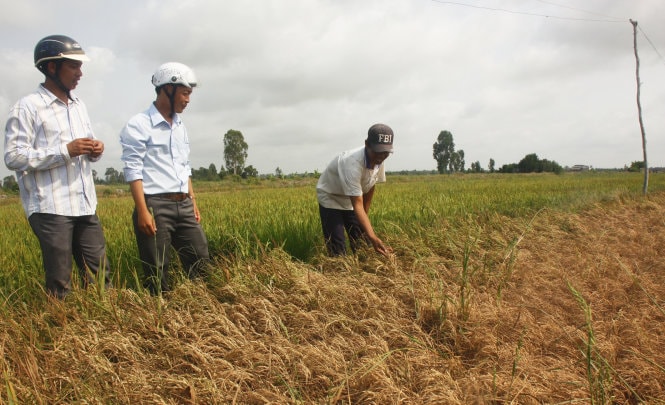 |
| Rice crops affected by salinity |
When water levels in rice fields on shrimp farming land are at risk of drying up, if there is no rain or freshwater, it is possible to introduce water with a salinity of 5-6‰ into the fields to prevent salinity from penetrating the soil when the fields dry up. However, note that when introducing saline water, it must be done continuously for 2-3 days before pumping it out and introducing fresh water, because if left for too long, the water will evaporate and the salinity will continue to increase, harming the rice plants.
Symptoms of salt poisoning
There are two symptoms of salt toxicity in rice plants:
- Direct manifestation: Na+ toxins will cause leaf tips to burn, because when rice plants absorb saline water and release it at the leaf tips, Na+ toxins (salts) accumulate. Under the influence of sunlight, this will cause the rice leaves to burn from the tip.
- Indirect manifestation: Na+ in the soil and water prevents rice roots from absorbing water, leading to a lack of nitrogen and potassium. Therefore, when suffering from salt toxicity, rice plants will lack nitrogen and potassium.
During the rice heading stage, observing two white husks without grains due to lack of pollination indicates that the rice plant is suffering from salt toxicity.
* Preventing salt poisoning
- Regularly inspect the fields and reinforce dikes to prevent saltwater intrusion. During periods of strong high tides from the sea, if the dikes are not well-maintained, saltwater will penetrate, so the dikes must be reinforced. If the fields are left dry and cracked, saltwater will seep through those cracks into the rice paddies.
- For shrimp-rice rotation areas, after harvesting the rice, when preparing for shrimp farming, avoid letting the land dry out and crack excessively, as this will allow saltwater to gradually seep through the cracks and penetrate the topsoil.
- Experienced farmers are advised to check soil salinity by digging one or more holes in the rice field before planting. After draining the water from the field, scoop out all the water from the holes, allowing the water to seep out of the soil, and use a salinity meter to determine the salinity. If the salinity is still 1-2‰, planting should be avoided because high salinity will cause the rice seedlings to curl up while germinating.
- If the saline soil is not acidic, apply Ca(SO4)2. In the Mekong Delta, salinity is usually accompanied by acidity, so it is best to apply quicklime at a dosage of 30-50 kg/1,000 m2. When preparing the soil for lime application, flood the field with water to dissolve the lime and flush out the salinity, then drain the water and measure the salinity. If the salinity is below 1‰, it is safe to proceed with sowing.
- Preventing salt toxicity should be done from the beginning of the season, as rice seedlings are very sensitive to salinity. During the heading and flowering stages, salt toxicity will significantly affect yield and grain quality; severe salt toxicity will lead to crop failure. A measure to detoxify rice plants during this period is to monitor tidal surges and introduce freshwater to save the plants.
* Experience in monitoring tidal surges to introduce freshwater to detoxify salt from rice crops.
In the Mekong Delta, the water in the inland fields is freshwater. When the tide recedes, freshwater flows from the inland fields out to sea. When the tide rises, saltwater flows from the sea into the inland fields. Therefore, farmers need to monitor the water until the tide recedes, then scoop up water to measure the salinity. If the salinity is below 1-2‰, they should pump water into the fields. When the tide rises again, measure the salinity; if it is higher, they should stop pumping water into the fields.
Note: Saltwater is denser and located in the lower layers, while freshwater is in the upper layers. Therefore, when people draw water from the upper layers to measure salinity, and then use a pump to draw water from deeper layers, they will be pumping water that is more saline than the water in the upper layers.
According to Khuyennongvn.gov.vn
| RELATED NEWS |
|---|