

Chinese rover finds strange rocks on the Moon.
China's Yutu (Jade Rabbit) lunar rover has discovered a new type of basalt while searching for minerals on the lunar surface.
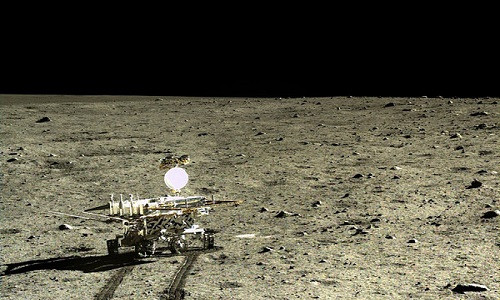 |
| China's lunar exploration robot. Photo: CNSA. |
Forty years ago, the US and Russia also collected basalt samples on the Moon. But China's Jade Rabbit lunar rover discovered a new type of rock with a completely different mineral composition, according to the Christian Science Monitor.
"We found a new type of basalt with a unique mineral composition compared to samples from the Apollo and Luna spacecraft and lunar meteorites," the scientists said in a study published on December 22 in the journal Nature Communications.
These rocks were discovered when the probe examined craters in the Mare Imbrium region on the Moon. This area has young geological features, formed approximately 2.9 billion years ago.
In-depth study of the mineral composition of rocks could help scientists better understand the evolution of the Moon, Earth's natural satellite. "Chemical and mineralogical data from the Yutu rover provides foundational knowledge about the formation of some of the youngest volcanoes on the Moon," the researchers shared.
The formation of the Moon has long been a mystery. One of the most compelling explanations is that the Moon was formed from debris from a collision between two planets. According to the hypothesis of a massive collision, one of the two planets was early Earth. The other celestial body was Theia, a planet about the size of Mars.
Understanding the composition of the Moon could help scientists determine what happened. If they can identify the materials that make up the Moon, they might be able to find its origin.
Because volcanic activity helps bring minerals from a planet's core to its surface, studying volcanic rocks is also key to determining the composition of the Moon. The basalts found by the Yutu rover have a different mineral composition than previous findings, and this difference speaks volumes.
"The diversity tells us that the mineral composition of the Moon's crust is less uniform than that of Earth. When we parallel chemical composition with age, we can see that the Moon's volcanic structure changes over time," The Guardian quoted Bradley Joliff of Washington University in St. Louis, USA, a member of the research team.
Because minerals crystallize at different temperatures as volcanic rocks cool, rocks with varying compositions could reveal information about what's happening deep inside the Moon.
According to VnExpress
| RELATED NEWS |
|---|