

The unique features of the Pu Nha Thau festival.
(Baonghean) - Every year, at the end of the first lunar month, the festival is solemnly held for two days, the 2nd and 3rd of March (i.e., the 24th and 25th of the first lunar month), with rituals rich in regional traditions, attracting a large number of people from within and outside the region to the festival.
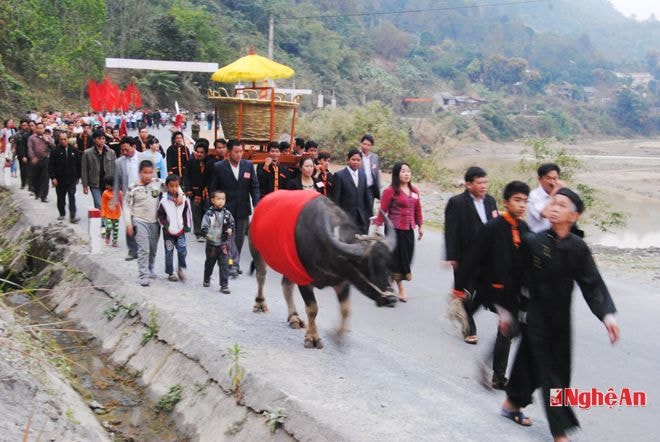 |
| Procession of the nine-handled cauldron at the Pu Nha Thau Temple Festival. |
Pu Nha Thau Temple is a provincial-level historical and cultural relic, located on the summit of a sacred mountain in Na Luong village (Huu Kiem commune). The temple is associated with legends and stories passed down through generations by the local people. The people of Na Luong village recount that, since ancient times, Princess La Binh, daughter of Son Tinh and My Nuong, granddaughter of King Hung XVIII, was a woman of great virtue and talent, always loving and protecting the people. She enjoyed traveling far and wide, often seeking out mountainous regions and villages to guide and assist the people, helping ethnic groups live peaceful and prosperous lives. The people of the nine villages and ten hamlets greatly admired Princess La Binh and revered her as the Mother Goddess of the Mountains. After the princess's death, the people erected a shrine on the mountaintop to worship her and offer incense year-round.
The Pu Nha Thau Temple and Na Luong village are also associated with the event of repelling foreign invaders by the Tran Dynasty's generals and soldiers in the 14th century. Around 1335, the Laotian invaders crossed the border to invade Vietnam, burning villages, plundering property, and killing innocent people. Emperor Tran Minh Tong decided to personally lead the army into the border region to repel the Laotian invaders and appointed Doan Nhu Hai (from Hoi Xuyen village, Tuong Lan district, Hong Chau province, now Gia Loc district, Hai Duong province) as the commander. Upon arriving in Nam Nhung (now belonging to Ky Son and Tuong Duong districts), the Tran Dynasty commander chose a high mountain in the area of Na Luong village, Huu Kiem commune, to set up a camp to train soldiers and observe the enemy's activities. The people there were overjoyed to have the imperial army come to their rescue, and many young men volunteered to join to contribute to repelling the invaders and protecting their villages. Many people in the region contributed their efforts and resources, providing food for the imperial army and encouraging their children to join the troops...
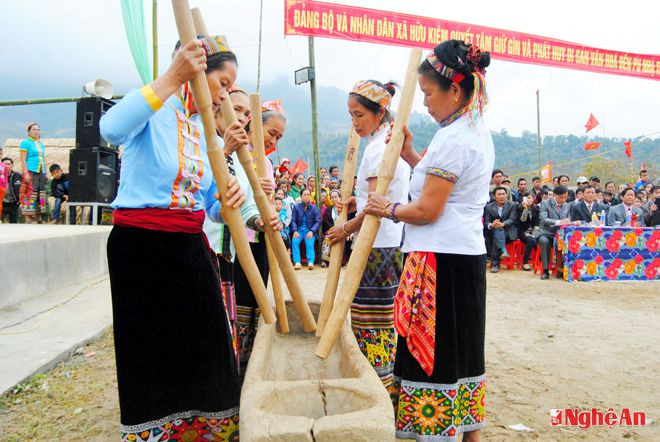 |
| The furrow carving competition at the Pu Nha Thau Temple Festival in Huu Kiem commune (Ky Son district). Photo: Cong Kien. |
Throughout centuries of ups and downs, the people of the region have always been conscious of preserving and protecting the sacred temple on the mountaintop. Even during the war against the Americans, when the Pu Nha Thau temple was bombed twice and collapsed, the villagers immediately went into the forest to gather wood to rebuild it. Mr. Vi Van Luong (86 years old) from Na Luong village, Huu Kiem commune, happily stated: "The Thai people of Huu Kiem commune in particular, and the ethnic groups of Ky Son in general, are extremely grateful to our ancestors who made great contributions in fighting foreign invaders, securing the borders, and ensuring peace and happiness in our villages. That is why the ethnic groups of Ky Son always strive to preserve the temple as if it were their own home. In particular, the villages in Huu Kiem commune voluntarily look after the temple every day and always do a good job of maintaining environmental hygiene in and around the temple."
Not only on holidays, but also on the 1st and 15th of each month, the people of Ky Son prepare offerings to take to the temple to tend to the incense and prayers. In recent years, many pilgrims have come to admire the beauty of Pu Nha Thau's landscape. From the top of the sacred mountain, one can see majestic mountains, peaceful villages, and below, the Nam Mo River winding like a green silk ribbon, creating a poetic and charming scene. In the distance, the town of Muong Xen is growing rapidly. And during the rice harvest season, one can admire the golden terraced rice fields... All these beauties easily captivate the heart and invite those who enjoy exploration and discovery.
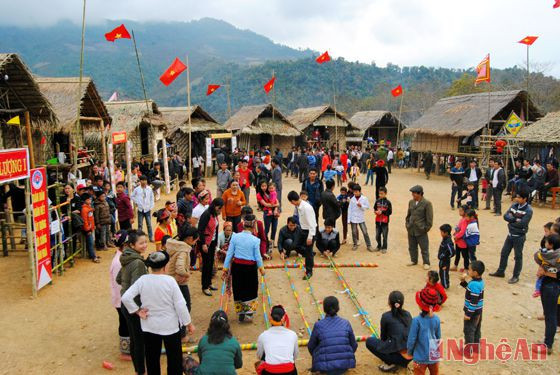 |
| Pu Nha Thau Peak festival day. |
In Phu Nha Thau, the festival days become even more lively with the sounds of trumpets, gongs, colorful banners, cheerful singing, and laughter. From the top of Pu Nha, one can see a stream of people flocking to the sacred temple in their brightly colored Thai costumes. Everyone chooses their most beautiful dresses, scarves, and bracelets to adorn themselves and beautify their village. Ms. Vi Thi Hoi from Na Luong village also prepared her most beautiful Thai outfit to wear to the festival. Ms. Hoi said that she personally wove the brocade dress to wear on the opening day of the festival. Everyone, in every household, had been arranging their work in advance, waiting for the day to attend the festival.
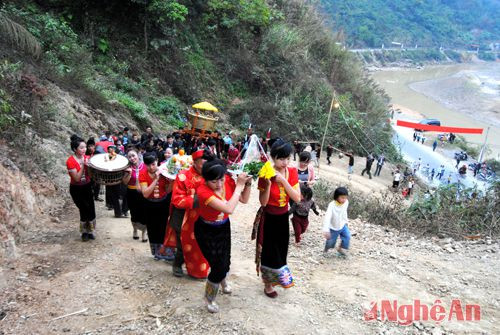 |
| Procession at the Pu Nha Thau Temple Festival. Photo: Cong Kien |
This year, the Phu Nha Thau Festival in Ky Son district has been entrusted to Huu Kiem commune for organization. From the beginning of January, the organizing committee assigned specific tasks to 9 villages and 3 schools (Huu Kiem commune's boarding secondary school, primary school, and kindergarten) – the units selected to participate in the ceremonial and festive parts of the festival. To date, all preparations for the festival have been completed. A new feature this year is the absence of the buffalo slaughtering ceremony; instead, there will be a buffalo sacrifice. The buffalo will be led to the temple grounds for the sacrifice. The ceremony will be solemn, with a procession starting from Na Luong village, traveling along National Highway 7A, and then following the road to the mountaintop where the Phu Nha Thau temple is located. The sacred tablets of the gods will be carried into the temple, and everyone will respectfully turn towards the main hall, where the grand sacrifice ceremony will begin. After offering the gifts, the shaman respectfully invites the spirits and ancestors of the clan to attend the festival and partake in the offerings, blessing the villages with prosperity, abundant rice fields, plentiful fish in the rivers, lush forests, and peaceful and united villagers... Next is the festival part with a cultural and artistic exchange program, drinking rice wine, dancing the Lam Vong dance, and attractive folk games such as tug-of-war, crossbow shooting, throwing the ball, Tò Mạc Lẹ, stick pushing... Especially, at the festival, visitors will have the opportunity to enjoy the special dishes of the mountains and forests prepared by the skillful hands of the women of Na Lượng.
Thu Huong
| RELATED NEWS |
|---|