
Tourism, sports combined with charity.
Coming from many countries, the participants of the Tu Lan Adventure Race 2016 not only had the opportunity to explore and conquer challenging routes, but also took practical actions to share with the local people.
Coming from many countries, the participants of the Tu Lan Adventure Race 2016 not only had the opportunity to explore and conquer challenging routes, but also took practical actions to share with the local people.
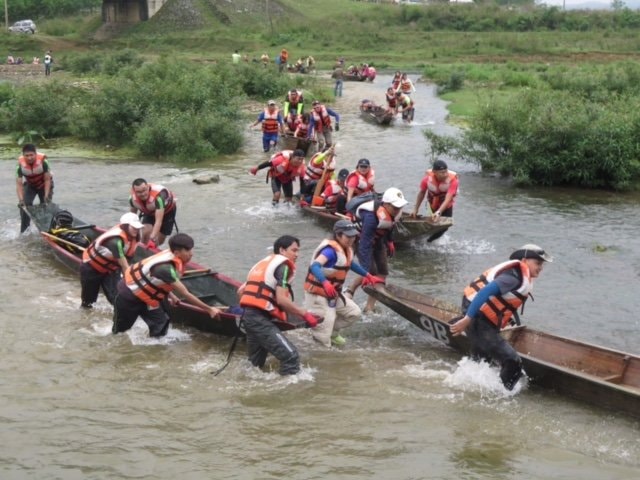 |
| Teams race across the Rao Nan River in the Tu Lan Adventure Race 2016 - Photo: Tan Vu |
At over 7 a.m., crowds from the villages had already gathered on the old bridge, with women on their way to the market lingering to watch the strangers rowing boats. Never before had Khe Rinh (Trung Hoa commune, Minh Hoa district, Quang Binh province) - an upstream branch of the Rao Nan river - had such a joyful morning, with nearly 100 members from 10 teams participating in the Tu Lan - 2016 race.
Crossing rivers and mountains
Nguyen Mai Trang (26 years old, from Hanoi), a member of the Ashkicker team, said she was very excited to participate in this race. Trang's team consists of many young men and women from Singapore, Malaysia, and Vietnamese international students, but it's difficult to tell who is from which country because the main language of communication in the group is English.
Although the Rinh stream is in its dry season, its water remains a vibrant green. The first challenge for the racing team is paddling the 15km-long Rao Nan river in the local people's dugout canoes, navigating through jagged rocks, waterfalls, and rapids.
The locals had a good laugh watching office workers, doctors, and teachers rowing dugout canoes.
Many boats sank mid-stream or drifted freely against the wishes of the operators, but this was also when they maximized teamwork and bonding among members who were initially strangers, as intended by the organizers. Members provided their own water and lunch, and it took nearly six hours for the fleet to reach its destination.
Thanks to their experience from last year's race and their youthful energy, the Jetstar Pacific team finished first on this race day, while the American doctors and their Vietnamese friends working in Ho Chi Minh City (the Funny Walker team) came in second.
The second day presented the real challenge as the racers had to trek through forests, wade through streams, climb slopes, and swim through terrifying, dark caves along a 24km route. At just after 8 am, the group set off from Tan Hoa, running over 3km to crawl through Chuot Cave, the first and most challenging cave.
Continuing across the La Ken valley, over the Lom Com slope, through the To Mo valley, past the Hung Ton cave, and across a valley full of reeds before reaching the finish line. Around 5 pm, the last group finally crossed the finish line, with many injured and bleeding from their limbs.
Ms. Nguyen Thi Tieu Phuong, a professional marathon runner from Ho Chi Minh City, who was also the first to cross the finish line, said that this race through the forest was very different and a real challenge.
“I’ve climbed Fansipan before, and run 42km road races, but this was a very interesting experience because of the difficulty. The steep slopes full of jagged rocks and the dark underground rivers created a unique feeling. Moreover, this was a team race, so the first person to finish didn’t matter; you had to get the last person in the group to the finish line to count towards the score,” said Ms. Phuong.
Mr. Luu Van Phong, head of the guidance department at Viet Mark Travel Company, who designed and guided the programs in this race, believes that the 24km route through the forest is not for those who are weak mentally or physically.
"Almost all of a person's survival instincts are pushed to their limits. And the value behind the race is something each person feels uniquely motivated to surpass themselves," Mr. Phong said.
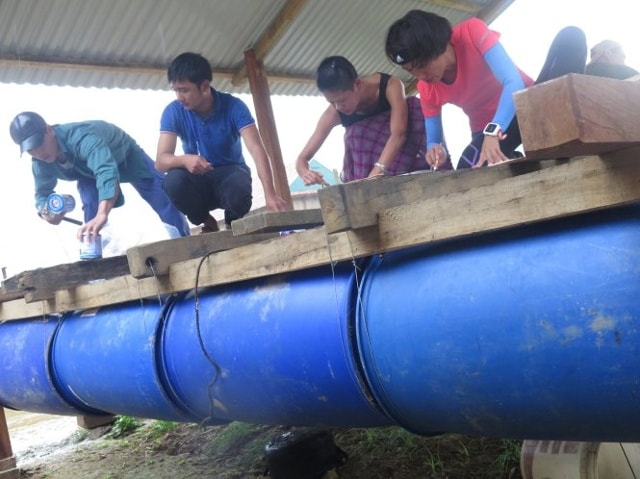 |
| Members of the racing team helped local people build floating houses to protect against floods - Photo: Tan Vu |
Responsible tourism
The route the race traversed lay right in the valley where the American film crew had just shot the movie Kong: Skull Island. The breathtaking scenery, captured in every shot and every glance, was well worth the trip for those from afar.
But those participating in the race were aware that they weren't there just to enjoy themselves, not just to satisfy their own desires, but to leave a greater legacy for the local people.
After deducting organizational costs, the organizers used all the money contributed by the participants to build 20 flood-resistant houses for local people.
On the third day, after the race ended, the teams visited each villager's house to see firsthand the houses they had helped build. The teams also painted their names on the walls of these floating houses as a memento.
Mr. Nguyen Truong Anh, a local resident who recently received a flood-resistant floating house as a donation, said that in Tan Hoa, the flood season is just like Ha Long Bay.
“The water in the caves recedes very slowly, so the entire valley is filled with water, in some places the water level rises as high as 12 meters. The valley is left with only rocks submerged in water. In previous years, we had to climb into the caves to take shelter,” Mr. Anh said.
An initiative to create floating houses, supported by 24 iron or plastic barrels that lift the entire house off the water, has been adopted by the local people for about three years now, and their lives have become somewhat less difficult.
Mr. Anh proudly said, "Now that we have a house, we don't worry when the water rises or falls because we can safely take shelter on this floating house for weeks. We just need to prepare our food supplies carefully."
Mr. Tran Trung Kien, director of Travel and Outdoor Gear Company in Hanoi and also a member of the racing team, believes that participants in the race are not only looking to discover themselves or simply admire the beautiful scenery, but also hoping to do something useful for the community.
"The benefits of tourism companies must be shared within the local community. They have preserved the natural beauty for generations, while tourism organizations monopolize the profits for themselves, which is unfair. Sharing the benefits of tourism with the local community is the only way to achieve sustainable tourism," said Mr. Kien.
Mr. Do Tuan Anh (Director of Viet Mark Tourism Company) shared: "The days of opportunistic, haphazard tourism are over. Why do some tourist destinations have so much waste while Cu Lao Cham doesn't? The issue is the benefit of the people; don't demand too much from the community when the profits that tourism companies reap are not shared proportionally with the community."
Local people need to have income and share in the benefits; their attitude towards tourists and investors will change. In my opinion, this is the core issue, and Hoi An is a prime example of this kind of development.
In Hoi An, every household earns a good living from tourism, so they naturally support and improve everything to attract more visitors.
According to Tuoitre.vn