

Dinosaurs had already become extinct before the meteorite impact.
This discovery could completely change our understanding of dinosaurs – the giant creatures that dominated the planet for over 165 million years.
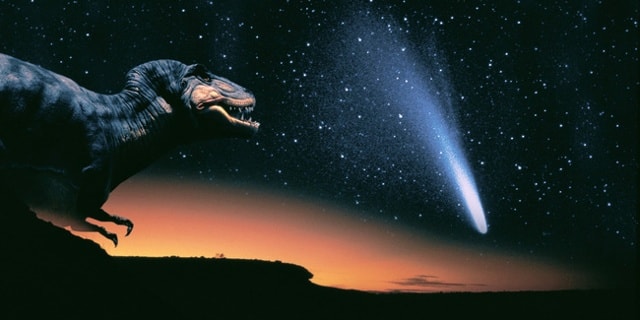
According to our traditional knowledge, dinosaurs—the creatures that dominated the planet for 165 million years—became extinct due to a giant meteorite impact.
But according to a shocking new study from the University of Reading (UK), the number of dinosaurs had already declined millions of years before the asteroid impact and may even have become completely extinct.
If this discovery is true, it would be a groundbreaking finding. It would put an end to the controversies surrounding dinosaurs that have lasted for many years, and help us understand what happened in the final moments when dinosaurs still existed.
According to researcher Chris Venditti from the University of Reading: "One of the most debated things about dinosaurs for decades has been whether they were thriving when the asteroid hit, or whether their numbers had declined and they might even have become extinct beforehand."
 |
To clarify the issue, Venditti and his colleagues analyzed fossil data to create a phylogenetic tree of three main dinosaur species: ornithischians (bird-hipped dinosaurs); theropods (theropods, represented by T-rex); and sauropods (lizard-hipped dinosaurs, represented by long-necked dinosaurs).
They found that when dinosaur species exploded at the end of the Triassic period (about 220 million years ago), some species began to decline very rapidly, and some even became extinct within the next 100 million years. That was 10 million years before the giant Chicxulub asteroid, with a circumference of up to 9.6 km, struck Earth.
In most previous studies, dinosaurs were thought to have flourished until the arrival of Chicxulub. But this new research completely refutes that. According to lead researcher Manabu Sakamoto: "The meteorite still seems to have been a cause of the extinction of all dinosaurs, but the truth is that the species had already experienced a significant decline in numbers, and many species had become extinct even before that."
Our research will completely change how we understand this giant species. A meteorite may have been the culprit, but there was another factor that hindered the dinosaurs' development, causing them to die out so quickly."
 |
Furthermore, according to previous studies, Chicxulub blew tons of dust into the atmosphere, causing the Earth's temperature to drop, killing many plant species that dinosaurs could not adapt to. But at the same time, there is a puzzling phenomenon: mammals rose to prominence, becoming the dominant species on Earth.
And now, scientists believe that because dinosaurs had become weakened millions of years earlier, other animal species—including our human ancestors—had the opportunity to develop enough strength to withstand the catastrophes caused by Chicxulub.
However, this research also raises the question: did dinosaurs become extinct regardless of whether or not a meteorite impact occurred?
On this point, scientists disagree. Venditti responded: "If these impacts continue, I believe that even if the asteroid hadn't fallen, the dinosaurs would have become extinct within the next few million years."
However, paleontologist Stephen Brusatte from the University of Edinburgh disagrees: "The consequences of the meteorite impact may have been more severe because the dinosaurs were weakened. But I think if the meteorite hadn't hit, they might have survived to this day."
The research was published in the journal of the National Academy of Sciences.
According to Tri Thuc Tre (Young Intellectuals)