

Things mothers should remember when taking their children on a beach vacation.
When traveling by boat, you must have your child wear a life jacket, and when eating, you shouldn't let your child try seafood they've never tried before.
Summer is the season for beach vacations, and many families have planned trips to the beach to enjoy the cool, breezy atmosphere of famous coastal areas. Besides places to eat, have fun, and comfortable hotels, mothers taking their children to the beach should remember the following crucial points to ensure their absolute safety and avoid health problems or unfortunate accidents.
When traveling by boat
The unchangeable rule when traveling by boat is that you must have your child wear a life vest. Afterwards, check if the life vest is usable (is it torn, punctured, or leaking?). If you are abroad, ask for a "life vest" when inquiring about one.
Don't be lazy or embarrassed just because no one else on the ship is wearing one. Life vests have saved many young children in accidents. Therefore, never forget to put a life vest on your child as soon as they board the ship. If the ship doesn't have life vests, don't let your child on board, and don't be overconfident in your swimming ability to save the child because accidents happen very quickly and no one has time to react.
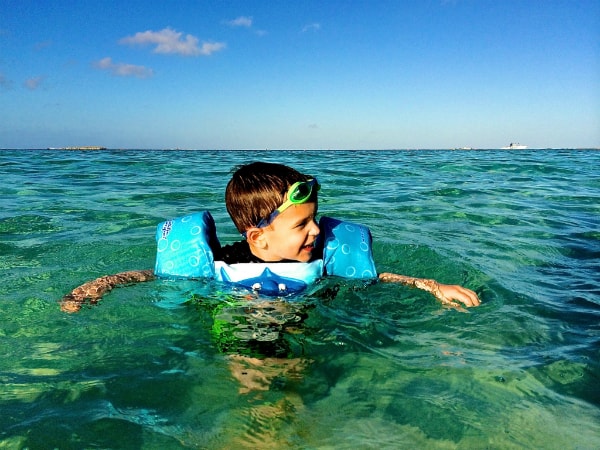 |
Always keep your child swimming under your supervision. Photo: pokerstarsblog |
When swimming in the sea
Always keep your child within swimming reach.
Every year, many drowning accidents occur involving young children in tourist areas, even when they are using life vests. Therefore, you must always keep an eye on your children and only allow them to play within your supervision.
When taking children to the beach or areas with rivers and streams, adults must always supervise them. Only let children play near the shore, with parents nearby holding a life vest. Many people often carelessly let their children use life vests on their own, which is very dangerous because children can easily be swept away without realizing it, and there's a high chance they'll be swept away by waves before you can react in time.
Avoid catching a cold.
Children often love playing in the water, but this can easily lead to them catching a cold or developing a fever. Therefore, the ideal time for children to play in the water or in the sun is no more than two hours continuously.
As soon as your child comes ashore, you must prepare a dry towel to wipe their body, then rinse them with fresh water and change them into dry clothes. Even after coming ashore, water remaining on their body can cause them to catch a cold. Not rinsing off the seawater properly can also cause skin irritation, itching, and allergies.
Avoid heatstroke.
Besides the risk of catching a cold from prolonged swimming in the sea, children are also very susceptible to sunstroke when playing outdoors under the intense sun of coastal areas. Mothers need to prepare thick coats and hats to protect their children before going outside, ensuring that their heads and necks are shielded from direct sunlight. It is best not to let children play outside between 10 am and 3 pm, as this is when the sun is strongest.
Ensure your child drinks plenty of fluids continuously and ideally supplement with vitamins A and E as prescribed by a doctor. This minimizes the risk of heatstroke and allergic reactions when at the beach.
 |
Don't let your child play in the sun for too long to avoid sunstroke. |
When eating and drinking
Except for babies who are still breastfeeding and have started eating solid foods, when taking your child to the beach, parents need to pay attention to whether their child has any allergies to seafood. There are many types of food your child has never tried before, and you shouldn't risk giving them an allergic reaction because if an allergy occurs, it will be very difficult to deal with, and could even be life-threatening. You should avoid foods with high mercury content such as whale, swordfish, tuna, and large mackerel.
It's best to consult your doctor before starting your trip, and inquire about allergy vaccinations to ensure your child stays healthy throughout the journey.
First aid in case of an accident.
When drowning accidents occur
If an accident unfortunately occurs while swimming in the sea, you need to quickly call for help from those around you, prioritizing the nearest rescue team.
After bringing the child ashore, check their airway. If there are any foreign objects in their mouth or nose, remove them immediately. Then, tilt the child to allow them to breathe. If the child stops breathing, immediately perform artificial respiration by placing the child on their back, pinching their nose shut, blowing a strong breath into their mouth 2-3 times, then interlocking your hands and pressing on their chest rhythmically (be careful not to use too much force as children's bones are weak) until they breathe again; then quickly take them to the nearest medical facility.
When suffering from heatstroke
Immediately move the baby to a shady spot indoors, using a gentle fan. Do not take the baby into an air-conditioned room immediately as this can cause thermal shock. Wipe the baby's body with cool water and give them oral rehydration solution (ORS). If the condition worsens, take the baby to the hospital.
According to Ngoisao.net
| RELATED NEWS |
|---|