

These 'miniature' mangoes originate from China.
Although confirmed by authorities not to be fake mangoes, the small mangoes being sold in markets throughout Ho Chi Minh City and many places in Hanoi are believed to be imported from China.
Following the controversial information about "miniature" mangoes – rumored to be from China with nylon insides – surveys show that these products are being sold extensively on the streets and traditional markets of Ho Chi Minh City.
Ms. Hoa, a small business owner at Hoa Binh Market (District 5), said she has been selling this product for two weeks now. All of her goods are sourced from the Thu Duc wholesale market.
“In the first week, I sold a hundred kilograms a day at 35,000 VND per kilogram. But for almost a week now, because of rumors that the mangoes have nylon insides, sales have dropped by 70%,” Ms. Hoa said, adding that initially, when she went to get the goods, traders at the wholesale market told her that these were products from Chau Doc (An Giang province), so she bought them in large quantities. However, after the rumors, she now only buys about ten kilograms a day and imports other products to sell alongside them to avoid losses.
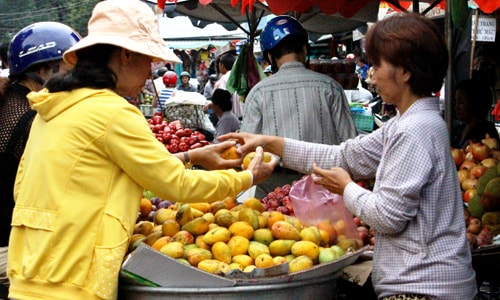 |
Mangoes with thick flesh are sold at the market for 35,000 VND per kilogram. Photo: Thi Ha. |
Thanks to assurances from traders that the mangoes originated from An Giang, Mr. Thanh, a small vendor selling from a pushcart at Ba Chieu Market (Binh Thanh District), buys 50-70kg daily. “In the first week, I sold out every day, sometimes by late afternoon, but for almost a week now, business has been very slow. At times, I had to cut open the seeds of several different types of mangoes to compare them and dispel rumors that the flesh was made of nylon, but sales were still sluggish,” Mr. Thanh said.
Looking rather downcast while selling this product, Ms. Thanh, a small trader at Thi Nghe Market (Binh Thanh District), said that in previous years, she sold Thanh Ca mangoes (from An Giang province) that looked exactly like the "mutt" mangoes, so when she saw the product arrive at the market, she immediately started selling them. "When I asked about the origin, the traders said it was from Chau Doc. Trusting them, I tried them and found them delicious, so I imported them to sell. Sales were quite good for the first five days, but for the past two days, sales have been slow, so I haven't gone to get a new batch," Ms. Thanh said.
In Hanoi,This type of mango is also widely sold in traditional markets such as My Dinh, Dong Xa, Cau Dien, and on some streets and roads.A small vendor on Nguyen Xien Street (Thanh Xuan District) said that the mangoes he sells are Vietnamese mangoes priced at 40,000 VND per kilogram, and customers can sample them before buying. "These mangoes are only in season in July and August, so if you don't buy them now, you won't have another chance to enjoy them," the vendor said, adding that he has been selling this product for two years.
While vendors in the markets claim the products originate from Chau Doc, in an interview with...reporterAccording to Ms. Nguyen Thi My Phung, Deputy Director of the Department of Agriculture and Rural Development of An Giang province, the "miniature" mangoes currently sold on the market resemble Thanh Ca mangoes from the province in appearance and design. However, Thanh Ca mangoes are grown in An Giang in relatively small quantities and the season ended more than a month ago, so the product sold on the market is definitely not Chau Doc mangoes.
As someone with long-standing ties to An Giang's agricultural products, Mr. Doan Ngoc Pha, former Deputy Director of the An Giang Department of Agriculture and Rural Development, confirmed that the aforementioned mango variety has never been listed in the Department's catalog of plant varieties. If it exists, it's only the Thanh Ca mango, but that variety is not seedless and has fibrous flesh, unlike the mango described above.
Regarding the origin of the "unusual" mango variety, Ms. Nguyen Thanh Ha, Deputy Director of Thu Duc wholesale agricultural market, confirmed that Thanh Ca mangoes (from An Giang province) have been out of stock for over a month. As for the "miniature" mangoes mentioned above, they originate from China.The product is transported to the South by container by a company in the North. Every night, this company transports 40-50 tons to the wholesale market, selling it at a wholesale price of 15,000-20,000 VND per kilogram (depending on the time).
She also added that to distinguish between domestic and Chinese mangoes, one can look for characteristics such as: Vietnamese mangoes have thick skin, fibrous flesh, and large seeds. Chinese mangoes, on the other hand, have thin skin, small seeds, thick flesh, and no fibrous texture.
Regarding food safety and hygiene, Ms. Ha stated that all shipments imported to the market are sampled by quarantine stations for testing for chemicals and pesticide residues, so the product quality remains within acceptable limits. If a product is found to be unsafe, it will be confiscated by the authorities. She added that the information about mangoes having nylon insides is fabricated, as each mango seed has a protective membrane.
Mr. Nguyen Quang Huy, a research specialist at the Department of Crop Production, Ministry of Agriculture and Rural Development, affirmed that the news about mangoes having nylon insides is a false rumor. According to him, inside the mango seed there is a fibrous layer, then a membrane surrounding the innermost embryo. This membrane is thin, translucent white, and easily peels off when dried. Those unfamiliar with it might mistake it for nylon, but this is the natural structure of the mango fruit. According to Dr. Nguyen Van Phong, Head of the Biotechnology Department (Southern Fruit Research Institute), this mango variety is very similar to the "coc/cu" mangoes grown in Ha Tien or some provinces in the Mekong Delta and Southeast Vietnam. In the Mekong Delta, there used to be many mango varieties, but only about 20 had names associated with the locality and were widely cultivated commercially, for example: Cat Chu, Hoa Loc, Thanh Ca, Tuong, and imported varieties such as Australian, Taiwanese, and Thai mangoes. The remaining varieties did not have clear names and were generally called "coc" or "cu" mangoes by the locals. This mango variety has very small fruits and the trees are very prolific, usually harvested from remaining old trees. |
According to VNE
| RELATED NEWS |
|---|