

Preventing and controlling livestock diseases after floods.
(Baonghean.vn) - Flooding in many areas in recent days has not only caused property damage but also significantly affected agricultural production, especially livestock farming. The veterinary sector in Anh Son district is implementing measures to prevent disease outbreaks and protect livestock and poultry after the floods.
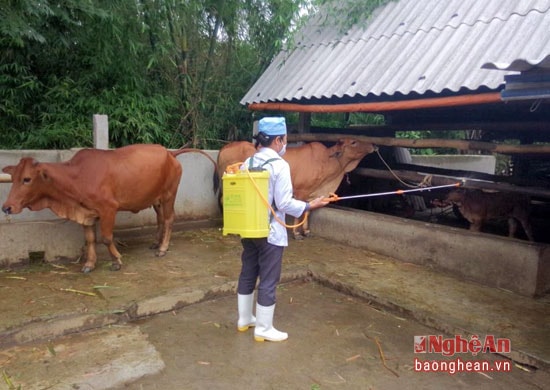 |
| Disease prevention and control measures for livestock in Anh Son are implemented systematically. |
In Cam Son commune, a significant number of poultry were lost during the recent heavy rains and floods, with over 1,150 birds killed or swept away. Along with the immediate losses, the area is also facing the risk of disease outbreaks, as prolonged heavy rains and localized flooding create favorable conditions for disease to develop and spread.
According to Mr. Nguyen Van Hung, a veterinary officer in Cam Son commune, the area has a large livestock population with 1,710 buffaloes, 1,490 cows, 8,400 pigs, 96,000 poultry, and 2,100 goats. To proactively prevent and control diseases after the floods, the local authorities are focusing on directing villages to inspect livestock households to promptly detect outbreaks, along with organizing disinfection in low-lying and flooded areas. Vaccination for the autumn season is also being implemented in all villages.
After the floods, food sources for livestock and poultry become scarce due to crops being swept away or damaged by the floods, pastures being contaminated, and the humid climate significantly affecting the health of the livestock and poultry. Therefore, this is a time when livestock and poultry are most susceptible to disease outbreaks and spread.
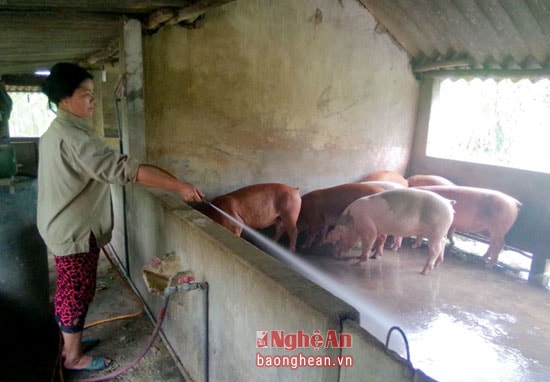 |
| Regular cleaning of animal enclosures is one of the important requirements for preventing disease in livestock. |
According to Mr. Nguyen Xuan Ung, head of the Anh Son district veterinary station: To ensure the stability and development of the 18,525 buffaloes, 17,438 cows, 54,450 pigs, and 810,112 poultry, the district's veterinary sector is focusing on implementing many solutions after the floods, such as: assigning veterinary officers to closely monitor the area and coordinate with local authorities to strengthen inspection and supervision work.
Vaccination efforts for the autumn season in localities continue to be implemented with the goal of achieving 100% of the assigned plan, including: foot-and-mouth disease (29,485 doses), bovine hemorrhagic septicemia (29,485 doses), swine cholera (44,494 doses), and swine hemorrhagic septicemia (44,494 doses). Along with this, guidance is being provided to people on hygiene in livestock pens, feed, and drinking water. Farmers should supplement their livestock's diet with nutrients such as minerals, starch, and mineral supplements to boost their immunity.
Huyen Trang
| RELATED NEWS |
|---|