

Countries on the verge of cash extinction.
In some countries, cash is like a bogeyman as card payments are preferred. In some places, cash is even not considered legal tender, according to the BBC.
A Wall Street businessman once said, "Cash is king," advising people to hold onto it when the economy gets tough. However, that advice is no longer relevant in some places.
In the Netherlands, cash is no longer valued, and is even not recognized as legal tender in many places. Increasingly, more and more shops in the country, from pharmacies to local bakeries, only accept card payments.
“I can’t remember the last time I received a cash payment,” said Marielle Groentjes, a property manager at Hoen Property Management BV. She added that office workers like her don’t like keeping cash in their offices, as there are no safes and banks charge fees for doing so.
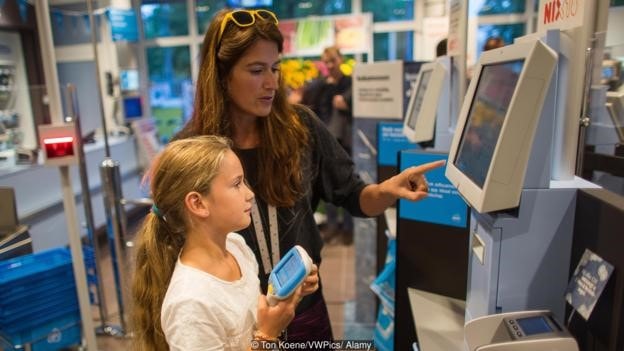 |
| At the supermarket, instead of queuing in long lines to pay, swiping a card saves people time. Photo: Alamy. |
"When I bought a tuna sandwich at the Dutch chain Vlaams Broodhuys, the cashier refused to accept cash. I couldn't even use euros to pay for parking in many cities," one woman said.
"Cash is a dinosaur, but it will survive," said Michiel van Doeveren, a senior policy advisor at the Dutch Central Bank (DNB). However, he pointed out that the logistical costs of circulating cash, such as transportation, security, inventory, and registration, are quite expensive, while electronic payments are easier.
"The growth of the digital economy is crucial. We want to promote more efficient payments," he shared.
A dilemma
Electronic payments at shops and supermarkets in the Netherlands surpassed cash payments for the first time in 2015 by a margin of 0.5%. A movement by a coalition of Dutch banks and cardholders aims to increase card usage to 60% by 2018. They argue that paying bills cashless will be cheaper, safer, and more convenient.
Like the Netherlands and its Nordic neighbors, Sweden is also one of the places where cash is gradually disappearing.
"It's a big problem. Small businesses spend a lot of money depositing cash into their bank accounts," said Guido Carinci, president of the small business association TOMER. He described the situation as "terrible" and said that each month he spends $35 per company to deposit cash into their own accounts.
In addition, Carinci said that Swedish banks profit greatly from transaction fees charged by retailers who accept card payments, amounting to millions of dollars annually. However, revenue from cash is almost non-existent. This situation makes banks reluctant to accept it.
The high cost of circulation has led many shops to refuse cash, including telecommunications giant Telia Company (since 2013). Meanwhile, the country's buses have been refusing banknotes and coins for years.
The problem has become so bad that many Swedes are feeling awkward about what to do with them when banks don't want to accept them, said Bjorn Eriksson, head of the security industry union Sakerhetsbranschen.
The new era
However, many other countries in Europe, and around the world, still value cash. In Germany, consumers find it easier to manage their spending without paying by card. Over 75% of payments are still made with cash. Meanwhile, in Italy, this figure is 83%.
And Americans still love the dollar. But last year the country adopted chip-enabled credit cards, a decade behind many European countries. Economists see this as a move toward a cashless society.
In January, several branches of the Sweetgreen restaurant chain stopped accepting cash in the Wall Street area.
“I was surprised to see so many young people using their smartphones to pay. I know my daughter uses the Venmo app for everything. It makes me feel outdated and old-fashioned,” said Persephone Zill, a New Yorker.
Advances in mobile technology have emerged at several banks in Africa, notably Kenya and Tanzania. The M-Pesa mobile banking system enables millions of people to pay bills, receive salaries, buy livestock, and even pay for groceries through their mobile phone accounts.
According to Zing/BBC
| RELATED NEWS |
|---|