
"Eating from the forest, tears well up in my eyes..."
We often hear about forests being rich and seas being rich. But in reality, those living on this "gold" are the ones with the most difficult, if not the poorest, lives! How to ensure that people in mountainous areas live in harmony with the forests is a difficult question that requires policymakers to research and find answers."
We often hear about forests being rich and seas being rich. But in reality, those living on this "gold" are the ones with the most difficult, if not the poorest, lives! How to ensure that people in mountainous areas live in harmony with the forests is a difficult question that requires policymakers to research and find answers."
From a difficult life
While complete statistics are unavailable, it's certain that the majority of poor and near-poor households in our country are located in mountainous areas. Especially since the government ordered the closure of forests and the strict control of logging, the pressure on employment and livelihoods of ethnic minorities in mountainous regions has become increasingly difficult. In Con Cuong district alone, out of 13 communes and towns, 11 are classified as extremely difficult; in Tuong Duong and Ky Son districts, 100% of the communes are classified as extremely difficult. The poverty rate here is 60-70%, and the near-poverty rate is undoubtedly also significant, due to limited arable land, thin alluvial soil, poor wind and sunlight conditions, and low farming techniques, resulting in low crop yields.
In the past, due to the vast land and sparse population, people compensated for low yields by clearing 5-7 hectares of forest for slash-and-burn farming, providing enough food for the whole family. The forests were also home to many animals, supplying them with food year-round. Currently, the commodity economy is underdeveloped, and there are no established industries. The two main sectors, farming and livestock raising, are carried out on a small scale, fragmented, and backward basis, resulting in low productivity; production remains largely self-sufficient. Forestry mainly involves enclosure, management, and protection, with each hectare receiving a subsidy of 50,000 VND per year. Living expenses, education, and shopping are high, while income from agriculture is low. In remote, border areas, having a year-round fire in the kitchen and sufficient food for the village is already a great blessing. Not to mention the difficulties in transportation and the difficulty in selling the pigs and chickens they raise. The reality is that people's lives are facing many difficulties, while the goal of escaping poverty is imminent!
To the devastated forest
In recent years, there have been many historical floods. Landslides, flash floods, and extremely hot summers are caused by severe deforestation, which has reduced the forest's ability to retain water and regulate the climate. While Vietnam's forest area before 1945 was over 14 million hectares, it is now only half that, despite the government's efforts to invest in reforestation in recent years. However, the amount of reforestation has not kept pace with the amount of deforestation. Just considering the amount of land cleared for farming in Tuong Duong and Ky Son districts – each district clearing over 5,000 hectares per year – is a significant figure. Furthermore, illegal and clandestine logging for timber and forest products is also considerable annually. Not to mention the needs of local people for wood to build houses and firewood for cooking... Many forests may appear green on the outside, but are hollow inside. When people are starving, it's impossible to preserve the forests, because they have to clear them to plant rice and corn, exploit forest products, and hunt wild animals to exchange for consumer goods and provide food to sustain themselves!
We should focus on investing wisely to preserve forests.
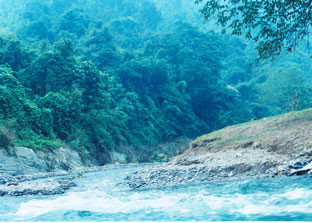 |
Headwaters of the Giang River, Mon Son commune, Con Cuong district. |
Text and photos: Phung Van MuiCon Cuong District Party Committee