
Many schools have become... indebted?
Implementing the policy of socializing education, the semi-public school system in both public and semi-public schools has developed strongly, contributing to accelerating educational development in mountainous and remote areas. However, while the government has decided to increase the starting salary from 350,000 VND to 450,000 VND, the tuition fees for the semi-public system have not increased, causing many schools in our province to become indebted. Many schools have total outstanding debts ranging from 150 to 250 million VND but do not know how to manage them. The classrooms at Thai Lao High School (Hung Nguyen district) are dilapidated but lack the funds for repairs.
Implementing the policy of socializing education, the semi-public school system in both public and semi-public schools has developed strongly, contributing to accelerating educational development in mountainous and remote areas. However, while the government has decided to increase the starting salary from 350,000 VND to 450,000 VND, the tuition fees for the semi-public system have not increased, causing many schools in our province to become indebted. Many schools have total outstanding debts ranging from 150 to 250 million VND and are unsure how to manage them.
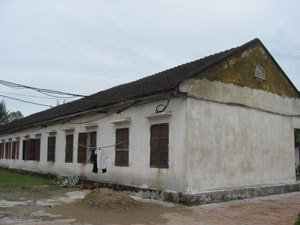 |
The classrooms at Thai Lao High School (Hung Nguyen district) are dilapidated but lack the funds for repairs. |
Due to the rapid development of education and to mobilize public contributions to education, budget allocations have been made.
To invest in educational development in mountainous and highland areas, after the Education Law was enacted in 1998, Nghe An province adopted a policy of establishing semi-public schools and opening semi-public classes within public schools. Over the years, this model has been very effective, and education in mountainous and highland areas has developed strongly at all levels. However, the problem arose in the 2006-2007 school year when the starting salary increased from 350,000 VND to 450,000 VND per person per month, while tuition fees for semi-public classes remained unchanged. This left many schools in a precarious situation due to the "mountain of debt" for teachers' salaries, substitute teaching fees, overtime pay, etc.
Currently, our province has 356 semi-public schools, ranging from kindergarten to high school, and 753 semi-public classes within public schools. At the high school level alone, there are 839 semi-public classes with a total of 41,532 students out of 145,349 high school students. Notably, in addition to semi-public schools, teachers in public schools with semi-public classes not only teach each system separately but also teach both. Therefore, most schools combine two funding sources (government funding and student tuition fees) to pay teachers' salaries. After several adjustments to the tuition fees for the semi-public system, according to Decision 110/2005/QD-UBND dated May 30, 2005, of the Provincial People's Committee, the funds only barely cover the basic salary of 350,000 VND. For the past few years, the provincial budget has had to be stretched thin, supplementing an additional 19.2 billion VND each school year. Since October 2006, the government increased the starting salary from 350,000 VND to 450,000 VND, leaving public schools with semi-private classes and semi-private schools without enough funds to pay salaries and overtime pay for teachers. The more semi-private classes a school has, the greater the debt. Currently, the average high school in the province (excluding those without semi-private classes) owes teachers between 150,000,000 and 250,000,000 VND in salaries and overtime pay. The lack of increase in tuition fees for semi-private schools has left these schools in dire straits, with no feasible plan to pay teachers' salaries and cover teaching expenses. This is a truly difficult problem for the education sector, school leaders, and has caused significant frustration among teachers.
Speaking with us, Mr. Tran Van Dong, Principal of Thai Lao High School, said: "Currently, the school has 35 classes, including 20 semi-private classes with over 1,000 students. To pay teachers the starting salary of 450,000 VND/month, the school has had to collect money from extra classes, parking fees, and even transfer public school tuition fees to pay the salaries of teachers in the semi-private classes after deducting minimum expenses, but it's still not enough. To date, the school still owes teachers two months' salary (July and August) totaling 168,491,700 VND. All school activities are very difficult; we don't even have money to build a gate, a guardhouse, or repair the dilapidated classrooms. This situation has made the teaching staff unenthusiastic and insecure about their work."
In response to this situation, the Department of Education and Training has developed a plan for collecting and managing tuition fees at semi-public schools and semi-public classes within public schools. According to Mr. Pham Huy Duc, Chief of the Department's Office, adjusting tuition fees in semi-public schools and classes to cover teacher salaries is absolutely necessary. The tuition fee for semi-public schools has been adjusted upwards from 8,000 to 24,000 VND per month for schools in different regions to ensure teachers receive salaries commensurate with the starting salary of 450,000 VND. Mr. Duc stated: The specific fee levels are as follows: In Vinh City, the old tuition fee for semi-public high schools was 90,000-105,000 VND per student per month, while the new rate will be 113,000-128,000 VND per student per month. For lowland communes in Zone 1, the old tuition fee was 80,000 - 95,000 VND/student/month, but the new rate will be 103,000 - 118,000 VND; for communes in Zone 2, the old rate was 75,000 - 90,000 VND/student/month, but the new rate will be 98,000 - 113,000 VND/student/month. It is known that this proposal has been reviewed by the Departments of Finance; Justice; Planning and Investment; and the Culture and Social Affairs Committee (Provincial People's Council). However, its implementation requires a decision from the Provincial People's Council in the near future. It is noteworthy that the issue of increasing tuition fees is always considered "sensitive," and some places have failed when bringing this issue to the People's Council and the wider public...
Text and photos: Ho Ha