

The sea is full this season!
These days, the atmosphere in Nghi Thuy fishing village is bustling. The lively atmosphere is partly due to Cua Lo's tourist season, but the main reason is the bountiful harvest of southern fish. The southern fish season begins in March each year and ends in August.
|
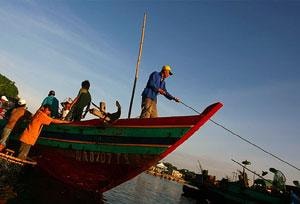
There's a story that year, after the famine, there was a bumper fish harvest, and many people died from overeating... of fish. Whether this is true or false in the memories of the elderly is unclear, but one fact remains: this year the fishing village is having a great harvest. Mr. Vo Van Tuat, vice chairman of the People's Committee of the ward, flipped through his ledger and gave us the figures: In just one month, from May 15th to June 15th, the entire ward caught 1500 tons of seafood. This is approximately the same as the entire year's catch in previous years.
A good harvest means the people are well-fed, and the government is at ease. However, when oil prices soar, fishermen are forced to abandon their boats and abandon their nets, and the government doesn't know how to solve the problem. With thousands of workers left unemployed and numerous social ills arising, the government has a solution to address these issues...
The ward is also encouraging fishermen to take advantage of the good season and accumulate resources to acquire diverse fishing gear, making it easier to return to work when the harvest season approaches in January and February. Following the agricultural extension officers, we took a stroll through the neighborhoods. Fish were everywhere – at the docks, along the village roads, in the yards, on the rooftops, etc. – shimmering in a dazzling array of colors.
After the fermentation vats are full, the locals turn to processing the fish by steaming and drying. This is a popular product among tourists, who often buy it as a gift for relatives after a relaxing beach vacation in Cua Lo. In recent years, as some businesses have found ways to export the steamed and dried fish, the steaming and drying fish industry has flourished in Cua Lo, attracting a significant workforce.
With the current catch volume, steaming and drying alone are insufficient to consume all the product. Therefore, the fish are purchased by businesses, frozen, and transported south to supply owners of catfish and pangasius farms. From Cua Lo, the fish travel north and south, and through unofficial channels to reach people in Laos, China, Taiwan, and other countries.
After wandering around for a while and feeling tired, we stopped by the house of a boat owner in Block 6, Mr. Nguyen Hai Long, who had just returned from a fishing trip. Yesterday's trip yielded over 3 tons of fish. For over a month now, his boat has been "hitting the jackpot" every day. The most successful trip was on the night of the 8th day of the 5th lunar month, when one net haul yielded over 3 tons. With two net hauls, his boat brought in 4 tons of fish.
After deducting lamp oil costs, each crew member receives 400,000 dong. That's for the best night; a catch of 2-3 tons is normal. Even the worst nights yield at least 1 ton. Previously, a week of the full moon required 4-5 nights of rest waiting for darkness, but now, with so many fish swimming close to the shore, they can fish even during the full moon and still have high productivity. At 60 years old, having spent 35 years at sea, he says he's never had a season as bountiful as this year.
The bounty of the sea was "endless," so Mr. Long instructed his wife to steam fish and grill squid to treat the guests. The aroma of the "sea bounty" filled the air. After a few weeks of drinking, and with the alcohol taking effect, he shared his experiences with us about the fishing profession. He recounted that on the first day of Tet this year, he had never seen such a high tide. Then, in January, two batches of fish appeared, and on many days, the nets were completely broken. These were signs of a bountiful fishing season. Spring is the breeding season for the inshore fish. The fish feed on plankton near the shore, growing bigger and bigger before retreating back out to sea.
When they reach maturity, the fish join the schools in the open sea. By the end of the southern fishing season, they reach the 24-foot-deep water and reside there, becoming the target of the northern fishing season, which begins in October of the lunar calendar. This year, with favorable weather, the fish have spawned abundantly. Pointing to a plate of steamed grouper, some slightly larger than his thumb, he asserted that the fish were over three tides old. By looking at the size of the fish, experienced fishermen can tell their age. Lost in his memories of fishing, Mr. Long returned to reality.
It's been over a month since the fish started appearing in abundance; the income of the fishermen on his boat has reached several million dong. At this rate, by the end of the southern fishing season, the laborers' income will exceed 10 million dong. For the fishing profession, this is a "bountiful" season. He said that the fishing industry in Cua Lo only experiences periods of both abundance and scarcity, never wealth. This year's bountiful harvest is a sure sign of abundance. Looking at the fishing village, you can tell whether it's a good or bad season. The bustling atmosphere from morning till night speaks volumes. A good fishing season impacts everything from tailor shops to motorbike taxi drivers and restaurants... With a good fishing season, the atmosphere in the fishing village has become more intense. Husbands go to sea, wives return in the morning to sell fish, steam, dry, and preserve them; the income of those at home is comparable to that of those at sea.
Mr. and Mrs. Long revealed that this year's fishing season in the South, besides accumulating funds to purchase more fishing gear, also allowed them to set aside some money to help their beloved daughter, who is about to graduate from university, find a job. When asked what he hoped for, he said: that the government's fuel price support policy would soon reach fishermen, helping to reduce production costs and increase their income. The conversation ended around noon, as the owner needed to rest, and would be back on the boat at 2 PM to begin a new fishing trip.
Cong Sang