

Concerns - in Huoi Moi
The once bustling village, nestled precariously along the Huoi Moi stream, was home to 32 Hmong households. Yet, after only two years of migration, Huoi Moi 2 village is now sparsely populated with only 8 households. The remaining foundations of the old houses create a desolate and chilling atmosphere...
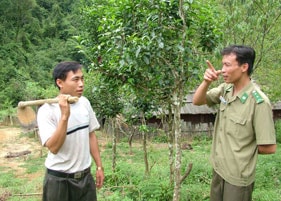 |
Soldiers from Border Guard Post 519 exchange experiences in reclaiming paddy fields with the Party Secretary of Huoi Moi 2 village. |
The village chief began recounting his "long march" leading the villagers to reclaim land for rice paddies, diverting water from the high hills, and then planting rice seedlings. The fertile land and the abundant, plump rice grains captivated the villagers, leading to stable lives and eliminating any thoughts of migration. At this point, the chief's tone softened: "Many households from our village who migrated to Minh Chau have now had to return to their old land due to a lack of water for production. I am also very worried that if the village population increases and the land for rice paddies cannot be expanded, it will be difficult to prevent migration, and we might end up migrating the entire village like in Huoi Moi 2...!"
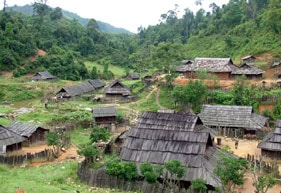 |
| In Bản Huồi Mới 2, only 8 scattered households remain, situated along the stream. |
From Huoi Moi 1, we crossed a hill to reach Huoi Moi 2 village. Indeed, on a wide strip of land along the ravine, only eight scattered houses remained. The old foundations left by the displaced families a few years ago, with their rotting wooden planks, added to the dilapidated state. According to the villagers, Huoi Moi 2, a few years ago, also had 32 households, living together in harmony like Huoi Moi 1. However, due to difficult living conditions, especially the lack of sufficient rice paddies, the villagers had to leave their village and cross the border into Laos. The village was deserted, with no Party branch, so Party members had to participate in activities with the Huoi Moi 1 Party branch. From May 2005, Border Guard Post 519 assigned Party member Captain Tran Van Son, Head of the Huoi Moi Border Guard Station, to temporarily participate in activities at the Huoi Moi 2 Party branch. The Party branch was established, strengthening its political base, and issuing resolutions to guide the villagers in reclaiming paddy fields, developing livestock farming, building the Party, and caring for the lives of poor households. The Party branch secretary of Huoi Moi 2, Va Pa De, said: "Luckily, Captain Son came to participate in Party activities and the border guards helped, so we were able to reclaim more than 2 hectares of paddy fields in Ca Tun. Having paddy fields and a stable rice crop has kept the villagers here. Since the beginning of the year, no household has gone to Laos."
The Huoi Moi 2 Party branch also admitted three more members and demolished two temporary houses for Xong Xo Cho and Va Giong Ly. When I asked if there were any more households in Huoi Moi 2 migrating to Laos, the Party branch secretary, Va Pa De, hesitated: "If we can't ensure that the people have enough to eat, we can't keep them here..."
The heartfelt words of the village head of Huoi Moi 1, Ly Tong Rua, and the explanations of the Party Secretary of Huoi Moi 2, Va Pa De, left us deeply concerned. To secure a stable livelihood, the Mong people here have struggled and worked hard to reclaim paddy fields. With paddy fields gradually replacing dry fields, the people have achieved some stability in their lives and no longer consider spontaneous migration. However, difficulties in transportation, rugged terrain, the inability to expand paddy fields, and limited government investment... who can be sure that the Mong people's nomadic lifestyle can be stopped?
Text and photos: Huu Nghia