
Wild fragrant root is exported.
After graduating from a veterinary vocational school, Tran Cong Quy volunteered to join the 5th Youth Volunteer Brigade (Thanh Thuy commune, Thanh Chuong district, Nghe An province). In this impoverished land, Quy harbored a dream that the local people could never have imagined: exporting the roots of the forest... Tran Cong Quy and his fragrant roots have now been exported abroad.
After graduating from a veterinary vocational school, Tran Cong Quy volunteered to join the 5th Youth Volunteer Brigade (Thanh Thuy commune, Thanh Chuong district, Nghe An province). In this impoverished land, Quy harbored a dream that the local people could never have imagined: exporting the roots of the fragrant forest...
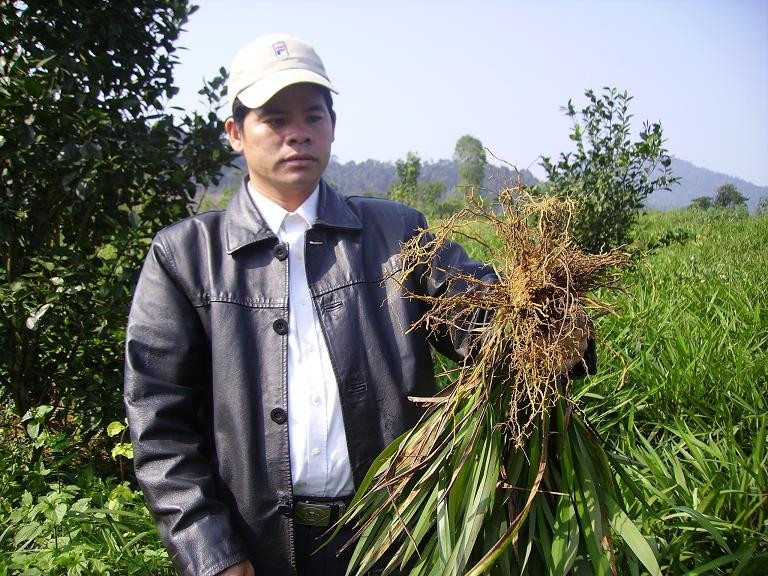 |
Tran Cong Quy and his fragrant root plants have been exported abroad. |

I heard that the forest has a lot of land...
Quy, armed with a fairly good vocational certificate in veterinary medicine, went to the mountains. Many thought he would apply for a job as a "veterinary doctor" for the commune. They thought that such a job would be sufficient in this desolate mountain region. Earning money here was very difficult. But Quy had a different idea. This rocky, barren land held much potential; getting rich wouldn't be too difficult.
The team assigned Quy nearly 4 hectares of barren hillside land to establish a farm. It was a patch of overgrown forest, full of wild trees and rocky, uneven soil. On his first day, holding a hoe, the blade bounced back from the ground, and Quy felt discouraged. The land was too barren! The water source for irrigation was also too far away. He spent his days tilling the land and his nights tossing and turning, but then Quy gritted his teeth and made up his mind, "If I can think of it, I can do it." For almost a year, he struggled with the patch of forest, finally tilling the soil and planting fruit trees and industrial crops. The land was barren, but the trees did not disappoint him. Two hectares of forest gradually covered the land with the green of oranges, pomelos, peppers, and betel nuts, providing him with "capital." He left the remaining half of the land fallow.
Looking at the scrawny cinnamon roots that Quy painstakingly pulled up from the forest and planted in pre-dug holes in the empty plot of land, many people didn't understand what this veterinarian intended to do. Quy said he was planting them for their roots, but few believed him, wondering how they could survive in this barren land. Quy searched for information to read, and gradually he figured out the "preferences" and "characteristics" of this plant.
The patch of fragrant root planted took root very quickly after a few months. The plants began to sprout leaves and looked "very promising," so Quy continued to go into the forest to find more seedlings. A few months later, the forest was completely covered with fragrant root plants.
"The fragrant scent of Tet (Vietnamese New Year) made me think of a profession: cultivating agarwood roots. Here, every year as Tet approaches, people flock to the forest to find agarwood roots to make incense to sell. The incense from this region is famously fragrant, unmatched anywhere else. I suddenly thought, why don't I propagate it in large quantities and sell it in big cities? I pondered for several days, then realized that the project I had outlined had a basis and I decided to pursue it," Quy recounted about his encounter with agarwood roots and the "life project" he is currently working on.
More than a year later, Quy began harvesting the roots of the fragrant tree. His 2 hectares of fragrant tree roots yielded nearly 1.2 tons of dried roots, which sold for over 40 million dong. Quy was overjoyed, as if he had struck gold. Everyone was surprised that this scrawny tree could actually be such a lucrative source of income.
Bringing the fragrance of our forest to the world.
Quy, carrying his backpack, traveled north and south to find markets for his products. Buyers in Hanoi, Hai Phong, and Ho Chi Minh City promised to purchase them under specific conditions. Reassured, Quy returned to inform his fellow villagers and shared his cultivation and propagation techniques with dozens of households in the Youth Volunteer Brigade. He also applied to study at Hue University of Agriculture and Forestry, in the distance learning program, to further his knowledge.
The area planted with fragrant root trees is expanding. Not only in the 5th Youth Volunteer Brigade, but fragrant root trees have also been planted in gardens and forests in Thanh Nho commune, his hometown. After 5 years, this brigade has over 250 hectares, yielding nearly 300 tons of dried roots per harvest (1 year). In 2006, Quy cautiously found partners in Taiwan and China and connected with them. This is a large market with a very high demand for this type of forest fragrant root. That year, Quy purchased and roughly processed nearly 500 tons for export to these two countries.
Raw agarwood roots are exported at a good price, but still result in significant losses. Quy considered processing them and persuaded three friends to pool their capital. Earlier this year, the four of them contributed over 600 million VND to establish a limited liability company called "Forest Agarwood Root Seed and Processing Company Limited," with him as director. Quy found two young men from the commune and invested in training them in processing and producing agarwood for export. In July of this year, both completed their training but were unemployed because the factory was not yet finished. Quy found them temporary jobs, paid them salaries, and even gave them an additional monthly allowance of 800,000 VND each to retain them. He also plans to add about 2,000 hectares of agarwood trees to meet the factory's operational needs and is traveling to other districts in the province to encourage people to plant this crop with guaranteed product purchase contracts.
A desolate, overgrown mountainous area has now been transformed into a lush green farm with fragrant root plants and over 2 hectares of Shan Tuyet tea, oranges, betel nuts, pepper, and a herd of cattle. But that achievement hasn't satisfied Tran Cong Quy's ambition. "I need to export over 3,000 tons of finished fragrant root products annually to feel secure. We plan that once the factory is operational, with that production volume, we will expand our market to other countries with similar cultures and who use this product extensively," Quy envisioned.
The family has eight siblings. For those who finished high school and wanted to continue their education, their parents tried their best to support them. For those who wanted to venture into business or production, they only had 2 million dong as capital. Success or failure, joy or hardship, they had to bear it themselves. That was Quy's family motto. The 2 million dong given to Quy when he finished vocational school has now multiplied many times over. But the asset of this 34-year-old unmarried man is a highly viable project that promises to bring great benefits to thousands of other farming households.
Nguyen Phe