
Part II: The Great Truong Sa Fortress
Visiting Truong Sa Lon Island. The round, bright red sun, resembling a giant bullseye, appeared at the edge of the waves. The ship sped straight towards that bullseye like an arrow. The sun rose higher and brighter, like a searchlight sweeping a beam of light across the sea. The ship followed this "path of light" straight towards Truong Sa Lon Island, the "capital" of the Truong Sa archipelago. Part I: Heading Towards the Sun
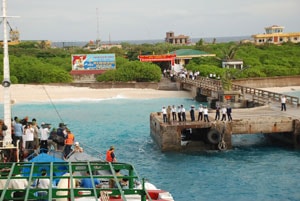 |
| Visiting Truong Sa Lon Island. |
The round, fiery red sun, resembling a giant bullseye, appeared at the edge of the waves. The ship sped straight towards this bullseye like an arrow. The sun rose higher and brighter, like a searchlight sweeping a beam of light across the sea. The ship followed this "path of light" straight towards Truong Sa Island, the "capital" of the Truong Sa archipelago.
Part I: Heading Towards the Sun
A green oasis amidst the "stormy archipelago"
Standing on the ship's deck, I gazed out at the vast expanse of sky and sea without anything obstructing my view. The sky was calm and the sea tranquil. This kind of weather is perfect for seafarers. Major Le Hai Son, the ship's captain, said: "The ship is sailing in deep water, thousands of meters deep. April and May are the two months with the most favorable weather for ships going to Truong Sa. In other months, the waves are big, soaking the sides of the ship. Sometimes, the ship can't even get its boats to the islands."
6:00 AM, May 4th. As dawn broke, journalists, laden with equipment, crowded the lifeboat deck, anxiously awaiting their first glimpse of this sacred part of the homeland, now situated amidst the windswept East Sea. The sky was clear and blue. The sea had changed color without us noticing. In shallow waters, around 100 meters, the water was a marble-like blue, but at depths of 500-1000 meters and above, it was a dark, ink-like blue. The over 2,000-ton ship was like a tiny dot in the center of the circle where the sky and sea met. The sea, a vibrant blue, mossy green, or emerald green, shimmered magically in the sunlight, depending on the depth.
The vast Trường Sa archipelago was gradually coming into view. We could clearly see the smiles and waving arms of the honor guard welcoming the mainland of our homeland closer than ever before. Despite the calm weather, Ship 996 was still unable to dock. The waves were strong, so it was more than an hour later before the mainland and the island finally met, hand in hand, with radiant smiles. Trường Sa began with the green of the sea almond trees, the Barringtonia trees... encircling the islands, and the golden sand dunes bordering the waves and the trees.
Previously, Truong Sa Lon (the largest island) was a submerged island, sparsely populated with only a few mangrove trees and densely covered in bird droppings. Even soldiers wanting to pick a mangrove branch to give to the performing arts troupe needed the island commander's permission. Just 5 or 7 years ago, a movement began on the island requiring each soldier to plant a tree before leaving. Lieutenant Colonel Nguyen Dai Duong, the commander of Truong Sa Lon, whose name is distinctly...sea-like, recounts that planting trees on the island has a unique characteristic: the geological formation of the island system here is due to the accumulation of dead coral reefs, making the soil as hard as rock. Digging a hole requires using a crowbar to pry up small pieces. The soil for planting trees has to be transported from the mainland and carefully protected to prevent salty sand from seeping in. At this time, the island has become a green oasis in the middle of the salty ocean. "Every square meter of the island is now meticulously planned," Lieutenant Colonel Nguyen Dai Duong revealed. In front of the sovereignty marker, we met Lieutenant Dinh Cao Toan, from the coastal area of Hau Loc (Thanh Hoa province), the commander of the 85mm artillery platoon. He confided that he didn't feel any difficulty coming to Truong Sa. Before going to the island, he had prepared himself mentally and made many preparations. But upon arrival, he was truly surprised by the abundance of trees and greenery, the vegetable gardens, and the wells... just like back home. "The longer I stay, the more I love Truong Sa."
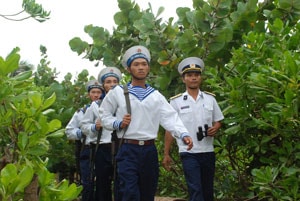 |
| Patrolling the island |
Storms and typhoons are often considered "symbols" of Truong Sa. But there are two equally remarkable trees: the Barringtonia acutangula and the Morinda citrifolia. Both the fruit and roots of the Morinda citrifolia can be used medicinally; soaking them in alcohol or drying them to make a decoction can treat back pain, muscle aches, and high blood pressure. In addition, there is another tree known as "Truong Sa grapes," which are edible. These are the fruits of the Tra tree, with long clusters of small, light green, marble-sized fruits that have a slightly sour and astringent taste, easily evoking memories of childhood in their distant homeland for those living on the island.
Throughout the island's platoons, green vegetables are everywhere. They're grown by the water tanks, under the shade of the sea almond trees, and around the barren houses. Each plot of land is tiny, only about 15 square meters, but it's surrounded by a 2-meter-high wall to protect against the salty wind during the rainy season. If calculated meticulously like on the mainland, the value of the wall would be hundreds of times the price of the vegetables. On the island, there's no fixed quota of how many kilograms of green vegetables per soldier; instead, each soldier is assigned to cultivate a specific type of vegetable. In the tank platoon, for example, soldier Duc grows jute mallow, Hoa grows water spinach, Binh grows loofah... Sometimes, these become nicknames for each soldier to call them by name for convenience. From July to the end of the year, the salty wind prevents the vegetables from growing, so the soldiers switch to growing pumpkins, a reserve of green vegetables for the transitional seasons.
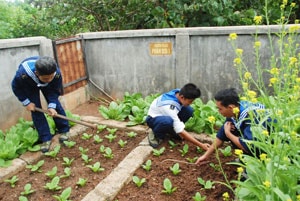 |
| Increase production |
According to the soldiers on the island, seafood is not as easy to catch as it used to be, so they mainly rely on canned goods from the mainland. Even with strong nets, they usually only catch a few grouper fish, around 1kg or less. Therefore, the island is now developing green mussel and clam farming around the pier. However, chickens, ducks, and dogs are raised in large numbers on the island.
The Spratly Islands have long been known as the "stormy archipelago," where the waves never cease, and the salt stains the tiny green dots on the vast nautical chart. But like steadfast soldiers, the green shoots silently and bravely bring the small islands closer to the mainland.
The story of the island defenders.
To reach the center of the island, we traveled along a wide airport runway that ran the entire length of the island. The island was covered in lush green trees, which the islanders cherish as much as food, clothing, and water. Here you'll find the headquarters of the Truong Sa District People's Committee; the Search and Rescue Center; and the Meteorological and Oceanographic Station. The outline of a town situated in the center of the archipelago was clearly visible to us. The story I heard most often was about the island's assistance to the fishermen. When sick, lacking food or water, the fishermen consider the island as a rescue station at sea to rely on.
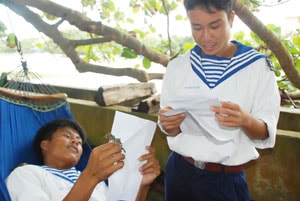 |
Reading letters from home. |
In the frontline islands, the young men from Nghe An province make up a significant portion, all striving to do their best, with everyone feeling relaxed and at ease. "Basically, we all volunteered to go to Truong Sa, considering it an honor in a soldier's life," Thang confided. The Nghe An newspapers I brought were passed around among the soldiers from Nghe An. Late at night, with the lights off, they still turned on their flashlights... to read secretly. Their hometown felt so close to them through these brief news items.
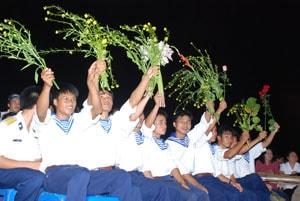
In the evening, beneath the sovereignty marker, the delegation organized a cultural exchange, with the Navy's performing arts group as the core. The song "Painting of Truong Sa" opened a night of music full of "island" spirit. The island soldiers showed their enthusiasm by continuously presenting the singers with seashells, square-leaved mangrove flowers, even mustard flowers and wild honeysuckle. A forest of hands connected, bouquets of wildflowers of all kinds were raised, rhythmically following the song, looking like tiny fireworks under the night lights. When it came to the more lively performances, the soldiers rushed onto the stage, spontaneously dancing with the singers. Smiles filled the small island. Singer Nhat Huyen, from Thai Binh province, was scheduled to sing only two songs, but ended up performing four. For the last song, Huyen sat down on the ground, mingling with the soldiers and singing along with them, causing MC Quang Long to panic, fearing the program would be disrupted.
 |
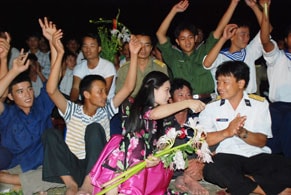 |
| Island soldiers interact with singers. |
A gift from Truong Sa
The night on the island was so short. Another dawn was slowly rising over the deep purple horizon. With each new day on the shore, I usually felt refreshed, because I was standing before a new day, with many things to look forward to. But at this dawn, I suddenly felt a pang of sadness. We were about to leave Truong Sa, and we would promise to meet again someday, but when would that be, my dear little island? When the moments that passed felt almost like blood and flesh.
The delegations and soldiers from the island excitedly made their way to the pier, where the HQ996 ship was glowing red in the morning light. The island's honor guard, in their neat naval uniforms, was waiting to see off the delegation. The gifts the island sent to the mainland were a few coral branches, some stones from the water's edge, and some even carefully scooped up some Trường Sa water. As for me, I quietly picked a few leaves of the sea almond tree to remember a sea voyage that is not easily repeated. Only one immeasurable gift I could never forget when leaving the island was the words of the island commander, Nguyen Dai Duong, at the pier: "Although it is a remote island, very far from the shore, the mainland can rest assured because the soldiers and people of Trường Sa district are determined to protect the sacred sea and islands of the Fatherland. That is Trường Sa's gift to the mainland!"
At 5:30 AM on May 5th, the ship dropped anchor, and we bid farewell to Truong Sa Island. What remains are the markers of sovereignty and the people who guard the island.
(Continued in Part 3)A wreath in the middle of the ocean
Tran Hai