

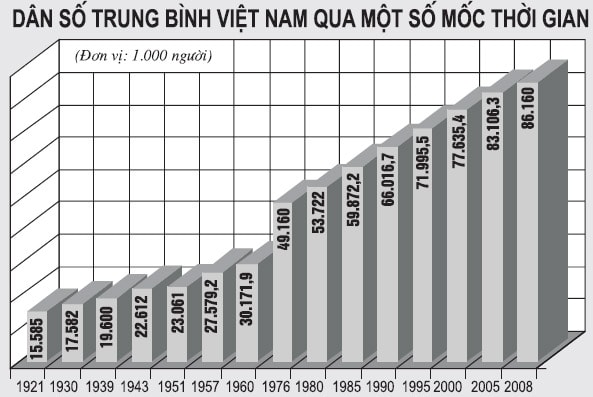
Vietnam's population throughout different periods.
In conjunction with the upcoming national population census as per the Prime Minister's decision, we would like to provide some information on Vietnam's population over the past period for readers to refer to related population indicators.
 |
| According to preliminary estimates, in 2008, Vietnam had 1,772 secondary school students per 10,000 people. |
In there:
- During the period 1921-1943, the population increased by 319,500 people per year, equivalent to an annual increase of 1.71%.
- During the period 1943-1951, the population increased by 56,100 people per year, or 0.25% per year, mainly due to over 2 million people dying of starvation in 1945 and the number of people who died in the war.
- During the period 1951-1957, the population increased by 753,000 people per year, or by 3.03% per year;
- During the period 1957 - 1976, the population increased by 1,135.8 thousand people per year, or by 3.08% per year;
- During the period 1976 - 1985, the population increased by 1,190.2 thousand people per year, or 2.21% per year;
- During the period 1985 - 2008, the population increased by 1,142.9 thousand people per year, or 1.60% per year;
Specifically, during the period 2000-2008, the population increased by 1,065.6 thousand people per year, equivalent to an annual increase of 1.31%.
Thus, although the population growth rate has slowed down in recent years, in absolute terms, it still increases by around 1 million people annually, equivalent to the average population size of a province.
With a population of nearly 86.2 million, Vietnam is the 12th most populous country in the world, after China, India, the United States, Indonesia, Brazil, Pakistan, Bangladesh, Nigeria, Japan, Mexico, and the Philippines.
Vietnam's population density is 260 people/km2, more than five times higher and ranking 41st out of 208 countries and territories worldwide; more than twice as high and ranking 8th out of 11 countries in Southeast Asia, and twice as high and ranking 16th out of 50 countries and territories in Asia.
Vietnam currently has a natural population growth rate of 1.2%, ranking 8th in Southeast Asia, 32nd in Asia, and 114th in the world. This is a positive result of early population planning efforts.
The average life expectancy is 72 years (70 for men, 73 for women), ranking 4th in Southeast Asia, 20th in Asia, and 83rd in the world.
 |
Vietnam's urban population ratio was 7.4% in 1930, 10.0% in 1951, surpassed 20% in 1976, and only reached 27.9% in 2008, ranking 8th and lower than 39% in Southeast Asia, 41st and lower than 41% in Asia, and 177th and lower than 49% globally.
Although the proportion of women in the population remains higher than that of men, it has gradually decreased, from 52% compared to 48% (in 1976) to 50.9% compared to 49.1% (in 2008), mainly in older age groups. In younger age groups (especially those under 20), the proportion of women is lower than that of men, a sign of gender imbalance similar to what is currently seen in China.
There are many socio-economic indicators related to population. Among these indicators, some are very important.
The average agricultural land area per capita remains low and has decreased sharply, currently standing at less than 0.11 hectares; if we consider only the area of land used for rice cultivation, it is even lower (only 0.048 hectares).
This highlights two issues: firstly, the need to reclaim and improve 340,300 hectares of unused land; and secondly, the need to protect agricultural land, especially rice-growing land, to ensure food security.
The large and rapidly growing population creates an already abundant labor force, putting pressure on job creation each year; in a context where the economy is still small, labor productivity is low (the average annual labor productivity is only about 1,959 USD, of which the agriculture, forestry, and fisheries sector accounts for only 821 USD, and agriculture is even lower).
The advantage of cheap labor is gradually diminishing; on the other hand, in terms of income, purchasing power is low, making strikes more likely, as well as facing anti-dumping lawsuits, etc.
GDP per capita in USD, calculated at current exchange rates, has increased considerably (from 289 USD in 1995 to 402 USD in 2000, 639 USD in 2005, and 1,024 USD in 2008), but it remains low compared to the world average of over 7,500 USD, the Asian average of nearly 3,000 USD, and the Southeast Asian average of nearly 2,000 USD.
Vietnam ranks 7th out of 11 countries in Southeast Asia, 39th out of 48 countries and territories in Asia, and 146th out of 185 countries and territories with comparable data worldwide in this indicator.
GDP per capita – calculated using purchasing power parity – is the lowest of the three indicators in the Human Development Index (HDI), and its ranking is also the lowest compared to life expectancy and education levels.
Recognizing the crucial role of population, Vietnam conducts a population census every 10 years, and citizens are encouraged to participate and provide timely, complete, and truthful information as requested.
According to the Economic Times