
The quiet seeker of ancient Vietnamese script.
It can be affirmed that a person like Mr. Do Van Xuyen, who dedicated his life to searching for ancient Vietnamese script, is truly unique to this day. Thanks to people like Mr. Do Van Xuyen, the ancient Vietnamese script of our nation has had the opportunity to be revived, contributing to the immortal vitality of our people.
(Baonghean)It can be affirmed that Mr. Do Van Xuyen, who has dedicated his life to searching for ancient Vietnamese script, is truly unique to this day.
Thanks to people like Mr. Do Van Xuyen, the ancient Vietnamese script of our nation has had the opportunity to be revived, contributing to the immortal vitality of the nation.
|
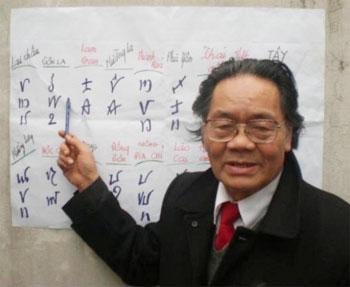
Researcher Do Van Xuyen (Tan Dan ward, Viet Tri city, Phu Tho province) has quietly devoted many years to searching for and deciphering ancient Vietnamese script. Mr. Do Van Xuyen asserts: “During the founding of the nation, the Hung Dynasty, we had a brilliant education system. The Vietnamese people had a writing system even before the Han Chinese.”
I went to Viet Tri at his invitation before the inauguration of the ancient Than Qui temple (March 29, 2009, which is the 4th day of the 3rd lunar month, at Thien Co Temple, Huong Lan village, Trung Vuong commune, Viet Tri city - a place of worship for the teacher couple Vu The Lang, from the 18th Hung King's reign, who taught the two princesses of Hung Due Vuong, Tien Dung and Ngoc Hoa), because I knew he was the first person to date to successfully decipher the ancient Bach Viet script.
Seeing that I wanted to ask a question but hesitated during our first meeting, he happily replied:
- Over 50 years ago, returning to my ancestral land, I was just a passionate 20-year-old teacher. Whether it was fate or destiny, during a field trip with my students, we unearthed many ancient stone and bronze artifacts with strange patterns resembling writing. Curious, I discovered similar sites in many other places. So, I quietly began my journey of research and discovery. I kept asking myself: Our nation, 3,000 years ago, created a series of incredibly sophisticated bronze drums, reaching the pinnacle of art and the essence of a brilliant civilization, astonishing the modern world. Did our nation have a written language at that time?
I found the Thai script discovered by Pham Than Duyet in 1855, also in the Northwest region. Then I read the book "Tongjian Gangmu" by Zhu Xi of the Song Dynasty, which says: "In the 5th year of Emperor Yao's reign (2352 BC), the Southern Yi Viet people came to pay homage and offered a large turtle..." According to ancient Chinese history, "during the reign of Emperor Yao (2357 BC), an envoy from Viet Thuong came to the capital in Binh Duong (north of the Yellow River - present-day Shanxi Province) to offer a divine turtle, more than three feet square, with inscriptions on its back recording events from the time heaven and earth were first created onwards." Emperor Yao ordered it to be transcribed and called it the Turtle Calendar. Our book "Lingnan Zhiquai" also clearly records this.
What kind of script was the Khoa Dau script that Hung Quoc Vuong gave to King Nghieu, the script that teachers during the Hung Vuong era taught widely? In a genealogical record from the time of King Tran Thai Tong, it is also recorded: "During the reign of King Nghieu, Viet Thuong presented a thousand-year-old divine turtle with Khoa Dau script on its back," meaning that during the reign of King Nghieu, the Viet Thuong kingdom presented a thousand-year-old divine turtle with Khoa Dau script on its back. Researcher Le Trong Khanh also mentioned the prehistoric Khoa Dau script of our people. By chance, I found a set of 17 characters called Hoa Tu (resembling a burning flame) written by Vuong Duy Trinh (in 1903, Governor-General of Thanh Hoa) in "Thanh Hoa Quan Phong" printed in 1903, which he considered to be an ancient Vietnamese script remaining in the Northwest. Vuong Duy Trinh wrote: "Because the ten provinces (Northwest region) are a remote border area, our people still preserved that script. In other places, Si Nhiep (186) forced them to abandon it and learn Han script." Looking at the words blazing like fire, I couldn't help but be moved. It was as if a voice within me was prompting me to feel a sense of responsibility towards the legacy of our ancestors.
- Sir, as far as I know: According to the latest report from Arkansas University, USA, "up to 6,000 other languages are dying out, and half of them are at risk of extinction in the 22nd century. In ancient times, humankind used between 10,000 and 15,000 different languages. Now there are about 6,000 languages left, and they are declining. According to this university's prediction, by the year 2100, only about 600 languages will still exist. So, does our ancient Vietnamese script fall into such a category? If we only rely on the Fire Script, is that sufficient evidence to prove the existence of ancient Vietnamese script?"
- I looked in the preface of the Vietnamese-Portuguese-Latin dictionary published in Rome in 1651, where the author Alexandre de Rodes wrote: "For me, the most skillful teacher was a native boy. Within three weeks, he taught me all the tones of that language and how to read the words." In my opinion, that language is Old Vietnamese.
Based on my field research and the studies of scholars both domestically and internationally, one of the most brilliant achievements our ancestors built from prehistoric times was education. During the Hung Kings era, we had an education system with schools, teachers, and students. Our ancestors invented writing paper. I have diligently researched and translated the names of 18 teachers from the Hung Kings era, starting from the 6th Hung King, and many names of famous students in history.
In the book "The Formation and Development of Ancient Vietnamese Script," published by the Institute of Culture in 1986, Professor Le Trong Khanh cited: "Many ethnic groups in the Bai Yue region used the Khoa Dau script from the time of Fu Xi and Shen Nong to record their own languages. So, did the Kinh and Lac Viet people not have any written script? In Vietnam, the Khoa Dau script was used for even longer. It continued until the time of Si Nhiep, even though Si Nhiep forbade it, our people still used it." Many researchers, from Ha Van Tan, Le Trong Khanh, Bui Van Nguyen, Tran Ngoc Them... to Vuong Duy Trinh, Truong Vinh Ky, and even foreign researchers in England, Czechoslovakia, the United States, France, and especially China: from Luc Luu to Hua Than, Trinh Tieu... all affirm that ancient Vietnam had its own writing system…
Honestly, I deeply admire him. From various sources, I learned that he wasn't a scientist, didn't have a professional salary, and suffered from several serious illnesses. Yet, whenever he heard about a strange script, regardless of his advanced age and frail health, he would immediately go with great passion, a strong sense of responsibility, and a highly scientific approach to his work. He traveled to the remote mountainous regions of Quang Binh province to study the ancient script on leaves of the Coi ethnic group, and to Nghe An, Thanh Hoa, Hoa Binh, Son La... He studied the scripts of Thai, Lao, Nepalese, and Cambodian people... On many trips, he had to mortgage his meager pension. In 2003, after a trip to Sa Pa to study the ancient script on rocks, he was bedridden for four months, at times almost dying. Perhaps it was his talent, the dedication of a true educator and researcher, his sense of responsibility to his ancestors and his country, and his faith in the culture of a nation with a thousand years of civilization that gave him the strength to persevere.
He gave me a set of books: "Summary of the initial results of the search for ancient Vietnamese script" and "On the conjecture and proof for the existence of ancient Vietnamese script," because he knew I had lived and taught in Northwest Vietnam for 30 years and had some understanding of ancient Thai script.
A fire seemed to ignite in his eyes:
- What strengthens my belief, along with that of other researchers, is that the script we found has a shape and structure similar to characters found on stones, pottery, bronze drums, and other artifacts characteristic and unique to the Lac Viet people throughout their thousands of years of history. This confirms that they share a common origin, from a very distant past. We believe this because the script we found has a unique structure, which could only have been created by people with Vietnamese moral traditions and identity. The complete preservation of this script within the Vietnamese language is the most important condition for confirming the origin of a script.
We believe this because, during our search for this script during its wanderings from 187 to 1621, we unexpectedly found traces of the script from the time of King Hung present in the early Vietnamese Quốc ngữ script in the library of the Holy See in Rome, in Lisbon, and several other places. This allows us to initially conclude that the script of King Hung has not disappeared. However, to avoid extinction due to the insidious schemes of foreign powers, this special script took full advantage of the opportunity when Western civilization flooded into Vietnam in the 16th and 17th centuries, quickly borrowing the Latin script to disguise itself and integrate into the ranks of the most civilized scripts in humanity.
|

He affirmed:
- Vietnam is the only country in Asia that has Latinized its writing system, because Vietnam already possesses the ancient Vietnamese script, a type of alphabet similar to Latin. Even Father André Palmeiro, before A.de Rhdes, in his short writings in 1632 upon arriving in Vietnam, used four ancient Vietnamese characters. Father Iginio Văn Tín, in his handwritten book on national history from 1659, persistently worked on converting from ancient Vietnamese to Latin. Even Father Philip Bỉnh, who was born at the same time as King Quang Trung in Hai Duong, spent the last 30 years of his life in exile in Lisbon, Portugal. During this time, he dedicated himself day and night to writing over 20 books, deliberately incorporating ancient Vietnamese characters into every page, not only in their structure but also in their original form: “When I die here, please send these books back to my country for my brothers to use!” Two hundred years have passed, and only today do we understand his profound intention: He wanted to preserve traces of ancient Vietnamese script within the national script, so that future generations would one day have a basis for discovering the invaluable heritage of their ancestors, a heritage that the political situation at the time did not allow for direct expression.
In 2005, during a visit to Phu Tho province, President Tran Duc Luong discussed ancient Vietnamese script with Mr. Xuyen and encouraged him to continue his research. Recently, Mr. Xuyen also presented a report on this matter to Deputy Prime Minister and Minister of Education and Training Nguyen Thien Nhan. At the end of 2007, at the Center for the Elderly's Culture, more than 40 scientists listened to his report on new discoveries regarding ancient Vietnamese script. Professor Tran Phuong, former Deputy Prime Minister, highly praised his findings.
I understand that in the coming days, the Vietnam Senior Citizens Cultural Center will be organizing a seminar on ancient Vietnamese script, with the participation of leading Vietnamese language experts.
Thanks to people like Mr. Do Van Xuyen and other researchers, the ancient Vietnamese script of our nation has the opportunity to be revived. The people of this land of the Dragon and the Immortal, in the spirit of brotherhood with thousands of years of civilization, now have reliable evidence of our cultural traditions, contributing to the enduring vitality of our nation.
I always wished that Mr. Xuyen's research project and his team's work could be included in the list of national key projects and receive funding from the State and sponsors – how wonderful that would be!
Please note that Mr. Xuyen's time is running out, even though his enthusiasm is boundless!
Tran Van Hac