
21 years of "friendship" with fallen soldiers.
That's Mr. Thai Khac Trung, the cemetery caretaker in Nghi Loc district. He believes that the martyrs who fell for the independence and peace of the Fatherland are still alive and still need companionship and conversation. Therefore, despite his failing health, he and his wife have voluntarily dedicated the rest of their lives to caring for the resting place of these martyrs.
(baonghean.vn)That's Mr. Thai Khac Trung, the cemetery caretaker in Nghi Loc district. He believes that the martyrs who fell for the independence and peace of the Fatherland are still alive and still need companionship and conversation. Therefore, despite his failing health, he and his wife have voluntarily dedicated the rest of their lives to caring for the resting place of these martyrs.
A disabled veteran of the special category
We arrived at the Nghi Loc District Martyrs' Cemetery on a hot, humid summer afternoon.
|
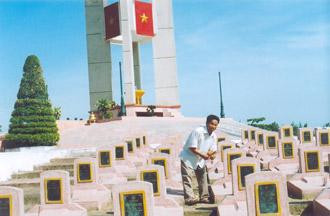
Meeting Uncle Trung again after more than 10 years, time had left its mark on his face. Recounting his early days in the army, he couldn't help but feel emotional. Leaving his hometown of Nghi Van commune to enlist in 1977, young Thai Khac Trung – the youngest son in a family where both his father and older brother were soldiers – eagerly went to the southwestern border battlefield to fulfill his international duty, hoping to contribute to serving his country and a friendly nation. After nearly two years of direct combat duty in a regular unit of the 3rd Army Corps (now the Central Highlands Army Corps), in August 1979, he and his unit transferred to the North to take on a new assignment on the northern border.
Here, in early 1981, while on duty with his comrades at the 400-meter elevation (a military outpost of ours at the Chi Ma-Loc Binh border gate, Lang Son province), his unit encountered a landmine. He himself had his right thigh amputated by the mine and suffered severe head injuries; his left eye was completely blinded, and it took him more than half a year to be certain he would survive. Due to his serious injuries and weak health, he was transferred to the 105 Military Hospital for further convalescence.
At Nghi Loc Martyrs' Cemetery |
Concerns for the deceased...
We were also born and raised in Nghi Loc. When we were children, we often went to the Martyrs' Cemetery with our friends, especially during the summer, because it was cool there. However, at that time, the cemetery was almost empty except for a memorial monument and cement graves that hadn't been arranged in rows. Ten years later, when we returned, everything had changed. The entire cemetery grounds were more beautiful; the courtyard was paved with tiles, the graves of the martyrs were no longer plain cement but covered with colored stone and arranged in straight rows; the trees were lush and neatly trimmed, the grounds were surrounded by a wall, and there was a gate with a solemnly closed door. Everything exuded the peaceful and solemn atmosphere of a sacred place.
|
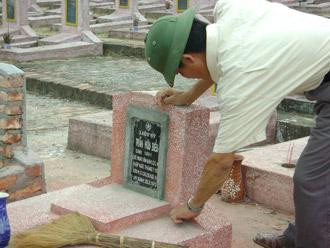
In early 2006, the district continued the second phase of renovating and upgrading the entire cemetery. Today, the cemetery is as beautiful as a park and ensures the solemnity and peace of a sacred place.
I asked, "So, what is your daily work? Don't you feel sad having to keep going back and forth here?" He smiled and slowly said, "No, this is an invaluable joy in my life. Every day is the same; my job is to look after and maintain the graves of fallen soldiers; to sweep and clean; and to welcome and guide relatives who come to visit the graves. On days when I feel well, I trim and care for the plants. Besides that, there's an important matter that always weighs on my mind: currently, only over 40% of the graves at the cemetery have been claimed by relatives, the rest are still unclaimed, so I have to find every way to inform them. This is not an easy task because the fallen soldiers resting in the cemetery come from almost all over the country. So, together with various agencies and organizations, every day, I still try every way to find relatives for the graves of fallen soldiers."
Currently, out of 700 graves, more than 400 remain unclaimed. These are mostly the graves of martyrs from northern provinces such as Hai Duong, Thai Binh, Nam Dinh, and Thanh Hoa... even though their full names are known. There are even graves of martyrs from within the district that have yet to be claimed by relatives. Suddenly, the old man's face clouded over with sadness: "If the government doesn't relocate them to the cemetery, these graves will be forgotten over time!..."
|
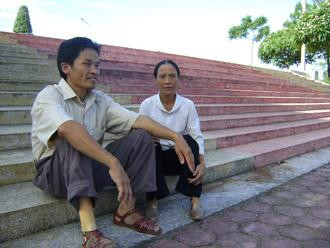
I asked him about his personal wishes, and he shook his head thoughtfully: “Every day I still keep them company, talking to them as if I were living and fighting alongside them. I understand their sadness and share it with them. Recently, I asked the district to build a small guesthouse for the cemetery so that relatives of fallen soldiers visiting the graves have a place to rest. I only hope that this project will soon become a reality. There are still many graves in the cemetery without relatives; please write my phone number in the newspaper, so that perhaps some relatives of fallen soldiers will come looking for the graves.”
Twenty-one years have passed, and a war veteran with a 91% disability rating, along with his wife, has quietly continued the work they consider a duty and a heartfelt commitment to those who have fallen. Mr. Trung believes: "The only difference between us and the fallen soldiers is that they are in the afterlife, while we are in the living world. With such disabilities, what else can we do? The only difference is that we are alive, in the living world!" Perhaps that is why the couple has voluntarily dedicated the rest of their lives to caring for the resting places of the martyrs who sacrificed their lives for the country.
As I said goodbye to Uncle Trung and left, a feeling lingered in my heart: I hoped that Uncle Trung's wishes would soon be fulfilled.
Text and photos: Le Xuan Thang60 Dao Tan Street, Vinh City