

Say big things in small letters.
Starting from the first article "The Mind"Colonialism" written in 1919, signed by Nguyen Ai Quoc, addressed to her.In his last article, "Raising Responsibility for the Care and Education of Children and Young People," signed TL and published on June 1, 1969, journalist Ho Chi Minh had written articles for over 50 years, totaling approximately 2,000 pieces.
According to Uncle Ho, the overarching theme throughout his journalistic career was "fighting colonialism, imperialism, feudalism, and landlords; propagating national independence and socialism." In the article "Mass Mobilization," published in the newspaper Sự Thật (Truth) on October 15, 1949, under the pseudonym XYZ, Uncle Ho wrote about the most intense period of the resistance war against the French, focusing on the major theme of "propagating national independence and socialism." Specifically, the content concerned the work of mobilizing the masses to participate in revolutionary movements organized by the Party, government agencies at all levels, and people's organizations. This is a classic work, a handbook for cadres and Party members in mass mobilization work.
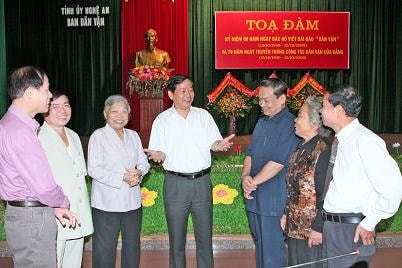 |
Comrade Tran Van Hang, Member of the Central Committee of the Party and Secretary of the Provincial Party Committee, had a cordial conversation with former leaders of the Provincial Party Committee's Mass Mobilization Department. Photo: Sy Minh |
Indeed, the article "Mass Mobilization" contains only 612 words, yet it addresses and answers very fundamental and urgent issues of mass mobilization work. Readers, regardless of their level of education, even those who are illiterate, can understand and follow its instructions. Uncle Ho wrote in a concise, easy-to-understand question-and-answer style, clarifying four specific points in turn: 1. The fundamental premise of mass mobilization work; 2. What is mass mobilization? 3. Who is in charge of mass mobilization? 4. How should mass mobilization be conducted? And Uncle Ho concluded with a profound truth: "Poor mass mobilization leads to poor results in everything. Skillful mass mobilization leads to success in everything!"
The article "Mass Mobilization" begins with a very specific reason: "The issue of mass mobilization has been discussed extensively and thoroughly, but many localities and officials have not fully understood or implemented it correctly." This is followed by questions such as: "What is mass mobilization?", "Who is in charge of mass mobilization?", and then answers. Part 1, of particular importance, outlines the premise and basis of mass mobilization work, affirming: "Our country is a democratic country" with the elements of a truly democratic nation.
The article continues by posing the question, "What is mass mobilization?" and answering: "Mass mobilization is the mobilization of all the strength of every single citizen, without leaving anyone out, to form a nationwide force to carry out the tasks assigned by the Government and organizations."
The article outlines a solution to the problem: four steps in mass mobilization work: "1. Every effort must be made to ensure that each citizen understands that the task is beneficial to them and is their responsibility, and they must enthusiastically strive to accomplish it; 2. In any undertaking, consultation with the people is necessary, seeking their opinions and experiences, and together with them, developing practical plans tailored to local circumstances, then mobilizing and organizing the entire population to implement them; 3. Monitoring, assisting, urging, and encouraging the people; 4. Upon completion, the work must be reviewed with the people, lessons learned, criticisms made, and rewards given."
The article "Mass Mobilization" is written in a clear and simple style: Those engaged in mass mobilization work must "think with their minds, observe with their eyes, listen with their ears, walk with their feet, speak with their mouths, and work with their hands." There are: "poor mass mobilization" and "skillful mass mobilization." The word "skillful" is indeed irreplaceable because in folk parlance, "skillful" is often associated with skillful hands, skillful eating, skillful speaking... Those engaged in mass mobilization work are skillful in speaking and skillful in working... this is very relevant, close, and logical in that context. Here, Uncle Ho did not use contrasting terms: poor - good, or poor - excellent, for reasons stemming from simplicity, closeness to people, and logical alignment with the requirements he mentioned above.
After neatly resolving all issues, Uncle Ho stated a simple conclusion, a truth: "Poor mass mobilization leads to...", "Skillful mass mobilization leads to...". Here, it can be said that the author does not cite any works or authors at all. The absence of citations does not diminish the importance or appeal of the article; on the contrary, it becomes a "classic" in its clear and concise presentation and resolution of the issues, its rich and practical content, its clear and simple writing style, its precise and flexible use of language, and its overall logical structure with rigorous argumentation.
Clearly, Ho Chi Minh's journalistic style is vividly expressed through his easy-to-understand thinking and expression, deeply touching people's hearts, inspiring great ideas, and promoting good deeds with simple, figurative language. "Speaking of great things with small words" is something journalists must learn and follow. The "great thing" of the article "Mass Mobilization" is its enduring relevance over the past 60 years, not only for those working in mass mobilization but also for all aspects of Party building and harnessing the strength of the entire nation in building and defending the Fatherland. Ho Chi Minh's "small words" are 612 words that everyone understands and can follow to create "great things" for the country and the nation, creating the boundless strength of the Ho Chi Minh era!
Phu Chau