

In early spring, I met writer Son Tung and gained a deeper understanding of his poem "Living Torch".
In early spring, I, along with teacher Hoang Dao Chuc, visited writer Son Tung as previously arranged so that he could provide me with a poem about the heroic martyr Le Van Tam, which he had memorized since he was a member of the propaganda team after the August Revolution, when he was 18 years old and full of youthful energy.
(Baonghean) –In early spring, I, along with teacher Hoang Dao Chuc, visited writer Son Tung as previously arranged so that he could provide me with a poem about the heroic martyr Le Van Tam, which he had memorized since he was a member of the propaganda team after the August Revolution, when he was 18 years old and full of youthful energy.
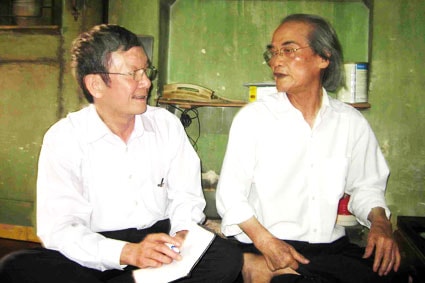 |
The author (on the left) with writer Son Tung |
The literary screening that day included not only a number of young writers, but also writer Hoang Kinh (born in 1933), who was a volunteer soldier fighting on the battlefield in Laos.
At 82 years old, writer Son Tung is still healthy and sharp-minded. He pointed to a stack of newspapers: "Ho Chi Minh City Literature and Arts Weekly":
- I regularly follow articles about Le Van Tam because of the compelling evidence, the appropriate perspective and attitude, and the respect for historical truth and for heroes who selflessly sacrificed themselves for the country.
After a moment of contemplation, he suddenly became animated, his eyes blazing with fire:
"Many years have passed, but I can never forget the memories of the cultural performances in Dien Chau, Nghe An, and many other places, serving the military units and the people. The poem 'Living Torch' was always requested to be recited many times; both the reciter and the listeners were deeply moved, and many couldn't hold back their tears." Then he spoke in a clear, resonant voice:
That afternoon, Saigon trembled with resentment.
Gritting his teeth, he listened to the thundering footsteps of the enemy.
He stood with his arms crossed, his heart heavy with anticipation.
The time to save the country, now is the time to save the country!
He looked down; his clothes were soaked.
The intoxicating smell of gasoline filled the air with a defiant spirit.
Beyond the distant horizon, golden stars flutter in the breeze.
A series of gunshots echoed from Ong Bridge.
Each gunshot claimed a young life.
We'll rise and fall together, just like him.
My heart swells with the color of water, my soul is filled with green.
He felt a burning sensation inside him; why was he so hot?
He lit the fire, his brother had wings of fire.
He stormed into the middle of the oil depot.
The crimson flames rose higher and higher…”
I was extremely surprised, because this was also the poem that the researcher of ancient Vietnamese script, Do Van Xuyen, born in 1937, read to me at the end of 2009 and confirmed that it was the poem "Immortal Fire" published in the "Quan Bach Dang" newspaper of the Third Military Region, and that he had heard soldiers recite it many times in his hometown of Thai Binh during those days. Thus, this poem was printed in many newspapers at that time under different names, widely disseminated throughout the army and among all strata of the population.
Writer Son Tung was moved:
- Later, when I went to the South, I met the former commando soldiers, and they recounted how they organized the attack on the fuel depot. They discussed at length how to make the attack effective, because the French troops were guarding it very strictly. Several young boys who sold roasted peanuts and shone shoes daily to gather intelligence on the enemy troops volunteered for the mission. Because they were so young, the enemy didn't pay attention, making it easy to create a surprise attack.
Writer Hoang Kinh added:
- I was born in Laos. In those days, not only the volunteer soldiers, but also Vietnamese expatriates in Laos and Thailand regularly recited and passed around the poem that writer Son Tung just read. Even now, I still know by heart the poem. The example of hero Le Van Tam's sacrifice for the country has given us faith in the inevitable victory of our nation.
I boldly asked writer Son Tung:
- Mr. Writer, what are your thoughts on the recent claims by some people that Le Van Tam was a fictional character, and even a desire to remove his statue from Le Van Tam Park in Ho Chi Minh City?
- Those who hold such opinions, regardless of their position, lack a thorough understanding of national history. Even if this person is not a real historical figure, they have become a historical icon. Denying or erasing this historical icon is a crime against the country, erasing the faith of an entire nation in a period of suffering yet heroism, yet brimming with revolutionary optimism. We Vietnamese are proud to be descendants of the Dragon and the Immortal, descendants of the Hung Kings. The beautiful images of national heroes like Saint Giong, along with countless other national heroes revered by our people as gods, saints, and guardian spirits, will live on with our land, igniting the flame of faith in future generations to live, fight, protect, and build the country.
He smiled happily:
France is incredibly proud of Victor Hugo's Gavroche. Yet they don't bother to investigate his background, to find out who he was or who his descendants were. It's not that they don't understand history, but because the image of that character has deeply ingrained itself in the subconscious and emotions of every citizen, becoming a symbol of the nation's patriotism. So why do we have to spend so much time dissecting and tracing the origins of the hero Le Van Tam, when the image of the "Living Torch Boy" has already become a symbol of the nation's patriotism, a flame in the heart of every true Vietnamese citizen?
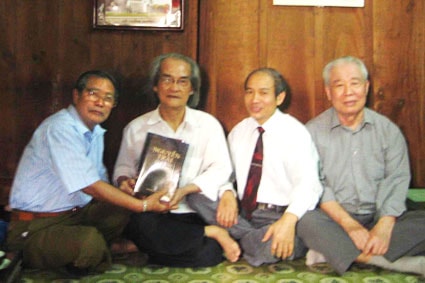 |
From left to right: Educator Hoang Dao Chuc – president of the "Association of those who admire and respect world cultural figures Nguyen Trai and ceremonial scholar Nguyen Thi Lo"; writer Son Tung; director of Trang An Cultural Center - Bui Phuc Hai; writer Hoang Kinh. |
- Mr. Writer, as we approach the new year, what message would you like to convey to the younger generation?
- Our country is on the path of opening up and integration, creating new opportunities for the nation and each individual. This year is also a very special one, marking the 1,000th anniversary of Thang Long - Hanoi. I wish the young people good health, wisdom, and the ability to always nurture and care for the flame in their hearts. That flame is the flame of love, of life; the flame of faith in themselves and the bright future of the nation. That flame was ignited by our ancestors with the blood of countless generations, and each of us has a responsibility to keep it burning forever. That immortal flame will help us to correctly understand the past, present, and future, to master ourselves, to overcome all obstacles, and to build a civilized, modern country with a rich national identity.
I suddenly remembered my grandson, who attends Le Van Tam Primary School. Every afternoon, while waiting at the school gate to pick him up, I often hear the song praising the young hero playing. It's "Le Van Tam" by composer Phong Nha, a song that moved me deeply, and I still remember the lyrics: "I remember most vividly a story from the past, in the South, one day the enemy's fuel depot suddenly burned to ashes. Who was the first to be credited with such heroic deeds? At the age of 13, his name was Le Van Tam. A living torch, shining brightly, illuminating the path for our team to advance quickly. Today, surrounded by the blazing fire, the flames seem to call out his name." The heroic melody of the song has touched the hearts of many generations, contributing to the cultivation of patriotism and revolutionary heroism. Even in peacetime, it remains incredibly important. When I expressed these thoughts, writer Son Tung nodded in agreement.
-Thank you, writer. Happy New Year! Wishing you good health, a long life, and continued success in creating many new works!
Tran Van Hac