

The reflections of a "Nghe An scholar"
While still in university, whenever we encountered courses, topics, and materials related to Eastern thought, medieval and modern Vietnamese literature, almost every lecturer or author mentioned Professor Tran Dinh Huou. This compelled us to learn more about him and his scholarly works. And interestingly, the more we learned, the more captivated we became by the vast knowledge and insightful interpretations of this "scholar from Nghe An."
While still in university, whenever we encountered courses, topics, and materials related to Eastern thought, medieval and modern Vietnamese literature, almost every lecturer or author mentioned Professor Tran Dinh Huou. This compelled us to learn more about him and his scholarly works. And interestingly, the more we learned, the more captivated we became by the vast knowledge and insightful interpretations of this "scholar from Nghe An."
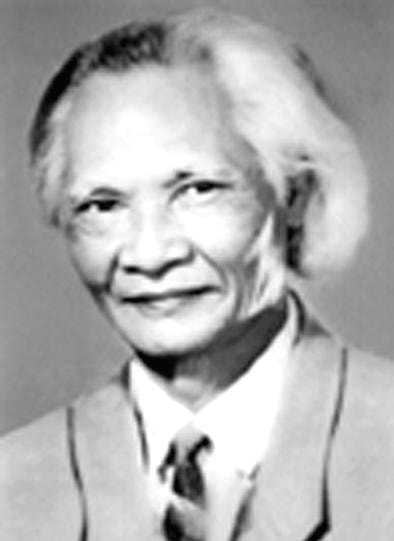 |
Professor Tran Dinh Huou (1926 - 1995) |
Professor Tran Dinh Huou's scientific contributions are evident in two fields: Philosophy and Literature. In the field of Literature, with the mindset of a philosopher, he chose to examine and analyze subjects from a cultural perspective. This is clearly demonstrated in his work "Confucianism and Modern Vietnamese Literature." While literary researchers were still struggling to define the literary period of 1900-1930, by examining the subject matter from a cultural viewpoint, Professor Tran Dinh Huou recognized this period as a dynamic entity gradually integrating into the orbit of modern world literature, and he called it "Vietnamese Literature in a Transitional Period" (the title of one of his textbooks). This designation garnered consensus among researchers. Through this approach, Tran Dinh Huou identified the roots and essence of each literary phenomenon, thereby finding an accurate and objective explanation. More importantly, from this direction, Tran Dinh Huou found outstanding "disciples" to continue his unfinished projects. These included names like Tran Ngoc Vuong, Tran Nho Thin, Lai Nguyen An, and others.
In the field of research on the history of Eastern thought and philosophy, Professor Tran Dinh Huou also achieved outstanding accomplishments. In this area, he produced "masterpieces" such as "Lectures on Eastern Thought," "From Tradition to Modernity," and papers presented at scientific conferences. Through these works, readers can easily see the profound and extensive knowledge of Eastern thought, especially Confucianism, possessed by this "scholar from Nghe An." This is understandable, as this was his field of study, and he also absorbed the traditional, upright cultural values of his family. Among ancient Eastern doctrines, Tran Dinh Huou devoted much effort to studying Confucianism. He advocated: "Examining Confucianism in a state of relative independence from the political practice of the autocratic state model" (Tran Ngoc Vuong). The extraordinary talent of "the scholar from Nghe An" Tran Dinh Huou lay in his ability to prevent theoretical systems from becoming "gray," and moreover, to keep "the tree of life forever green." This means that through his research, Tran Dinh Huou proposed a policy of separating the good from the bad, applying reasonable aspects to build a modern society.
Proposing the motto "From Tradition to Modernity," the scholar Tran Dinh Huou of Nghe An diligently studied and examined the constituent elements of society, placing them within a consistent flow from past to present to future. Remarkably, this work, written approximately 20 years prior to his death, still holds true today. In his article "Village and Clan: Issues of the Past and Present," Tran Dinh Huou pointed out the dynamics of these two community organizations of Vietnamese people, offering his opinion on how to approach the modernization of the country: "The issue of villages and communities is not confined to the village itself. Village-style organization, village working methods... have influenced general thought and culture. Therefore, solving the problem of villages and communities is not just about reorganizing villages and rural areas, but also about considering the broader consequences beyond the village and community."
The issue of family in modern society has long been discussed extensively by sociologists and journalists. However, since 1989, Tran Dinh Huou's article "The Traditional Vietnamese Family under the Influence of Confucianism" has pointed out the relationships and types of traditional families and raised the need to find a direction for the modern family.
In the development strategy of every nation, the issue of building a model of human character plays a crucial role. With the sense of responsibility of an intellectual, the "scholar from Nghe An" analyzed past models of character and affirmed that every model aimed to achieve truth, goodness, and beauty, even though these values may change throughout history. From this, he asserted: "To build a new model of character, we must consider the level of development of the modern world, the future of our country, and at the same time, pay attention to humanistic values, Eastern values, and national values. To do this, we cannot fail to thoroughly analyze the models of character that have existed throughout history..." and "We also cannot ignore the emerging trends among today's youth."
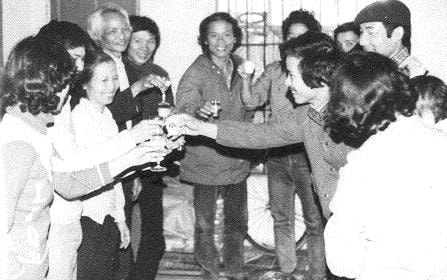 |
Students congratulate Professor Tran Dinh Huou (fourth from the left) on his 60th birthday. |
And in our development strategy, we cannot ignore the importance of understanding, preserving, and promoting national identity. With the keen eye of a researcher and lecturer of Eastern philosophy, Professor Tran Dinh Huou offered profound insights into national culture and cultural identity throughout history, characterized by the overarching features of the rice-farming agricultural community. In this context, human life is governed by family, clan, and village relationships, as well as Confucian ideology and, to a greater extent, Buddhist worldview.
In the current context, many people are discussing the issues of "public awareness" and "national spirit." Since 1993, Professor Tran Dinh Huou has focused on analyzing these two concepts and placing them within the historical context of the nation, from the beginning of the 20th century, through the periods of resistance against the French and Americans, and the period of reform. There were times when our public awareness was not high, but our leaders knew how to unite and foster national spirit, thus achieving miracles of global significance. And he pointed out the relationship between these two concepts: "...we need to deeply understand the lessons of Phan Boi Chau, Phan Chau Trinh, and Ho Chi Minh, three great figures who supported each other in reviving the national spirit of our country to achieve the victory we have today. All three were great personalities. Enlightening the people probably requires erudite minds, a team of talented intellectuals. But revitalizing the national spirit requires "special" people whose personalities have the power to win over and inspire confidence in everyone. Only with national spirit can the people's intellect be fully utilized, and at the same time avoid being shaken by circumstances...". Besides Confucianism, Tran Dinh Huou also paid much attention to Buddhism. Studying from the perspective of thought and ethics, Professor Tran Dinh Huou proposed applying the Buddhist worldview to contemporary life.
Nearly 15 years have passed since Professor Tran Dinh Huou's passing, but his thoughts, anxieties, and even his deep concerns remain and are well worth contemplating and seeking solutions for. In conclusion, I would like to quote Associate Professor Tran Ngoc Vuong, an outstanding student, who wrote about his teacher: "He never put himself in the position of a futurist, yet he was always deeply concerned about the future. It is this attitude towards life that has allowed Tran Dinh Huou, at least until these years, to remain a companion to many intellectuals, and even more so to those who want to live authentically and strive to understand their own lives, to understand 'the life around us'."
Bui Cong Kien