
Flower growers and a new perspective
It can be said that after Vinh City, many other localities such as Thai Hoa and Do Luong are now just as popular in terms of recreational activities...
It can be affirmed that after Vinh City, many localities such as Thai Hoa and Do Luong are now just as passionate about bonsai. Mr. Pham Dinh Thanh, a retired soldier from Block 8, Do Luong town, has also expressed his burning passion for bonsai for several decades. His house, nestled deep in a small alley, is made even more magnificent by the nearly 100 bonsai trees in his garden. His collection includes Lagerstroemia indica, Ficus microcarpa, Ficus microcarpa, and Citrus grandis... Many of the Lagerstroemia indica trees are quite beautiful, with balanced shapes, and according to him, they are worth no less than 30 million dong, with the smallest ones costing a few million.
;)
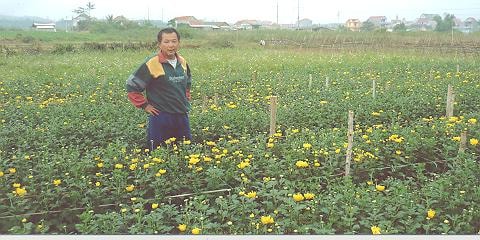 |
Mr. Tran Sy Ngoc's chrysanthemum garden. Photo: Nguyen Minh Thao |
The ornamental plant garden of the Do Luong Town Ornamental Plant Association, with a 2,000 m2 area, also boasts over 200 artistic bonsai trees and thousands of saplings. The garden is managed by four member households under contract. Mr. Tran Duc Quang, Chairman of the Do Luong Town Ornamental Plant Association, stated that many trees in the garden are worth hundreds of millions of dong. Members not only satisfy their passion for bonsai but also earn a significant income of 20 to 40 million dong per year. The chairman himself has a collection of five Ficus microcarpa trees, valued at hundreds of millions of dong.
Meanwhile, at An Luong Farm Production and Service Enterprise, this spring, the rubber tree nursery has nearly 10,000 seedlings, now one year old, that have been grafted and are ready for planting in the spring season to supply the markets of Nghia Dan, Anh Son, and Quy Hop. Nearly 1,000 pepper seedlings, almost 6,000 crape myrtle trees, seasonal flowers, and ornamental plants are also ready for sale. The enterprise recently contributed a significant quantity of ornamental plants such as royal palms, white palms, and purple bauhinia flowers to beautify the green garden urban area of Nam Do Luong town, with a total value of hundreds of millions of dong.
The hobby of growing bonsai trees is a refined and cultured pastime. It is a hobby for those who love beauty, contributing to beautifying family and social life, protecting the ecological environment, and preserving cultural heritage. Unlike in the past, the passion for bonsai tree cultivation has spread to the rich and the poor, those of working age and those who have passed retirement.
When the lives of most people are comfortable, food and clothing are no longer a worry, and especially as Thai Hoa enters its second year celebrating Tet since becoming a town, flower trading has become a cultural tradition of the mountain town's people. Therefore, some people say that "without trade, there is no wealth," and the fastest way to get rich is through Tet flower services.
However, in recent years, alongside flower service providers, many gardeners have realized that starting a new flower and ornamental plant cultivation business is a sure and sustainable way to capitalize on urban development. While in the past people only thought of imported flowers from other provinces like Nhat Tan peach blossoms, Ha Tay kumquats, Nam Dinh, or even Southern yellow apricot blossoms, now mountain peach blossoms, gerbera daisies, chrysanthemums, etc., grown in villages on the outskirts of Thai Hoa town are proving increasingly popular. For most consumers, this is likely because the prices are more affordable than commercially available flowers, and they can buy directly from the gardens, allowing them to choose freely. For producers, there is always a supply of fresh flowers, not only during Tet (Lunar New Year) but also on the 15th and 1st of each month, birthdays, festivals, and the opening of restaurants, hotels, and companies – where there is demand, there is supply. According to the gardening association, Thai Hoa now has about thirty people growing flowers, but very few have long-term experience. One of them is Mr. Tran Si Ngoc in Nghia Thuan, a place considered to have been one of the first to introduce vegetables and flowers into the crop structure during the winter season, which have high economic value. Mr. Ngoc has spent a full 10 years growing flowers through trial and error, learning and finding a suitable and sustainable method. A few years ago, he only specialized in bringing in Da Lat chrysanthemums. He bought seedlings and planted them at the end of September, investing in their care day by day, with both joy and anxiety, because he could have a successful harvest and suffer a great loss. 2006 was a successful year compared to previous years, earning him nearly 100 million VND. However, in 2008, out of 150,000 chrysanthemum seedlings, only 60,000 were sold, bringing in only 28 million VND because the flowers didn't bloom as expected. The reason was that the climate in Da Lat differs from that of Thai Hoa in winter, while the weather in the North is closer to the conditions here. Flower growers today mainly rely on natural conditions and haven't been able to apply scientific advancements to flower cultivation as they do in Da Lat. From this realization, he shifted his focus to bringing flowers from Hanoi. Of the 100,000 chrysanthemum seedlings, over 20,000 were large-flowered chrysanthemums, a type currently popular in the market, and the rest were multi-colored chrysanthemums.
Flower growers also realize a very basic fact: for flower cultivation to be profitable, experience alone is not enough; scientific knowledge is also necessary, from selecting varieties, determining planting seasons, types of fertilizers, using growth stimulants, and making flowers bloom whenever desired. A new aspect for Mr. Ngoc is the need to research the market, constantly monitoring information about flower types and prices at different times, and especially linking production with relationships with distributors in areas like Quynh Luu and Dien Chau. He says, "Eventually, flower cultivation will require collaboration between three or four parties, just like other agricultural commodities."
Luong Mai - Le Dinh