
One afternoon by the sea
The road to Lach Van is fragrant with the scent of the sea – the smell of dried fish, fish sauce, and even from the grilled fish stalls. The women and mothers hurry towards the boat dock. Boats have just returned and are preparing to set sail again. Fishermen from the fishing village are making plans to go out fishing, their voices echoing throughout the estuary.
The road to Lach Van is fragrant with the scent of the sea – the smell of dried fish, fish sauce, and even from the grilled fish stalls. The women and mothers hurry towards the boat dock. Boats have just returned and are preparing to set sail again. Fishermen from the fishing village are making plans to go out fishing, their voices echoing throughout the estuary.
 |
To own a pair of boats like Mr. Chau's, one needs to invest around 300 million dong, mostly borrowed from relatives. The locals here want to build larger boats, but the waterways are impassable. The channels are small and shallow, and with so many boats, getting in and out is difficult. They say this year they are fortunate to receive government support for fuel, which helps offset costs, so all the boats are actively heading out to sea. No one wants to take a break as Tet (Lunar New Year) approaches; so many things need to be prepared, and everything depends on the catch. As the boats prepare to set sail, the shore is bustling with activity as trucks load fuel, ice, charcoal, rice, and vegetables onto the boats. Everything is ready: socks, clothes, pickles, fish sauce, salt... The cold at sea is perhaps only truly understood by those who work as fishermen...
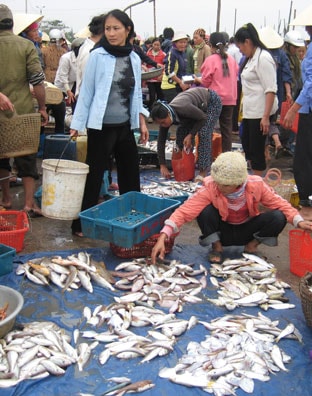
...1 PM at Nam Lach Van wharf. Boats arrived in droves like swallows soaring over the sea. Group after group excitedly docked. These were the boats that had gone out for the day, leaving in the morning and returning in the evening. There were probably two or three hundred boats, all hurrying to find their way into the wharf. Fish were hastily carried ashore. Squid, shrimp, mackerel, scad, and other fresh fish were dumped onto the cement floor. Thousands of people were waiting to buy and select the fish. Everyone wanted to work quickly, to move as fast as possible so that the fish would be as fresh as possible and fetch the best price at the market. Ms. Sau, a woman from Chien Thang hamlet in Dien Bich, excitedly said: "I'm hired to select squid for the owner to send to China, I earn about 60,000 dong a day. There's so much fish this year!" On the wharf and on the boats, the atmosphere was bustling and lively. The fish and squid were steamed and dried on the spot before being distributed to the markets. Fresh shrimp and fish wriggled in the joyful celebration of a bountiful harvest. It was all here! Now I understand why the harbor holds such a special place in my hometown for the people. Now I understand why the sea has captivated generations, its salty waters intertwined with the bustling sounds and pungent aromas of the ocean.
The ship sailed away, leaving behind a deep-seated worry. I realized this as I rode my bicycle with Ms. Thuy, Mr. Chau's wife, back home. Their newly built two-story house was quite spacious. Ms. Thuy said they had saved up for almost ten years to build it. For a young couple like Chau and Thuy, having such a house in the center of Dien Bich commune was a dream come true. The husband was diligent and hardworking, the wife resourceful and thrifty, and their three children were healthy and well-behaved. She invited me to have dinner with her and her children, a hearty meal with fresh fish, meat, and vegetables. She boasted, "That's the fish he caught. He brought back the best ones for us." She recalled their love from their teenage years, filled with countless memories, but she almost lost him once. It was during a storm at sea; he went to lower the sails, and the mast fell overboard. It was dark, and no one on the ship knew. So he kept swimming and swimming until he was exhausted... Luckily, a ship from Thanh Hoa province spotted him and rescued him, bringing him ashore at Quynh Lap. He was unafraid of the sea, and couldn't bear to leave it. Then, thanks to God, his life gradually improved...
Despite the hardships, those who are capable and daring enough to start their own businesses have a comfortable life. Walking through the Ngọc Văn seafood processing village – located in the center of Diễn Bích commune, with its many modern two- and three-story houses with green and red tiled roofs – one can clearly see the increasingly prosperous lives of the coastal people. From the fish they catch, households on shore collect and process them into the famous Vạn Phần fish sauce. Ms. Luận Thụ, a household specializing in fish sauce processing who buys hundreds of tons of fish from fishermen each year, said: "The fish in Lạch Vạn are the freshest, so the fish sauce is fragrant and delicious, selling throughout the North." Many families have become rich quickly. The two hamlets of Hải Đông and Hải
The abundant sea has brought the people of the coastal villages an increasingly prosperous life. The villages of Dien Bich, Kim Thanh, Ngoc... Hai Dong, Ngoc Bich... their names evoke the age-old aspirations of the coastal people, truly precious and beautiful. Generations of fishermen have been deeply grateful to the sea. The men of the fishing villages, like Chau, Hung, and Hoan, have continued the work of their ancestors, preserving a traditional occupation for the village – an occupation that provides livelihoods for many others.
One afternoon by the sea, I felt a warmth in my heart amidst the biting cold of the changing seasons, as the year drew to a close; because I had a moment to live and feel the hardships of making a living, the heartfelt kindness of the fishermen, and the deep gratitude I felt for the sea.
Late Winter 2008
Notes from Chau Lan