

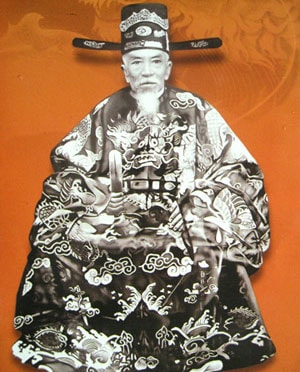
Truong Quoc Dung - A renowned general and great cultural figure.
Truong Quoc Dung isA high-ranking official, possessing both literary and martial talents, he served under the reigns of Minh Mệnh, Thiệu Trị, and Tự Đức. He hailed from Thạch Khê, Thạch Hà, Hà Tĩnh. He was known as a virtuous scholar, a multi-talented intellectual, a scientist, and a skilled general. This book is published with the desire to "express respect and gratitude for a great official renowned for his literary and martial skills."He was a man of complete virtue and talent, a great cultural figure of 19th-century Vietnam.
Part 1. Truong Quoc Dung - his life and career, serves as a brief overview to answer the most common question: Who was Truong Quoc Dung? To convince the reader, the authors have quoted from reputable works of the past, including: Dai Nam Chinh Bien Liet Truyen, volume 29, which details his biography; the National History Institute of the Nguyen Dynasty, which provides a chronological table; and the inscription on Truong Quoc Dung's tombstone at the temple in Thach Khe, which speaks of his contributions.
Therefore, on the one hand, the texts have a concise and succinct writing style, consistent with the thinking and expression of the ancients; on the other hand, they ensure authenticity and highlight the contributions of the talented Truong Quoc Dung.
 |
Part 2: Truong Quoc Dung - Literature and Poetry. In Part 2, the book is divided into three sections: an overview of Truong Quoc Dung's literary works and the inclusion of translated works in both prose and poetry.
The works of Truong Quoc Dung, as well as those of his fathers in general, do not survive to this day, due to time, fires, and wars; most of the writings of prominent figures are not preserved in their entirety.
According to the book-making group, the number of works by Truong Quoc Dung currently includes those written in Chinese characters: Thoai Thuc Ky Van, Truong Nhu Thi Tap, Ban Tau Ve Ve Quy Ky The Troi Thi Thi Dinh, Bai Binh Thi Dinh, Bai Van Suc Khi Thi Hoi, Buc Tu Mat Chinh, Cu Thi Hoi, Bai Van Suc Khi Thi Hoi, Buc Mat Thuc Tuc...; and works in Nom script, mainly in the Ca Tru style: Thu Thuy Cong Truong Thien Nhat Sac; Trung Thu Vong Nguyet, Dong Dao Nguyen; Ky Dong Vinh. In addition, Truong Quoc Dung also participated in proofreading and compiling several valuable books: Chieu Bien Luan Thuc; Luc Tuyen Kim Co Tu Luc Van Sach. Among the aforementioned works, many are of significant value, the most prominent being Thoai Thuc Ky Van.
The "Retreating Realities Chronicle" consists of eight volumes: territory, regime (2 volumes), human dignity, ancient tales, historical events, miscellaneous events, and animal classifications. Currently, only five volumes have been translated. The work is the result of what "one hears and sees, as well as conversations among scholars, down to everyday stories in villages, about the territory of the State, people, things, anything that can be referenced is often recorded on paper" (Truong Quoc Dung). Nguyen Dong Chi, Nguyen Loi, and Hoang Van Lau, in their introduction to the translation, affirmed: "A book written by such a person, from a literary perspective, has inherent value worth preserving." And, search through the works to understand the place names (Ngang Pass, Mother and Child Mountain, Solitary Mountain, Gathering of the Young Man Tower...), the legends (Le Thanh Tong, Nguyen Huy Oanh, Bui Cam Ho...), the names (Cuong Quoc Cong, Tran Nhat Duat, Tran Nguyen Han...), or the conclusions and advice on literature: "Although it is a literary profession, human character is better or worse. (...) Therefore, when writing poetry and prose, one must take gentleness and peace as the main principle and avoid frivolous and indifferent sentences. Practice writing gentle and peaceful sentences so that the spiritual nature is gradually cultivated to perfection; practice writing frivolous and indifferent sentences for a long time so that one becomes accustomed to them and does not know how to find a balanced spirit, and thus one will be further and further away from error."
Part 3. Truong Quoc Dung in the hearts of Vietnamese people past and present, a collection of texts from historical sites, posthumous writings, and contemporary articles. Regarding historical sites and posthumous writings, the compilers have taken couplets, inscriptions, royal decrees, and horizontal and vertical plaques from temples in Thach Khe commune and Quan Dai temple in La Khe (Tien An - Quang Ninh); printed congratulatory banners, royal decrees, and the agreement of Truong Quoc Bao.
Articles about Truong Quoc Dung have appeared quite frequently in various magazines today, especially the Nghe An Culture Magazine, which dedicated an entire issue to commemorating Truong Quoc Dung. This book compiles a comprehensive collection of these articles and adds further contributions. Among them, notable contributions include those by Nguyen Dong Chi, Nguyen Dac Xuan, Tran Van Giap, Hoang Thach Ha, and the Dictionary of Literature (by Do Duc Hieu, Nguyen Hue Chi, Phung Van Tuu, and Tran Huu Ta).
From this, readers gain a certain understanding of Truong Quoc Dung's life and career; at the same time, those who enjoy learning about famous people and talented individuals can have a basis and materials to further explore Truong Quoc Dung's contributions, especially his literary works, as these works are still rarely analyzed and interpreted.
Finally, the book concludes with an appendix titled "Original Chinese Texts," spanning 583 pages... This article simply introduces a valuable book, revealing the deep concern for national peace and prosperity of the rulers, who assisted the king in "governing the people and governing the country"; thereby fostering pride in historical traditions and cultivating patriotism in the modern era.
Nguyen Manh Ha