
Rural market during Tet (Lunar New Year)
As Tet approaches, the feeling of homesickness, after a year of hard work, revives in the hearts of those far from home. It's a joyful, heartwarming feeling, a boundless excitement at returning to relive the atmosphere of the Tet market in their hometown.
As Tet approaches, the feeling of homesickness, after a year of hard work, revives in the hearts of those far from home. It's a joyful, heartwarming feeling, a boundless excitement at returning to relive the atmosphere of the Tet market in their hometown.
The Tet market in my hometown used to be very poor. The rhythmic, rumbling sounds of carts and motorbikes carrying loads of goods, eagerly arriving from the early morning of the 25th and 26th of Tet, remain vivid in my memory.
Some people carry baskets of oranges, tangerines, pomelos, beautiful bunches of betel nuts, bundles of fragrant tea leaves, and fresh roosters that they had been eyeing for months. Then there are the most beautiful and delicious things that the villagers have saved up for so long, all brought out to sell for Tet.
In the final days of the year, people working far from home reunited with their families and hometowns, making the Tet market even more joyful and crowded. Back then, only my village had a large market; not all the surrounding villages had one, so it was packed with people, with buying and selling spilling out onto the nearby village roads and alleys. The market was held outdoors, with many vendors having thatched or bamboo stalls, or, if they were better off, temporary booths. People greeted each other warmly, shaking hands and exchanging pleasantries.
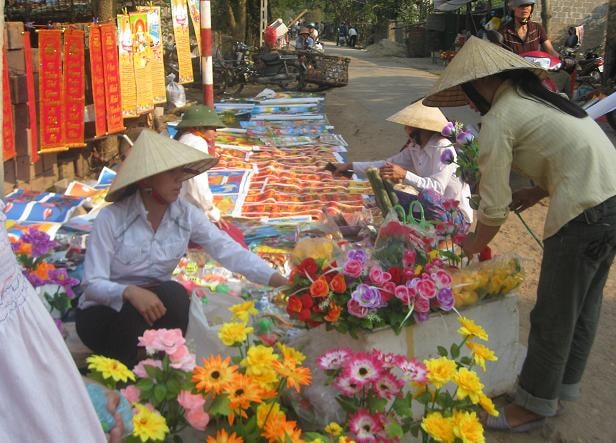 |
Rural market. Photo: Bui Van Dung |
Life is changing, and both urban and rural areas are now "dressed in new clothes." Rural markets are springing up everywhere like mushrooms. From Do Luong district, 28 out of 33 communes and towns now have rural markets, of which nearly 15 have been built with sturdy walls and wholesale stalls, each market covering approximately 10,000 square meters or more.
Some markets, due to meeting the significant demand for the exchange of goods and trade, have now been developed into regional markets such as Thai Son Market, Thuong Son Market, Dai Son Market, Giang Son Dong Market... In the mountainous district of Anh Son, a sense of new energy is gradually emerging from every alley and village... Almost every commune in Anh Son has a rural market. While not as vibrant as in Do Luong in terms of scale and quality, in recent years, the construction of rural markets, despite limited funding, has seen significant progress from the government and local people, with some communes receiving considerable investment in their rural markets...
Crossing the Lam River by ferry to Hung Son, the picture of a region with a struggling economy and poor transportation infrastructure is no longer there. In the past, the people of Hung Son commune had to cross the river by ferry, especially during the Tet holiday when the demand for shopping and selling agricultural products was high, requiring them to travel all the way to the district market, and some even went to neighboring areas to sell wholesale.
Now, Hung Son has received attention from the province and district. In 2005, with funding of nearly 200 million VND, Hung Son market was established with a total area of nearly 500 m2, featuring two wholesale stalls, facilitating the exchange and circulation of groceries and agricultural products for the local people. Since the establishment of the rural market, the people have been relieved of many hardships.
The project relied primarily on contributions from the local people. From this, farmers in Tuong Son and Duc Son communes, as well as people from some ethnic minority groups living in Cam Son district and some neighboring communes, have had another opportunity to open their doors to trade and conduct business during Tet (Lunar New Year).
The markets in Dinh Son, Long Son, and Vinh Son have truly become major trading hubs, contributing to the distribution of goods directly to local communities. In Con Cuong, Tan Ky, and other areas, the landscape has also changed since rural markets and village markets have asserted their new role in the market economy.
The appearance has changed, but the beauty of the countryside remains. That's the beauty of the rural market. Familiar Tet (Lunar New Year) goods can be found in rural markets everywhere. However, each region has its own unique characteristics. The Tet market in my hometown still cannot be without bundles of green tea from Gay, bunches of fragrant, juicy tangerines, bundles of dong leaves, bamboo tubes, and reed tubes. Nowadays, the goods in the rural market during Tet seem to be "poured in" from large trading centers.
Trucks transport goods from Vinh City, Hanoi, and Hai Phong deliver items directly to customers. During Tet (Lunar New Year), the supply increases five to ten times, giving traders, sellers, and buyers plenty of choices. Many stores selling products such as speakers, televisions, electronics, clothing, and confectionery can now adequately supply rural residents during Tet.
Most notably, during holidays and Tet (Vietnamese Lunar New Year), Vietnamese products are almost entirely "prioritized" in rural markets. The majority of people choose Vietnamese-made goods because they are cheaper and more reliable than foreign products. Generally, even when shopping for Tet, goods from Thailand, China, and Laos remain unfamiliar and unappealing to most people in the countryside during this festive season.
Luong Mai