

Nghi Loc used to have the Nam Giao Altar.
Ly Nhat Quang was a renowned general and minister, a talented statesman of the Ly Dynasty. He was the eighth son of King Ly Thai To and dedicated his entire life to Nghe An province, leaving behind a great legacy.
When he was the governor of Nghe An province, he was bestowed the title of Uy Minh Vương by King Ly Thai Tong. After his death, more than 40 temples and shrines in Nghe An province worshipped him as the tutelary deity of the villages. At the Qua Temple, his main place of worship, there is a horizontal plaque inscribed with four large characters: "Nam Thien Thanh Tich" (The sacred relics of the South are preserved).
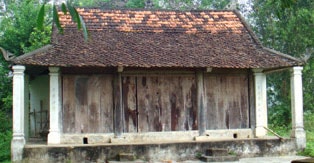 |
The temple dedicated to the Three Deities of Ly Nhat Quang, Nghi Cong Bac commune. |
After the Ly Dynasty replaced the Early Le Dynasty, King Ly Thai To, in the first year of Thuan Thien (1010), decided to move the capital from Hoa Lu (Ninh Binh) to Dai La citadel and renamed it Thang Long. King Ly Thai To focused on consolidating royal power, maintaining peace in the border regions, and building a strong Dai Viet state. The king personally led troops into Chau Hoan and Chau Dien to quell rebellions. Historical records state that in the third year of Thuan Thien (1012): The king personally led troops to attack Dien Chau... In the fourth year of Thien Thanh (1031): The king personally led troops to attack Chau Hoan.
The king sent a trusted prince, Ly Nhat Quang, to govern Chau Hoan and Chau Dien, and renamed the area Nghe An. Phan Huy Chu's book, "Lich Trieu Hien Chuong Loai Chi," writes about Nghe An as follows: In the early Ly dynasty, Hoan Chau was changed to a camp. During the reign of Thai Tong, in the 3rd year of Thien Thanh (1030), it was renamed Nghe An...
The headquarters of Chau Hoan, or the provincial capital of Nghe An during the Ly Dynasty, was located in Bach Duong commune (now part of Do Luong district). Bach Duong was situated on the left bank of the Lam River, stretching approximately 4 km along the inter-village road, from Mieu Duong village down to Luong market (now the communes of Ngoc, Lam, Boi, and Do Luong town). The Bach Duong provincial capital was about 35 km from the East Sea and over 60 km from present-day Vinh city as the crow flies. The Bach Duong provincial capital was also located on the Thuong Dao road (from Thanh Hoa, passing through Nghia Dan, Tan Ky, Do Luong, Anh Son, Con Cuong, Tuong Duong, and Ky Son districts...).
When appointed as the Prefect of Nghe An, Ly Nhat Quang built many warehouses and fortifications to stockpile food and weapons to firmly defend the western and southern borders of Dai Viet. The Dai Viet History Chronicle records: The King went to fight Champa and returned victorious: In the year of Giap Than (Minh Dao), the 3rd year (1044)... in the 8th month, he brought his troops back.
Upon arriving at the Nghệ An headquarters, the king summoned Uy Minh, the Marquis Nhật Quang, to offer him condolences and then bestowed upon him the title of Prince. Previously, the king had entrusted Uy Minh with collecting annual taxes in Nghệ An and ordered the establishment of the Bà Hoà encampment, which strengthened the garrison. He also set up guard posts and ensured sufficient food supplies, all to the king's satisfaction, hence the bestowed title.
From the above historical account, we know that Ly Nhat Quang, appointed as the governor of Nghe An before 1044, made significant contributions to building Nghe An into a strong and secure region with numerous warehouses and fortifications. Therefore, the king promoted him from the rank of marquis to the rank of prince. The king officially bestowed upon Ly Nhat Quang the title of Governor of Nghe An province. When he was given the royal insignia, Uy Minh was given the authority to act on behalf of the king in all matters in the border region of Nghe An, including the power to execute first and report later.
Because Ly Nhat Quang was instrumental in attracting settlers and establishing new villages in the Nghi Loc area, he is also worshipped as the tutelary deity of the village at Tam Toa Temple in Nghi Cong Bac commune, at the foot of Dai Hue mountain. This is one of the eighteen most sacred temples dedicated to Ly Nhat Quang in Nghe An province, as evidenced by the ancient couplet inscribed there:
For four hundred years, the Ly Dynasty has been a majestic imperial dynasty.
One of the eighteen temples of Hoan district, the magnificent royal spirit.
Temporary translation:
The Ly Dynasty, four hundred years old, still boasts a renowned imperial lineage.
The eighteen temples of Chau Hoan are all revered as sacred shrines dedicated to the illustrious King.
Ly Nhat Quang actively recruited people to develop the land of 2 communes: Hai Do and Nguyet Tinh; and 7 villages: Da Phuc, Lo Tuong, Phuong Lai, Truyen Thon, Nguyet Tinh, Xuan Hoa, and Kieu Moc (now belonging to Nghi Cong Bac and Nghi Cong Nam communes) into a base to support the administrative center at Bach Ngoc.
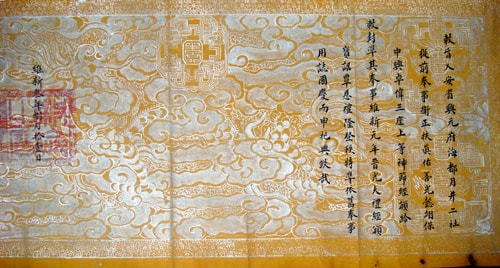 |
Royal Decree conferring the title of "Three Supreme Deities" (by Ly Nhat Quang) |
This base, also known as Nha Ba Camp (locally called Bai Nha Ba, possibly named after the benevolent woman who assisted Ly Nhat Quang in building the Bach Duong administrative center and throughout his career in developing Nghe An province?), was one of the vast areas with dense forests at the foot of the Dai Hue mountain range, very favorable for building a base to conceal troops and protect the southeast of the Bach Duong administrative center via the Gia An - Truong Soi route. From this base, it was possible to quickly send reinforcements to the Cua Lo, Cua Hoi, Cua Van coastal areas and the bustling port center of Xuan Giang, and the Vinh Phong (Vinh) warehouses.
To further secure the base, Ly Nhat Quang recruited people to establish seven villages in this area, so after his death, a temple was built here. The temple is very sacred, so it was bestowed the title of Supreme God and Great King by successive dynasties. The deity's title: Tam Toa Huu Quoc Li Trieu Dinh Quy Minh Vuong Trac Vi Thuong Thuong Dang Dai Vuong Ton Than Vi.
Every three years, on the 15th day of the 3rd lunar month, the procession and opening of the sacred relics; the welcoming ceremony (commemoration ceremony on the 17th day of the 12th lunar month); and the 15th day of the 6th lunar month (Nam Giao sacrifice ceremony) are held at the temple in a very solemn and sacred manner, with the participation of a large number of local people.
Because the temple is an international temple (worshipped by the state) and located in the sacred land of Nghe An province (with fragrant springs flowing down from the Dai Hue mountain range), it was also chosen as the venue for the Nam Giao Ceremony (the Ceremony to Worship Heaven and Earth). The temple's historical records state: In ancient times, the king held the Nam Giao ceremony every three years to worship heaven and earth. Our Holy Three-Treasures was a royal figure, hence this ceremony. After his death, the villagers still believed the king was alive, so they set up an altar in Bai Gia An. He wore his royal robes to worship heaven and earth.
Content and Method of the Nam Giao Sacrifice Ceremony: Seven days before the grand ceremony, the people of the seven villages gather to discuss and agree on the program and plan, from preparation to the content and steps of the ceremony... The people of the villages compete to buy new and beautiful flags, palanquins, swords, and ceremonial tokens; they write documents, petitions, and compile lists of young men to perform tasks such as carrying palanquins, carrying sacrificial objects, and the eight treasures... and elect a presiding committee to conduct the ceremony. Those assigned to these tasks are notified seven days in advance so that they can observe a vegetarian diet, and men and women must maintain distance from each other to ensure purity and solemnity on the day of the ceremony.
People from all over gathered for the ceremony, waiting in line from the evening before until throughout the night and into the following morning, anticipating the arrival of the King's palanquin for a very solemn and dignified ritual.
Throughout that night, seven villages organized folk games: the elderly played card games like "to tom" and chess... The young people played on swings, hopscotch, wrestling, bottle-throwing, cockfighting, and singing call-and-response songs... Goods for sale included betel leaves, tobacco, dried cakes, rice cakes, and sweet potato cakes... Candles illuminated the entire Gia An area, creating a lively atmosphere in this normally quiet and peaceful mountainous region.
The sacrificial altar is set up with offerings placed outside a shrine, including black wine, three-stream water, and high-mountain soil, each in a bowl, wrapped in yellow paper, along with yellow wax. In the center of the three-animal offering, a gong is on the left, a drum on the right, and in front are swords, daggers, and dragon tablets, and the five-element flag, all erected in that direction.
After the seven villages' dragon palanquins had gathered at Gia An field, the dignitaries and elders prepared the procedures to begin the Nam Giao ceremony. The steps of the ceremony were as follows: The most beautiful palanquin (called the eight-sided palanquin) was selected and carried into the temple to bring the Holy Three-Armed Deity, namely Lord Uy Minh Vuong Ly Nhat Quang, dressed in his royal robe and crown, out to Gia An field for the Nam Giao ceremony, praying for peace and blessings for the local people in the town and villages. After the ceremony, the people carried the deity's effigy back to the temple, and then the villages joyfully carried their own palanquins back home.
The Nam Giao Prayer (tentative translation as follows):
"Respectfully submitted: According to custom, the Nam Giao ceremony is held every three years. From ancient times, the dynasties have established rituals, with offerings made in June. That day is a grand ceremony, and according to custom, an altar is erected early in the morning to venerate the Saint, the abode of Vietnam. The people of the two villages (Nguyet Tinh and Hai Do) are ready at the altar, waiting to receive the sacred tablet and imperial decree to perform the ceremony. They pray for abundant and lasting blessings, especially prosperity, good fortune, calm seas, and a bright, beautiful moon. We, the people, respectfully request to erect a shrine and altar to respectfully worship Heaven and Earth, and the sacred spirits. Respectfully submitted!"
"The five-directional deities, the divine spirits of the two villages, the civil and military officials on the left and right, the local dragon god, the heavenly soldiers, and all the warriors are worshipped together."
Thus, from the Ly Dynasty, when Ly Nhat Quang was the Prefect of Nghe An, he chose Nghi Loc land, in what is now Nghi Cong commune, to perform the Nam Giao sacrifice and established the Nam Giao altar (sacrificing to heaven and earth) every three years. The altar was established here (on the sacred Dai Hue mountain), hence the place name Thien Phuc village (heavenly blessing), later changed to Da Phuc village (abundant blessing), with the land of the highest peak (Dai Hue) used as the sacrificial ground and the fragrant water from the three springs flowing down from Dai Hue mountain used as the sacrificial water (as recorded in the sacrificial text). This is a very important discovery in the atmosphere of our entire nation looking forward to the Grand Celebration of the 1,000th anniversary of Thang Long - Hanoi history.
Dao Tam Tinh