

Written from the top of the floodwaters in Central Vietnam.
Driven by the desire to write about the exemplary journalists who tirelessly served on the front lines of disaster relief, I closely followed every issue of Nghe An, Quan Doi Nhan Dan, Lao Dong, Tien Phong, and Tuoi Tre newspapers... From September 31st to October 13th, 2010, Lao Dong newspaper used 15 feature articles and reports, and 34 news items and photos by journalists Thanh Hai, Ha Binh, Giao Huong, and Pham Viet Thang.
The People's Army Newspaper published 17 articles and over 40 news items and photos on the topics of rescuing people, saving property, and hydroelectric projects. These articles almost entirely occupied prominent positions on the front page, with frequent appearances by authors such as Tran Hoai, Phan Anh, Duy Minh, Trung Kien, Thanh Hai, Ha Binh... and the journalist who stayed the longest in the flooded area was still Tran Hoai.
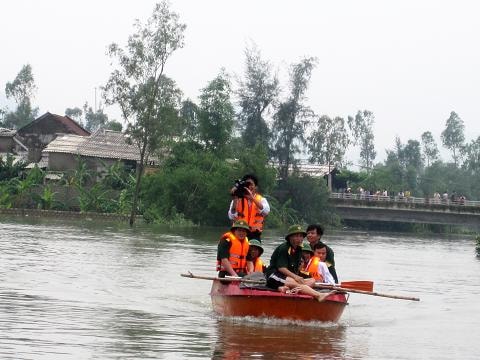 |
Reporters working in the flooded area - Photo: PV |
The core of each author's article is the struggle to rescue people submerged by the devastating floods in the communes of Tan Hoa, Thuong Hoa, Van Hoa, Son Trach, and Huong Khe. The key figures in the articles are the officers and soldiers of Unit C68, Battalion B24, Binh Long Battalion, and the Border Guard Squadrons of Ha Tinh, Quang Binh, and Nghe An; and six farmers in Son Trach and Xuan Son who, while their homes and belongings were swept away by the floodwaters, steered a tourist boat to rescue 300 elderly people, children, and women who were panicking and clinging to rooftops and treetops, struggling against the roaring, ever-rising floodwaters.
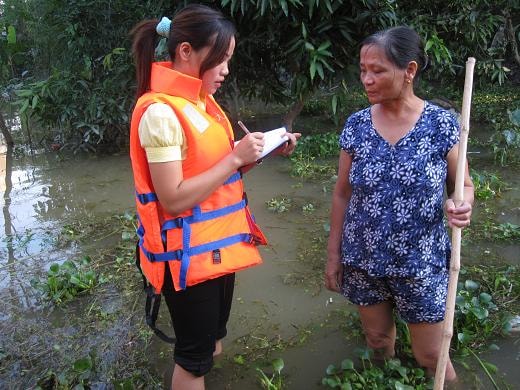
The individuals featured in the report "Eighteen Communes Escape the Great Flood" by journalists Ha Binh and Tat Thang, published on page one of the October 5th issue of the Lao Dong newspaper, are officers and soldiers of the Huong Khe Military Command, Military Region 4.
From the night of October 3rd to the early morning of October 4th, rescue forces, undeterred by hunger and cold, guarded the Ho Ho irrigation dam, which was in danger of collapsing. They found solutions to protect the dam and save thousands of lives by using generators to open the two floodgates that were blocked by earth, rocks, and trees that had buried the 35-kilovolt transformer station.
 |
The article served as a message that not only eased the anxieties of the leaders but also alleviated the deep-seated worries of those far from home in Phuc Trach (Ha Tinh), Huong Hoa (Quang Binh), and more than ten other communes located downstream of the dam, which had exceeded its capacity of over 40 million cubic meters of water.
The strength of the Lao Dong newspaper lies in its investigative reporting. Perhaps that's why articles like "Chaos After the Flood," "Heartbreak in Huong Khe," "Heartbreaking Plight of People in the Flood," "From the Flood-stricken Heart of Quang Binh," and "Lower Than...Mud" by journalists Ha Binh, Pham Viet Thang, and Thanh Hai have evoked emotion, empathy, and shared the loss, bitterness, and hardship of the people in the flooded areas in millions of hearts both domestically and internationally.
We must not have visited Len Voi area, Tan Hoa commune, Minh Hoa district, where more than 300 households took refuge from the flood, suffering from hunger and disease, and having to gather dry leaves to use as blankets for nearly 7 days. We must not have visited Thuong Hoa commune (Minh Hoa), where 700 Ruc people were isolated and had to dig up forest roots and cut banana leaves to build makeshift shelters.
Without asking the people in the flooded areas, "What do you need now, sir?", and receiving a weak reply, "I'm craving salt and rice so much, sir." Without going to the southern region of the Gianh River, where water blankets the fields and beaches, and where people drown or die from disease, their bodies left to wait for the water to recede for burial... how can one create persuasive content in their writings?
Journalists like Thanh Hai and Le Phi, upon encountering the precarious and impoverished plight of Mrs. Tran Thi Thao, a widow raising three children in a dilapidated house in Van Hoa commune, were overcome with emotion. They dug into their pockets the last of their money saved for the trip and handed it directly to Luong Viet Hung, urging him to try his best to attend university.
The series of articles published by the People's Army Newspaper, such as "The People's Pillar of Support," "Where Hardship Comes, the Army Is There," "Helping People Alleviate Their Suffering," and "Humanity Shines Brighter in Calamity," also contributed to building trust among the people in overcoming the floods.
All the essential elements—emotions, courage—are necessary for a journalist. If they only stopped at the indifferent and superficial "No," how could journalists at Lao Dong, Quan Doi Nhan Dan, and Tien Phong newspapers have produced articles that deeply moved millions of readers during the historic floods in early October, which caused nearly 300 billion VND in damage and resulted in 86 deaths and disappearances?
It wasn't until October 19th, after the floodwaters had receded, leaving behind scenes of terrible devastation in Bo Trach, Tuyen Hoa, Son Trach (Quang Binh), Huong Khe, Can Loc, Duc Tho (Ha Tinh), Hung Nguyen, Nghi Loc (Nghe An), that the C68 and B24 units of the 4th Military Region rushed back into the battle to clean up the environment, rebuild houses for the people, and clean up schools so that the children could return to school.
A reporter from the People's Army Newspaper called me with a brief message: "The editorial office has ordered the team of reporters stationed in Quang Binh to only withdraw from their position when the army has completed its flood relief efforts." He added, his voice hoarse, that he was with the People's Army Newspaper team delivering relief supplies to the flood-affected people in Son Trach. Looking south, where the sky was still heavy with water, my heart grew even more for my colleagues following in the footsteps of the relief team!
Van Hien