
My mother has become an immortal monument!
Every year on the anniversary of her children's deaths, or on Lunar New Year, or on War Invalids' Day, that mother lights nine candles, nine incense sticks, arranges nine bowls and nine pairs of chopsticks on a round tray, and silently calls out to her children. Seeing the photo "Waiting for My Children to Come Home" in the magazine, I cried.
(Baonghean)Every year on the anniversary of her children's deaths, or on Lunar New Year, or on War Invalids' Day, that mother lights nine candles, nine incense sticks, arranges nine bowls and nine pairs of chopsticks on a round tray, and silently calls out to her children. Seeing the photo "Waiting for My Children to Come Home" in the magazine, I cried.
Years later, although I no longer remember the name of the photographer, the image of Mother Nguyen Thi Thu, a Vietnamese Heroic Mother, in that photograph remains deeply etched in the minds of many. Her skin is etched with the wrinkles of time, her hands clutch the portrait of one of her nine sons who was a martyr, her heart burdened with the pain she has endured throughout her life, and I guess the soldier in the frame is probably only in his early twenties…
He wore a soft cap with military insignia, his mother sat motionless beside the meal, her hands still clutching his photograph. In the center of the table sat an incense burner, its smoke rising profusely. Surrounding the incense burner were nine white porcelain bowls, each with a pair of wooden chopsticks resting across it…
In "Waiting for My Son to Return," at the very heart of Mother Thu, the concept of time from decades ago seems to have fossilized; she patiently waits for her children. And even though tears have spilled onto the dinner table countless times, she lives with unwavering faith: Her children will forever remain as youthful as the day they set off to defend the country. The photograph captures a moment of silence within the long, drawn-out silence of Mother Thu's loss and sacrifice.
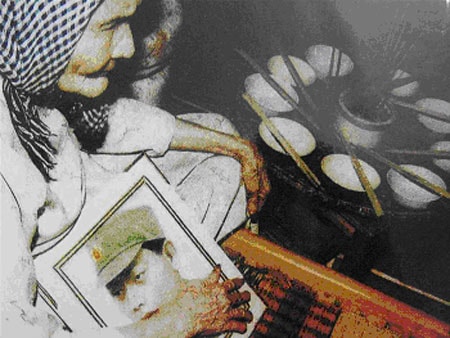 |
Waiting for my child to come home. |
That silence refuses to fade away; it grows ever larger in the minds of millions of Vietnamese people, across generations, who live, work, and increasingly prosper on the very land where tens of thousands of sons and daughters have perished, including nine of Mother Vietnam's sons. That silence is so vast that it encompasses all the immeasurable losses and sacrifices of Mother Vietnam. Beyond a news photograph depicting a real-life example, "Waiting for My Son to Return" has accomplished the task of "condensing the ocean into a bottle" to express what lies hidden deep beneath the surface: Every war, though long over, leaves behind a profound and lingering loss and suffering.
Inspired by the photograph, Mother Thu returned to Thanh Quyt 2 village (Dien Thang Trung commune, Dien Ban district, Quang Nam province, a place of unwavering courage and resilience), to continue living life to the fullest with the unwavering belief, "Waiting for my children to return." And on December 10, 2010 (the 5th day of the 11th lunar month of the Year of the Tiger), Mother's children returned amidst the fragrant smoke of incense to bid farewell to their great Mother as she departed to the eternal realm, at the venerable age of 107. Hundreds of newspapers, magazines, and media outlets reported on Mother's passing.
The memorial service and farewell ceremony for Mother took place in the "courageous and resilient" land of Quang Nam, and quickly spread to countless events among millions of Vietnamese hearts living both inside and outside the country. Mother's life is a prime example of countless heroic and tragic notes, notes that make up the epic of national defense written by the entire nation with blood and sacrifice throughout the 30 years of the 20th century. In that glorious national defense, Mother Thu dedicated nine of her children, one son-in-law, and two grandchildren to the independence and freedom of the Fatherland. Her immense sacrifice has become a model for the 5,797 Vietnamese Heroic Mothers of Quang Nam province, and for nearly 50,000 Vietnamese Heroic Mothers nationwide.
Mother Thu was born in 1904 in Dien Thang Trung commune, Dien Ban district (a district with 1,081 Vietnamese Heroic Mothers). During the two resistance wars, her garden contained five secret tunnels. Every day, Mother and her eldest daughter, Le Thi Tri, sheltered cadres, soldiers, and guerrillas. To deceive the enemy, the two of them would graze their cattle above the tunnels. When there was any disturbance, they would pretend to go to the garden to tend to the cattle, thus camouflaging and protecting the tunnels. When the enemy withdrew from the village, Mother would slightly open the tunnel lids to let in air so that her comrades could breathe more easily.
During the resistance against the French, four of Mother's sons joined the National Guard and the guerrilla militia. Within four months of 1948, Mother received news of the deaths of three of her sons: Le Tu Xuyen died on June 18th, Le Tu Han (the elder brother) died on October 5th, and Le Tu Han (the younger brother) died on October 15th, 1948. Le Tu Lem died on April 1st, 1954.
Swallowing back her tears, Mother continued to encourage her six grown children to join the nation in the resistance against the Americans to defend the country. Her children fought in many areas of the South, the impregnable fortress of the Fatherland. Then, Mother had to receive death notices for her children, enduring the suffering of the remaining flesh and blood of her bodies destroyed by war: Le Tu Nu died on September 5, 1966; Le Tu Muoi died on April 14, 1972; Le Tu Trinh died on September 12, 1972; Le Tu Thinh died on August 28, 1974; Le Tu Chuyen died on the historic April 30, 1975; and her son-in-law Ngo Tuong died in 1957, and her two granddaughters Ngo Thi Dieu died in 1970 and Ngo Thi Cuc died in 1973.
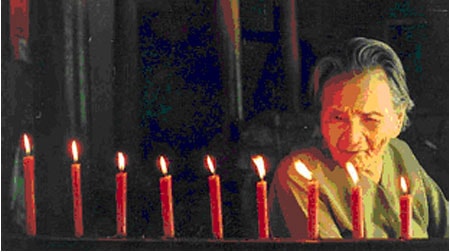 |
A photograph of my mother. |
Thirty years, two wars, eleven times sending off sons and grandsons to fight, and each time, Mother Thu wept silently. Is there any country in the world like Vietnam, my homeland? Two wars of resistance ended decades ago, yet so many mothers still bear the burden of immeasurable pain, like Mother Thu, like Mother Pham Thi Ngu, residing in Ham Hiep commune, Ham Thuan district, Binh Thuan province, whose eight sons are martyrs, and who herself is a Hero of the People's Armed Forces.
Mother Tran Thi Mit, from Hai Phu commune, Hai Lang district, Quang Tri province, has 9 children who are martyrs. Mother Nguyen Thi Ranh, residing in Truc Den hamlet, Phuoc Hiep commune, Cu Chi district, Ho Chi Minh City, has 8 children who are martyrs, and she herself is a Hero of the People's Armed Forces. Mother Le Thi Tu, from Thanh Quyt hamlet, Dien Thang commune, Dien Ban district, Quang Nam province, has 9 children who are martyrs. Mother Pham Thi Khanh, from Hon Dat, Kien Giang province, has 7 children who are martyrs…
There are so many more mothers quietly living in their homeland, their extraordinary hearts continuing to beat for the noble cause for which their children and grandchildren have dedicated their entire lives. Living quietly with extraordinary strength, sacrifice, and endurance, their lives will become legends for future generations.
Although birth, aging, sickness, and death are the harsh and unavoidable laws of nature, the news of Mother Thu's passing brought sorrow and tears to millions of Vietnamese hearts. On December 17, 1994, the President and the National Assembly of the Socialist Republic of Vietnam solemnly bestowed upon Mother Thu the title of Heroic Vietnamese Mother; the nation and people decided to choose her likeness as the model for the Monument to Heroic Vietnamese Mothers—a symbol of Vietnamese women who are "resilient, indomitable, loyal, and capable"—to be forever preserved for future generations. Inspired by Mother Thu's life, artist Nguyen Long Bieu sculpted a statue of Heroic Vietnamese Mother Nguyen Thi Thu using sandstone. Along with the statue, erected in the grounds of the Vietnam Military History Museum, Mother Thu's copper pot, which she used daily to cook rice and boil water for her husband, children, and soldiers and guerrillas during the resistance against the US, is also proudly displayed at the museum.
In 2007, on the occasion of the 60th anniversary of the War Invalids and Martyrs Day, sculptor Dinh Gia Thang created the Monument to the Heroic Vietnamese Mother, modeled after Mother Thu. On November 16, 2007, the Prime Minister issued a decision to include the monument in the list of national cultural works. On July 27, 2009, on the occasion of the 62nd anniversary of the War Invalids and Martyrs Day, the Quang Nam provincial government held a groundbreaking ceremony for the construction of the Monument to the Heroic Vietnamese Mother. The monument complex is erected on the summit of Cam Mountain, in Phu Thach hamlet, Tam Phu commune, Tam Ky city, Quang Nam province. The statue is made of sandstone, 18.5m high, 84.7m wide, and 117m wide along the curve. In the center of the monument is a portrait of Mother Thu, 18m high.
In front of the Monument is a forecourt with 30 lawns symbolizing the 30 years of the two protracted resistance wars. This is the largest Monument to the Heroic Mother of Vietnam in the country, chosen from the sketches of artist Dinh Gia Thang and architect Nguyen Luan, with the idea: Mother is an inexhaustible source, the soul of the nation. Mother was born from the heroic land, then gave birth to heroic children, and will again be transformed into the land and mountains of Vietnam. Mother will live forever, continuing to provide a powerful source of strength for younger generations in the cause of building and protecting the Fatherland.
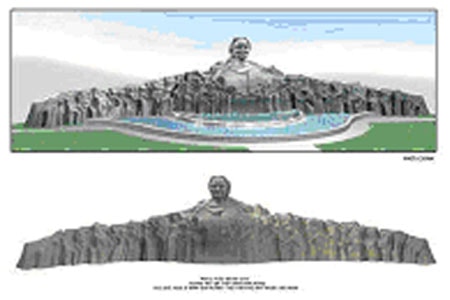 |
Mother transformed into an immortal monument. |
The monument complex consists of eight legendary pillars, each 9 meters high and with an average diameter of over 1.2 meters, made of sandstone, inscribed with the contributions of more than 46,000 Vietnamese Heroic Mothers from across the country. Inside the monument is the Memorial House for Vietnamese Heroic Mothers, covering an area of 400 square meters, including an exhibition room, a reception room, and a preservation area showcasing images, lives, and contributions of the Mothers to the Fatherland and the people. On either side of the monument are two 600 square meter flowerbeds featuring various motifs and colors representing the 54 ethnic groups living in Vietnam.
***
Mother Thu's life is a prime example of the unbearable loss and suffering endured by mothers in my homeland of Central Vietnam during the war of national liberation. It is also a prime example of noble sacrifice and the yearning for freedom and happiness of a heroic nation. Mother Thu's life was not eternal like that of many others, but her great life has become immortal, transformed into a monument in the heart of the nation and its people.
Diocese