
2010-2011 harvest season: High sugar prices, sugarcane shortage.
High sugar prices, high sugarcane prices, but a shortage of sugarcane, failing to meet the full capacity of the factories. In addition, sugarcane grassy shoot disease and many other diseases are devastating the sugarcane crop... causing the vast sugarcane growing area of our province to shrink...
High sugar prices, high sugarcane prices, but a shortage of sugarcane, failing to meet the full capacity of the factories. In addition, sugarcane grassy shoot disease and many other diseases are devastating the sugarcane crop... causing the vast sugarcane growing area of our province to shrink...
National Highway 48, the section passing by the NAT&L Sugar Factory, is bustling with trucks carrying sugarcane to the factory. The factory is nearing the end of the crushing season, but the atmosphere is one of urgency and speed. At the side gate, hundreds of trucks loaded with sugarcane are waiting their turn to unload.
Currently, the selling price of sugar at the factory is 20,000 VND/kg. Sugar demand exceeds supply in the world market, and sugar from the NAT & L factory is even more expensive due to its high quality and extensive trade network. To date, the factory has processed 385,000 tons of sugarcane, but the more they process, the more regrettable it becomes because of the high sugar prices and the shortage of sugarcane, with capacity operating at only about half.
In the 2009-2010 crushing season, the sugarcane area was 14,661 hectares, and the amount of sugarcane delivered to the factory reached 783,350 tons. This year's crushing season is estimated at 435,500 tons. The factory's production target of 1 million tons of sugarcane (achieved since 2007) has been steadily declining. Sugarcane is already scarce, and competition for it is further reducing the amount delivered to the factory.
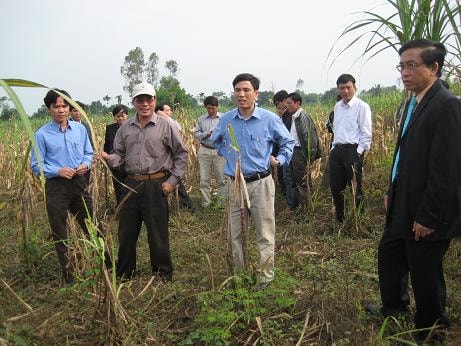 |
Officials from the Department of Agriculture and Rural Development inspect the situation of sugarcane grassy shoot disease in Quy Hop. |
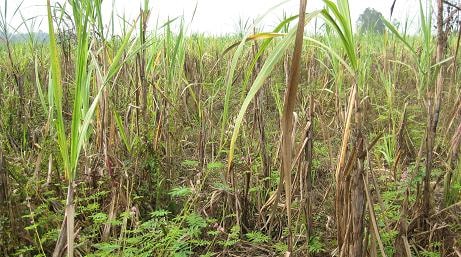
Mr. Ngo Van Tu, Director of Agriculture at NAT & L Sugar Factory, stated: "The area under sugarcane cultivation has been steadily decreasing in recent years, partly due to 3,000 hectares being reclassified for grass cultivation, and partly due to competition from cassava. However, the most challenging issue in the Phu Qui region is sugarcane mosaic disease—a viral disease that remains incurable—causing a severe shortage of both sugarcane for consumption and for seed production. If all the harvested sugarcane is sold to the factory, there will be no seeds left for planting; if sugarcane is used for seed, the yield will be low. This is a major concern for many farmers."
Mr. Le Van Sang, head of Dong Tam hamlet, Nghia Lien commune, Nghia Dan district, said while harvesting sugarcane: "Dong Tam hamlet has 50 households growing sugarcane. In 2008, we had 32 hectares of sugarcane, in 2009 it was 28 hectares, and this year's crushing season, the hamlet still has 24 hectares. Dong Tam has been growing sugarcane for decades, but the area of sugarcane has decreased because people have switched to growing cassava."
The sugarcane growing area belonging to Song Lam Sugarcane Joint Stock Company, as planned by the province, includes a total of 1700 hectares, of which 1300 hectares are for annual sugarcane cultivation. The sugarcane area is mainly concentrated in Anh Son district, covering 1000 hectares, including the Thanh-Binh-Tho area, Hoa Son commune, the October Tea Factory, and the Con Cuong area (approximately 300 hectares).
In particular, some dynamic mechanisms such as investment in free fertilizer and seeds for sugarcane areas with yields of 75 tons or more and high-lying rice fields have encouraged farmers to boldly switch to sugarcane cultivation. The policy of providing 100% sugarcane seeds to new growers in particularly difficult areas by the October Tea Enterprise, along with a subsidy of 4.3 million VND per hectare for new planting, has also been implemented. In some key areas such as Thanh - Binh - Tho (Anh Son), farmers have actively converted areas of low-yield peanut, bean, and rice cultivation to sugarcane. In Thanh Son and Binh Son alone, the land available for sugarcane cultivation is almost fully utilized; in Binh Son and Tho Son communes, farmers have increased the area of sugarcane cultivation to over 500 hectares.
 |
However, in the Song Lam sugarcane growing area, the annual sugarcane acreage and production have decreased compared to the planned targets. According to the factory's report, from the 2008-2009 crop year to the present, sugarcane processing has only reached 2/3 of the designed capacity. Sugarcane yield, which was previously 51-53 tons/ha, decreased to 50 tons/ha from the 2008 crop year onwards. Currently, in the 2010-2011 crushing crop year, sugarcane yield is 43 tons/ha.
Currently, high labor costs for harvesting sugarcane, high prices of supplies, and high prices of sugarcane seedlings are major obstacles hindering sugarcane farmers. According to Mr. Le Van Sang from Dong Tam hamlet, Nghia Lien commune, Nghia Dan district, although sugarcane prices are high, with factories buying it at 9 million VND/ton at the field, the profit per hectare is only about 25 million VND if the yield reaches 60 tons/hectare.
A yield of 70 tons/hectare generates approximately 30-32 million VND/hectare. Currently, rubber prices are at their highest (90 million VND/ton of crep (processed rubber)), meaning one hectare of rubber can yield nearly one ton of crep per year. The dynamism of local farmers in diversifying crops and livestock, and proactively managing product consumption, also presents a challenge for the NAT&L Sugar Factory.
Another household complained: Although the factory provides farmers with loans to invest in sugarcane cultivation, they still have to pay interest, so the profit is minimal. The NAT &L sugar factory also buys sugarcane at a lower price than other factories, so farmers sell a significant amount outside the region. For example, in Nghia Dan, over 20% of the sugarcane delivered to the Song Con sugar factory this crushing season.
The Song Con sugar factory seized the opportunity, buying sugarcane from the Phu Qui area at a higher price of 10.5 million VND/ton. While the outcome is uncertain, it has caused considerable disruption in this raw material area. This situation has been ongoing for a long time, leading to a situation where, despite many communes and households signing contracts with NAT & L, they only supply a certain amount of sugarcane. For example, they might sign for 50 tons/hectare, but in reality, they produce 60 to 80 tons/hectare, selling the surplus to other sugar factories for a profit. This remains an unresolved problem for NAT & L.
For many years, although farmers have benefited greatly from sugarcane, their profits have not been commensurate with the enormous profits of the factories. This situation has led to the continued practice of planting sugarcane and then cutting it down. Farmers in Phu Qui, Nghia Dan, Tan Ky, etc., remain loyal to sugarcane, but as Mr. Sang from Nghia Lien said: "Those who are not loyal benefit more because they sell their sugarcane elsewhere for a higher price, while we who adhere to the contract suffer losses."
Addressing the root cause of sugarcane grassy shoot disease, implementing a reasonable and flexible purchasing and pricing mechanism, comprehensive policies covering all sugarcane growers (previously, policies only focused on large contract holders), and a dedicated agricultural team closely connected to the fields and sugarcane farmers... these are essential solutions for making sugarcane a strong brand in Nghe An.
Chau Lan - Luong Mai