
Protecting aquatic resources is a community responsibility.
Currently, due to the development of fishing vessels and unsustainable exploitation, aquatic resources are increasingly depleted, resulting in low economic efficiency and directly affecting the livelihoods of tens of thousands of fishermen.
(Baonghean.vn)Currently, due to the development of fishing vessels and unsustainable exploitation, aquatic resources are increasingly depleted, resulting in low economic efficiency and directly affecting the livelihoods of tens of thousands of fishermen.
At the Nghi Thuy ward fishing port in Cua Lo town, we witnessed Mr. Binh's boat returning after a fishing trip. Today, his fleet caught nearly 7 tons of various fish, considered a successful trip, but the crew was still unhappy because more than half of the catch was only used as animal feed, sold at a low price of only a few thousand dong per kilogram. Ms. Nguyen Thi Minh, one of the fish buyers at the Nghi Thuy fishing port, said: Every day she buys about 10 tons of fish, of which about 6 tons are supplied to animal feed processing facilities. High-value fish species like mackerel, scad, and barracuda are becoming increasingly scarce.
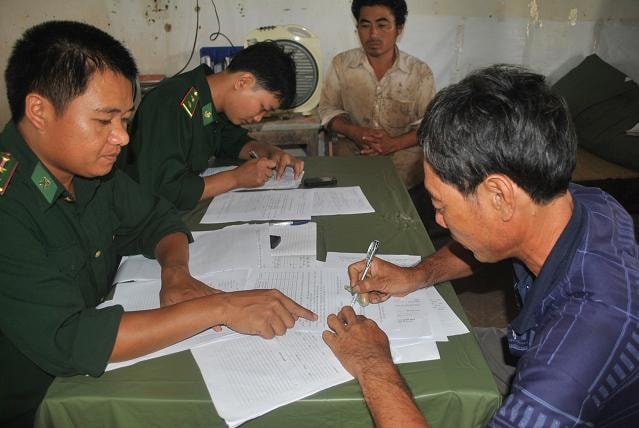
Officers from Border Guard Post 148 drew up a report on the violation of using electric shock devices to catch aquatic products on October 23, 2011.
Mr. Nguyen Van Ke, Chairman of the Fisheries Association of Tien Thuy commune, Quynh Luu district, said: In the first nine months of the year, the commune harvested 9,000 tons of products, exceeding the set plan, but the target for product value was not met. The production of some export products such as tuna and squid has seriously decreased... High-value fish species like mackerel and scad are becoming increasingly scarce. Not to mention crabs and lobsters, which used to be abundant, but are now rare. Mr. Ke also added that species like sea snakes and seahorses are so rare that you can't find a single one even after searching for seven days. Some common species like krill and shrimp are also absent this year, forcing many people to switch professions... These figures show that aquatic resources are seriously declining.
The primary reason is overfishing. In recent years, the catch has exceeded 50,000 tons (more than 10,000 tons over the permitted limit). Furthermore, the province currently has 4,323 fishing vessels, nearly half of which are equipped with engines smaller than 20 horsepower. These vessels operate only in coastal and offshore areas. Regarding the industry structure, the province has approximately 650-700 vessels engaged in trawling. This is a highly detrimental practice that the industry advises against developing. Nghe An has two spawning grounds for fish and shrimp in Dien Chau and Quynh Lap bays. Because most vessels concentrate their fishing near the shore, and fail to comply with regulations from the Fisheries sector such as mesh size and fishing gear type, the majority of the harvested fish are underage. This explains why 50-60% of the harvested seafood is of low value.
The use of explosives and electric shocks is becoming increasingly common. Speaking with us, Mr. Tran Duy Thanh, Commander of Border Guard Post 148, said: The post is tasked with controlling two waterways with over 900 fishing vessels. Most of these vessels use explosives for fishing. Due to the sophisticated methods of transportation and concealment, despite increased inspection and control measures, boat owners still manage to bring explosives out to sea. The post has organized numerous special operations and stakeouts lasting for months, but without success. Regarding the harmful effects of landmines, Mr. Thanh shared: A single landmine explosion can cause casualties within an area of tens of square meters of water.
All living things in that area were destroyed. The number of fish recovered is estimated to be only about 1/10. Since the beginning of the year, the station has detected and handled 43 violations, collecting 157 million VND for the State Treasury. A typical example is the arrest of Ho Xuan Phuong in Hamlet 7, Quynh Xuan, for transporting 6 kg of explosives and 70 detonators on May 23rd. This is only a very small fraction of the violations detected by the station. Mr. Nguyen Van Ke, Chairman of the Tien Thuy Fisheries Association, also acknowledged that fishermen in his commune are still using explosives to exploit marine resources. And without them, they cannot go to sea, Mr. Ke affirmed with certainty.
Following explosives, electric shock devices are now quite commonly used by people in Tinh Gia district, Thanh Hoa province, for fishing in the waters off Nghe An province. On October 23, the Vietnamese fisheries patrol vessel VN 93969 KN, in coordination with border guards, patrolled the waters north of Nghe An and discovered and seized 8 vessels using electric shock devices to harvest seafood... Explosives, electric shocks, and toxic substances are strictly prohibited in accordance with Directive 01 of the Prime Minister.
Given the signs of decline in coastal fisheries resources, on October 10, 2011, the Provincial People's Committee issued Directive 26/CT-UBND to strengthen the protection of fisheries resources. The Directive also outlined the responsibilities of various sectors and localities, as well as the tasks of relevant agencies... Accordingly, protecting fisheries resources must be the responsibility of the entire community.
To strengthen measures to protect aquatic resources, the People's Committee of Nghe An province recently signed an agreement with the People's Committee of Thanh Hoa province to divide fishing areas in each province to enhance responsibility for protection. Since 2008, with the assistance of the government...
The project focused on providing vocational training to 100% of the fishermen in Quynh Lap. With the support of the project, the fishermen here have focused on changing their occupations. Previously, fishing with nets and seines near the shore was the main occupation, but now they have focused on shifting to offshore fishing. From 35 offshore vessels, by 2011 the entire commune had 120 boats capable of going offshore, using new fishing methods such as gillnets, crabbing nets, and 4-pole and 2-pole trawls... only 20 vessels remained fishing in inshore areas.
Because individual responsibility is fostered in relation to the benefits they receive, awareness of protecting aquatic resources has been raised. People view the sea areas allocated to them as their "family land," so they have strengthened all measures to protect them and prevent others from encroaching. As a result, aquatic resources are increasing, and the lives of the people are becoming more secure.
To implement Directive 26 of the Provincial People's Committee, based on the results of the co-management model in Quynh Lap, the Department of Agriculture and Rural Development will soon work with coastal localities to organize consultations to delineate boundaries between districts and communes to enhance shared responsibility for protection and exploitation, linked to community interests. A unified management mechanism will be established to improve the effectiveness of protecting aquatic resources.
Cong Sang