
Management and use of plant protection products: Many shortcomings
According to the Department of Preventive Medicine, pesticide poisoning is one of the top ten causes of death in hospitals, second only to hypertension, lung disease, and traffic accidents. Besides farmers underestimating the dangers of pesticides to human health, the management of pesticide sales by relevant authorities remains inadequate.
(Baonghean)According to the Department of Preventive Medicine, pesticide poisoning is one of the top ten causes of death in hospitals, second only to hypertension, lung disease, and traffic accidents. Besides farmers underestimating the dangers of pesticides to human health, the management of pesticide sales by relevant authorities remains inadequate.
Pesticides - "A double-edged sword"
Ms. Bui Thi Thuy Hong (Dien Lien - Dien Chau) candidly stated: "Whenever my rice crop is infested with pests, I go to the pesticide store, tell them what kind of pest is affecting it, and take the pesticide they sell me. If there are many pests, I mix more pesticide to kill them quickly."
This is a very worrying situation in the agricultural production areas of our province today. According to Mr. Trinh Thach Lam, Head of the Plant Protection Department (Provincial Plant Protection Sub-Department): Although plant protection officers have made many efforts to advise farmers on the safe use of pesticides, in most localities, the improper use of pesticides is still widespread. This not only negatively impacts the environment and reduces the effectiveness of pesticides but also directly affects the health of users and the community.
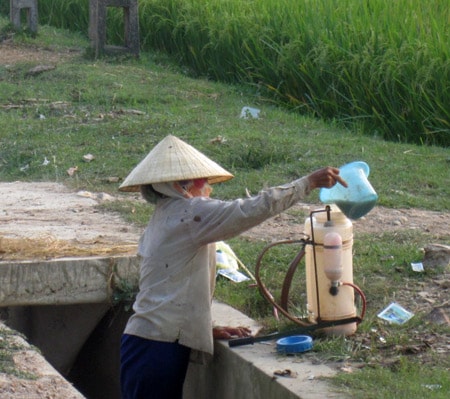
Farmers have not paid enough attention to protecting their health when using pesticides.
According to recommendations, to maximize the effectiveness of pesticides and ensure the health and safety of users, spraying must adhere to the "four correct principles": the right type, the right dosage, the right method, and especially the right time. However, in reality, most of these recommendations are not taken seriously by farmers. Correct spraying is a "prerequisite" for achieving effective results. Farmers must know the specific pests and diseases to be eradicated in order to choose pesticides that are specifically targeted. Only then will the spray be highly effective, minimizing negative impacts on human health, the environment, and beneficial natural enemies in the fields. Yet, in practice, very few farmers follow this recommendation. Common mistakes include farmers "conveniently" mixing in other growth stimulants based on the "advertisements" of sellers, sometimes containing 3-4 different types of pesticides in a single sprayer. Regarding specific pesticides, farmers mostly rely on the sellers rather than following the recommendations of the agricultural sector. Ms. Cao Thi Dao (Dien Lien - Dien Chau) said: "Even though we've received training, the pesticide packaging is all in foreign languages, and there are so many types that I can't remember them all. After the announcements from the commune's loudspeaker, I just vaguely remember them and then go to the dealer and tell them what pesticide they give me, and I buy whatever they offer."
Another common mistake is that people spray pesticides incorrectly, not following the recommended dosage and concentration. Most mix less pesticide and water than required, but some increase the amount and concentration. These errors reduce the effectiveness of the spraying, cause pests to develop resistance, and have a very negative impact on the environment. Proper and timely spraying is also largely neglected by farmers. The Director of the Department of Agriculture and Rural Development, Mr. Nguyen Tho Canh, expressed concern: "It's very common for farmers to only spray when pests have already caused severe damage. Besides that, many people spray incorrectly, not paying attention to the methods of damage caused by each type of pest, so the pesticide doesn't come into contact with the pests' habitats, resulting in very low effectiveness. This is not to mention the 'team' of hired sprayers with poor sense of responsibility."
Particularly dangerous is the failure of people to properly implement protective measures. According to regulations, those spraying pesticides must have raincoats, gloves, boots, masks, goggles, and hats. However, in reality, only the most cautious people have raincoats and masks, thus they may inhale or have pesticides adhering to their bodies, immediately causing acute poisoning, fatigue, dizziness, headaches, and, more dangerously, long-term health problems, even cancer.
Currently, there are 3,146 pesticide products on the market. With such a wide variety of products, farmers find it very difficult to choose a quality product. Meanwhile, according to surveys by relevant authorities, no farmers have field diaries to record the growth stages of rice, the use of fertilizers, and specific pesticides. Most farmers simply buy whatever pesticides the local authorities sell, and if the spraying is ineffective, they buy more and spray again.
Lax management in the pesticide business.
Mr. Nguyen Xuan Binh, Head of the Plant Quarantine Department (Provincial Plant Protection Sub-Department), frankly admitted: The management of pesticide business activities in our province faces many difficulties and shortcomings. The number of organizations and individuals trading in these products is quite large, the number of pesticides on the permitted list is very high, while the number of specialized personnel responsible for managing pesticide business is too small, inevitably leading to an inability to manage everything!
According to statistics from the Plant Protection Department, there are currently nearly 600 licensed pesticide dealers in the province, not including a significant number of seasonal "dealers" that are currently difficult for authorities to manage and supervise. Regulations stipulate that to obtain a pesticide business license, traders must meet strict conditions such as: completing training courses, having warehouses, stalls, or shops that meet requirements, and being located far from densely populated areas and water sources. However, in reality, most pesticide dealers are located within residential areas, posing potential harm to the environment and human health.
According to a report by the Plant Protection Department of Nghe An province, in the first six months of this year, out of 229 organizations and individuals trading in plant protection products that were inspected, 99 units were found to be in violation. Of these, 86 organizations and individuals received warnings or had their business suspended due to violations such as not having a professional license, violations regarding labels and packaging, etc. Alarmingly, 15 types of pesticides were found to be of unknown origin or past their expiration date. These pesticides are commonly found among households that buy them for seasonal sale, where sellers lack knowledge, cannot read the full names of the pesticides, and may even sell the wrong product.
According to Mr. Nguyen Van Lap, Deputy Director of the Nghe An Department of Agriculture and Rural Development: Through inspections, the practice of people "selling" pesticides alongside veterinary medicine at grocery stalls in markets or at veterinary medicine dealerships still persists. This situation, in addition to the responsibility of the Plant Protection sector, requires close management from local authorities, along with public awareness campaigns to guide people to buy pesticides according to recommendations and from licensed dealerships with the knowledge to advise on the correct type of pesticide to use. Mr. Nguyen Xuan Binh acknowledged: "Through inspections, the inspection team has fined several households selling pesticides alongside veterinary medicine in Nam Dan district." However, it is evident that these inspections and penalties are merely like "throwing stones into a pond," because with such a small force and a vast area, managing all the minor violations among the people is extremely difficult without close coordination and supervision from local authorities from the village level upwards.
To put an end to violations of regulations in the pesticide business, it is necessary to have more coordinated and regular cooperation between the agricultural sector and other functional agencies such as market management, police, and local authorities.
Plant protection experts advise farmers to use a pesticide usage manual, choose reputable manufacturers and dealers, and select high-quality pesticides. If farmers do not conduct thorough investigations or bring disease samples to reputable suppliers, the pesticides used will be ineffective. |
Phu Huong