

Numerous violations occurred during the construction process.
The Student Housing Project, also known as the Duc Loc Student Village Project, is built on a 2.26-hectare campus and is therefore represented by Nghe An College of Education as the investor. This is one of five social housing projects for students and low-income individuals in Nghe An province.
(Baonghean.vn)The Student Housing Project, also known as the Duc Loc Student Village Project, is built on a 2.26-hectare campus and is therefore represented by Nghe An College of Education as the investor. This is one of five social housing projects for students and low-income individuals in Nghe An province.
According to the approved documents, the Duc Loc Student Village project has a total investment of 70.3 billion VND, mobilized from government bonds, including 5 five-story student dormitories and 3 two-story buildings housing a student cafeteria, a student clubhouse, a service and medical building, grounds, sports fields, and a water supply and drainage system.
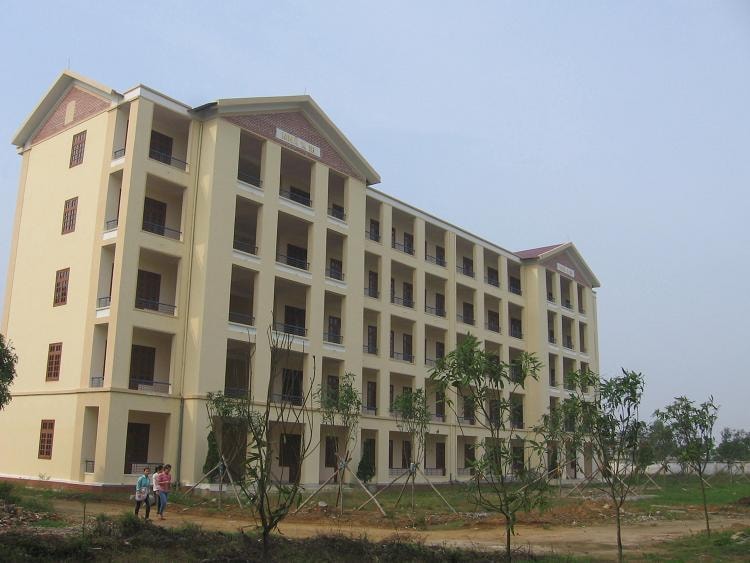
The dormitory buildings of Nghe An Teacher Training College have been completed but are not yet in use..Photo: My Ha
The total floor area is 34,137 m2, including 13,965 m2 of five-story residential buildings, 705 m2 of cafeteria, 588 m2 of clubhouse, 189 m2 of student service building, 198 m2 of infirmary, and 18,690 m2 of sports facilities. According to the approved plan, these projects were to be implemented in 2009-2010 to provide accommodation for 3,000 students.
Therefore, the Duc Loc Student Village project not only serves the accommodation needs of students from Nghe An Teacher Training College (which is scheduled to be upgraded to a university by 2015), but in the long term, it will also provide accommodation for students from other colleges and vocational schools in Nghi Duc and Hung Loc communes.
The project was awarded through a direct bidding process, and Song Hong Corporation was selected as the contractor. Construction began in October 2009, with the five-story buildings scheduled for completion in 2011. However, many items remain unfinished due to the extremely slow progress. As of early October 2011, only buildings K1A and K1B were completed but not yet inspected, building K2B was nearing completion, building K2B had reached the fifth floor, and building K2C had not yet begun construction.
It has been found that, in addition to objective reasons such as the K2C building being cut back according to Government Resolution 11 or being affected by weather conditions, rotating power outages, etc., the main cause of the delay lies with the construction contractor.
The aforementioned errors and violations were clearly identified by internal monitoring and consulting supervisors during the construction supervision process, with many items and quantities being violated. Specifically, according to the consultant's report dated March 27, 2010, regarding the quality, quantity, and progress of the K2A dormitory building project, the contractor lacked construction methods, the workforce allocation did not meet the requirements of the bid documents, construction staff on site did not closely monitor the site, worked irresponsibly, and the site layout and storage areas were not properly arranged.
On the other hand, during the construction of the first-floor pillars, the contractor made several mistakes in the installation of the first-floor column reinforcement; some deviations from the design were found, such as insufficient spacing of floor slab reinforcement in some areas, insufficient reinforcement in beams in frames K1, K2, and K3; and excessive rusting of the reinforcement.
On November 18, 2010, the periodic report of the supervisory consultant of the Project Management Board for Civil and Urban Infrastructure Construction Projects regarding the K2A building stated that: the contractor's construction methods did not meet the technical requirements of the project and did not comply with the proposed documents; the construction organization and personnel allocation were not in accordance with the proposed documents and the contract with the Investor (technical and operational staff did not match the contractor's proposed documents). In addition to the lack of a site manager and on-site technical supervisor, a series of other specialized tasks such as architecture, quantity surveying, electrical work, water supply and drainage, and site surveying lacked assigned personnel; the number of construction workers was also insufficient and did not match the project documents.
One year after the commencement of construction, in October 2010, the Department of Construction conducted an inspection of several social housing projects, including the housing project at Nghe An College of Education. The inspection concluded (Notice of Conclusion No. 1622/SXD.KT dated October 5, 2010) that several shortcomings and violations existed, such as: the investor and project management and supervision consulting organizations contracting with project management consultants who lacked the necessary qualifications; construction contracts with contractors lacking the necessary capacity and not conforming to the provincial People's Committee's approval when awarding contracts; payment settlements to contractors before meeting the required conditions; slow construction progress; and numerous errors in supervision and acceptance during the project, requiring repairs and remediation, thus delaying the project.
Currently, although the K1A and K2A buildings, worth 20 billion VND, have been completed, they cannot be put into use because the acceptance and handover procedures have not been finalized.
Mr. Tran Anh Tuan, Vice Principal of the school representing the project investor, stated that the above issues had been addressed in writing by the school's management board and the supervisory consultant, but the contractor was slow to rectify them. In fact, at times, there were signs of neglect of construction, with insufficient and inappropriate manpower allocation; failure to keep construction logs for many days; and failure to complete quality documentation according to procedures, leading to significant delays in construction and handover compared to the contract. Furthermore, the rectification and procedures for reimbursement and disbursement of funds for 2011 were still very slow.
To expedite the project and bring it into use as originally intended, the College of Education recently sent a letter to the contractor, Song Hong Joint Stock Company (a subsidiary of Song Hong Corporation), requesting them to complete the acceptance documents for the completed works. Otherwise, the remaining funds will be transferred to implement other items, and the College will not be responsible for the delayed disbursement.
Phuong Ha