

Lesson 1: Scattered Foam
Recently, residents in some resettlement areas of the Ban Ve Hydropower Plant have left their new homes to return to their old residences in the reservoir area of the Ban Ve Hydropower Plant in Tuong Duong district. Furthermore, although the Ban Ve Hydropower Plant has officially been generating electricity for over a year, nearly 50 households in the reservoir area have yet to relocate... The lives of these people are chaotic, precarious, and fraught with danger.
(Baonghean)Recently, residents in some resettlement areas of the Ban Ve Hydropower Plant have left their new homes to return to their old residences in the reservoir area of the Ban Ve Hydropower Plant in Tuong Duong district. Furthermore, although the Ban Ve Hydropower Plant has officially been generating electricity for over a year, nearly 50 households in the reservoir area have yet to relocate... The lives of these people are chaotic, precarious, and fraught with danger.
From the upstream dock of the hydroelectric dam, we boarded a motorboat and traveled upstream on the Nam Non River, deep into the heart of Ban Ve Lake. The small boat, with six people on board, swayed precariously as it cut through the green water, leaving behind two rows of white foam. The boat driver, Luong Van Thang, said that reaching the nearest village slated for relocation was 40 km by river, taking 1 hour and 30 minutes by boat. He had previously transported many people from villages relocated from the lake, and recently he had been transporting many more back.
The village of Xop Lam (formerly part of Huu Duong commune) slowly emerged from the mist, with more than 20 stilt houses with dark, decaying thatched roofs nestled at the foot of the mountain slope, at the edge of the lake. Some slopes had recently collapsed due to heavy rains, revealing red soil like a wound… The first challenge Xop Lam presented us was navigating through floating raft houses and dilapidated, moss-covered wooden boats anchored in front of the village. Stepping out of the boat and crossing the muddy area, we reached the village. Adults sat inside their houses looking out, while the children played on the floor. Ngan Van Oanh, 40 years old, a Thai man, invited us to visit his home and explained: Following the government's policy, his family moved out of the lake to Cha Lanh village, Tri Le commune, Que Phong district to settle. However, in their new home, partly due to an inability to adapt to the way of life and a lack of arable land, his family faced many difficulties. Unable to find a livelihood, Mr. Oanh brought his whole family back to their old land to live. They've been back here for almost two years. Every day, the family clears the land for farming, fishes, and the children stay at home. This harvest season, Mr. Oanh sowed 7 kg of seeds in his fields. Oanh compares the situation: across the road, the houses are better, the children get an education, but the parents suffer because they can't earn enough to eat. Here, it's easier to find rice and food. The lake has plenty of fish; they can catch 20-30 kg of fish each day to exchange for rice and sell. But the surrounding area is vast, the children can't go to school; they have to treat illnesses themselves. He doesn't know how to plan for the children's education. But either way, he has to choose one... Joining the conversation, Mr. Oanh's son-in-law, Luong Van Huong, 29 years old, said: "Living by the lake like this is very dangerous, but at least we can earn a living. We don't know how to make money in the new place. The whole family still prefers it and wants to stay here..."
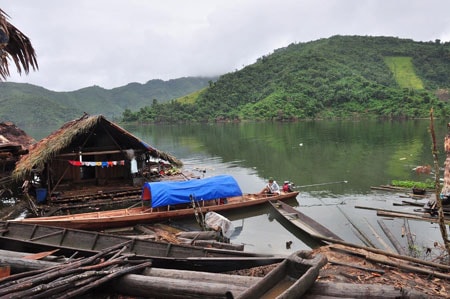
The boat landing of residents who left the resettlement area and returned to the lake.
in Xop Lam village.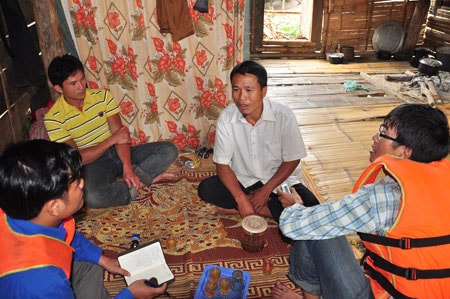
Reporters from Nghe An Newspaper interviewed residents in Xop Lam village.
After saying goodbye to Mr. Ngan Van Oanh's family, we continued our journey climbing the slippery, muddy hillside to Mr. Kha Van Tinh's house. Taking deep drags of his pipe, Mr. Tinh explained that his family was similar to Mr. Oanh's, having migrated to Que Phong at their own request. His two children had dropped out of school. There were four mouths to feed, but the new place had no land for farming; the area for wet rice cultivation was small, and they were unfamiliar with the work. The compensation money had been spent and wasn't enough to buy land in Que Phong, so his whole family returned to their old village. First, to make a living, where the vast mountains and forests offered plenty of space for clearing land; second, to wait for government compensation for his family's agricultural land – he couldn't remember exactly whether it was 3 or 4 hectares. Mr. Tinh added: "When we returned here, officials from the district and Huu Khuong commune came to visit and offer encouragement. All the people from Xop Lam village who migrated to Que Phong at their own request have now returned here."
"Previously, Xop Lam village had 25 households, but now over 13 have brought all their members back; some others have left their children and houses with relatives in their new homes while they return to Tuong Duong to work," said Luong Van Thy, 47, from Xop Lam village. "My family migrated to Yen Khe commune, Con Cuong district. The compensation from the government helped me buy a house and enough land for production and a decent living. But to have money for my two children to study at university and college, my wife and I returned to the reservoir area to work more; my elderly parents look after our house and fields in Con Cuong. In Xop Lam, Mr. Thy salvaged driftwood, cut bamboo to build a floating house; bought a motorboat to transport passengers and cultivated some land." Mr. Thy revealed: "Life in the new place is indeed difficult at first, but if you are diligent and learn from others, life will be stable." The families who spoke to the journalist weren't telling the truth: They said that because they wanted to come here so much, but in reality, farming and fishing here aren't profitable. Rice and fish are only enough to eat; there's no way they'll get dozens of kilograms a day... On Luong Van Thy's floating house, we met Luong Thanh Minh (Thy's nephew, from Xop Lam village, Thanh Son commune, Thanh Chuong district, who was visiting). Minh recounted life in his new home: "We have to strictly follow the government's policies. If we don't have enough money for relocation and settling down, we borrow from relatives and pay it back later, all for the benefit of the country." In the new location, electricity, roads, schools, and social infrastructure are much more convenient, but the difficulties mentioned by the villagers are real: First, the difficulty of changing production methods from slash-and-burn agriculture to wet rice cultivation; land is limited, unlike the land of the past, so farming and livestock raising are difficult. The family didn't receive their land when it was handed over because they were away. Down there, he works as a hired laborer, cutting acacia trees, planting cassava, and growing tea to make ends meet, but if the weather is unfavorable and he can't work, the whole family goes hungry. No one in Xop Lam village in Thanh Chuong has rice paddies as promised. However, some villagers have adapted to the new way of doing business and become wealthy, even buying cars. This time, if Minh returns and finds things profitable, he'll leave his children in Thanh Chuong to study, while he himself comes back here to farm, fish, and... burn the forest.
The surface of Bản Vẽ Lake after the rain is covered with countless floating branches and tree stumps. The lives of those who were relocated and have now returned to Xốp Lằm village, Tương Dương district, are similarly chaotic: makeshift houses, children unable to attend school, no electricity or clean water, and a life fraught with danger. In the event of natural disasters, timely relief is impossible due to the deeply isolated and fragmented terrain. They live in clustered houses, caring for each other, not belonging to any community, meaning they do not receive the amenities and support of society as a whole. "Settling down and establishing a livelihood"—a segment of the relocated residents of Xốp Lằm village returning to their old homes has taken the wrong path, leading them into a dead end...
Tran Hai - Thanh Chung - Cong Kien