

Warships "made in Vietnam"
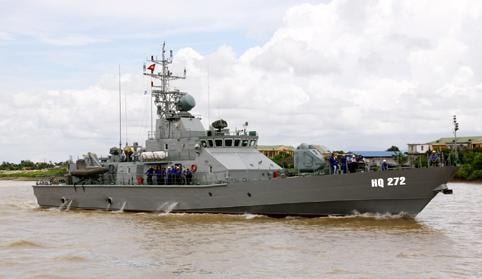
At the end of September 2011, the TT400TP gunboat was officially and successfully inspected at the dock of Hong Ha Shipbuilding Company (also known as Z173 Factory, Hai Phong City). This is the first gunboat manufactured in Vietnam.
On the morning of September 27th, Colonel Nguyen Van Dac, political commissar of the shipyard, received a phone call: "Reporting to the political commissar, all weapon systems and equipment on the ship have been tested and hit their targets."
The political commissar's eyes welled up with tears of happiness. It was just a very brief message, but it was the moment that thousands of cadres, engineers, and workers of the factory had been waiting for for so many years.
The colonel recounted: "Foreign experts were surprised, saying that in their countries, they had to conduct test firings several times, then readjust the shots to hit the target accurately. But the ships built by the Vietnamese only needed one test firing to achieve perfect accuracy."
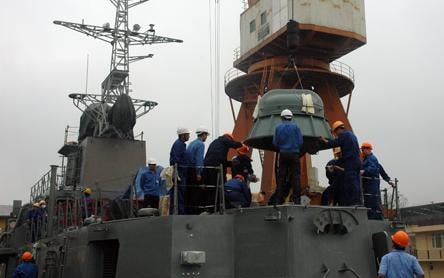
The TT400TP gunboat is currently having its weapons installed by Vietnamese engineers and workers.
Photo: Provided by Z173 Factory
A breakthrough turning point
Seven years ago, upon assuming the position of director of the Z173 Shipyard, Colonel Nguyen Van Cuong was constantly grappling with the question: should we build warships domestically or buy them? This was a matter of great national importance. If we bought, should we buy new ships, or purchase all the materials and then transfer the technology, allowing foreign experts to come and guide us on how to build them? Or should we just buy the preliminary design, utilize the existing workforce and domestic experts, send people abroad for training, and then build them ourselves?
Some data on the TT400TP gunboat. |
"If we bought the design and technology transfer, the price of each ship would be over $10 million! Buying preliminary design drawings only costs a few hundred thousand dollars, while we handle the technology design ourselves. Then, the production cost of a ship will be much cheaper, only around $1 million, saving 90%!" - Mr. Cuong explained.
Colonel Cuong observed: "People are the most important. Previously, we successfully built the TT400 coast guard vessel, also purchasing preliminary designs from abroad. So why can't we build warships? Why don't we dare to take a path that no one else has dared to think of, a path we dare to take, when we have so many talented people?"
Hundreds of Z173's best engineers were sent to academies and trained abroad for over three years to prepare for this historic project. The Z173 factory leadership proactively negotiated with foreign partners, independently purchased preliminary designs, and then presented reports demonstrating to the investor (the Navy) and the Ministry of Defense that Z173 was certain to build warships.
On April 22, 2009, the TT400TP vessel had its keel laid. Colonel Le Van Thuoc, Deputy Director of Engineering, stated: “The TT400TP was built using a new global method of constructing individual modules (each module is designed and equipped with almost complete components, then simply craned, connected, and assembled into a whole new module). Therefore, prefabricated equipment can be brought in beforehand, resulting in faster progress and higher accuracy. However, the transition from the traditional shipbuilding method to the modular system represents a significant technological leap in shipbuilding. Achieving this requires skilled personnel and specialized tools.”
And it was none other than the engineers of Factory Z173 who successfully designed on computers which components needed to be prioritized and which needed to be prioritized... The factory's officers and engineers also collaborated with experts at domestic research institutes to apply advanced software to implement the entire technological design, design systems in three-dimensional space, and use software for projection and transformation...
According to Colonel Bui Duy Chinh, head of the technical department, the most difficult part was designing the detailed technology for the construction of the ship and the installation of weapons. For the ship, the engineers had to solve a problem with many unknowns: how to minimize the ship's resistance and displacement while maintaining constant engine power to achieve optimal speed. To find the answer to this challenging problem, the factory's engineers had to stay up almost all night for many nights.
Silent drops of sweat
Colonel Nguyen Van Dac said: “To date, the skill level of engineers and workers has improved dramatically. We hope that by the third TT400TP gunboat, we will be able to be completely self-reliant in all aspects of shipbuilding technology.”
To achieve that pride, there are countless simple yet touching stories about the great love for their work shown by the engineers and workers during the construction and production of the TT400TP gunboat. Mr. Dac vividly remembers the image of a slender and pretty female welder diligently working with a loaf of bread and a bottle of water. If she stopped working, she would forget and make a mistake because a single connector has hundreds of tiny solder points.
As for Major Nguyen Van Tiep, the foreman of the weapons and equipment workshop, since receiving the weapons and equipment for the TT400TP ship, he has been so worried that he couldn't sleep, suffered from hypoglycemia, and had to receive intravenous fluids several times. Many nights, unable to sleep until 3 or 4 in the morning, the engineer would take out the blueprints to study the installation plan for the weapons and equipment system.
“He worked so hard he forgot about meals, even during months when the temperature in the tightly sealed hold reached 37-38°C,” Mr. Dac recounted. Major Tiep said simply, “For us, TT400TP is not just a job, but a great source of pride and a great responsibility to our country.”
And the result of those silent but immense efforts: in August 2011, the first "flesh and blood" TT400TP gunboat appeared, much to the emotion of thousands of officers, engineers, and workers at Factory Z173.
Colonel Cao Hoa Binh (Head of the Naval Engineering Department): Enhancing the combat strength of the Vietnamese Navy.
However, the results were highly appreciated by the acceptance councils at all levels. The technical and aesthetic aspects of the TT400TP gunboat are of high quality, and the technical specifications are in accordance with the design. The TT400TP will contribute to increasing the combat strength of the Vietnamese navy, and most importantly, Vietnam has gradually mastered the technology of warship construction, creating a proactive position in ensuring technical support, equipment, vehicles, and weapons to serve national defense and security, protect maritime sovereignty, and develop the marine economy. |
According to Tuoi Tre newspaper