

The dream of literacy in the highlands of the border region.
(Baonghean) - The boarding houses are perched precariously on the mountainside, clustered together in a circle. Each hut is constructed from...
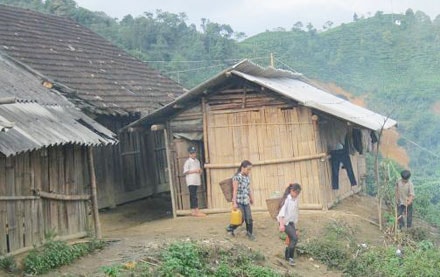
(Baonghean)The boarding houses are perched precariously on the mountainside, clustered together in a circle. Each hut is constructed from planks of wood, with a breezy roof, allowing the wind to carry a chill that penetrates the skin. But despite all this, the children persevere in their pursuit of literacy in the remote border region of Nghe An.
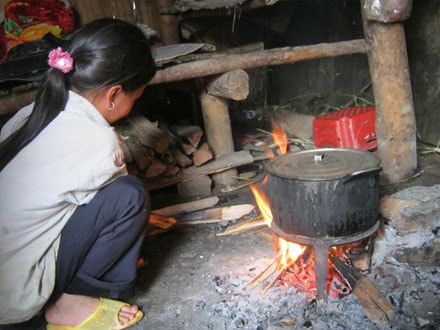
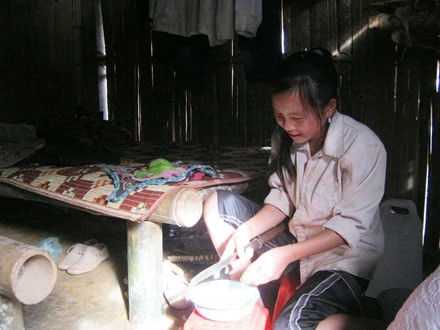
In a simple, makeshift boarding tent, Vu Chong Kan (a 6th-grade student at Huoi Tu Ethnic Boarding Junior High School in Ky Son district) is diligently cooking dinner.“What are you having for dinner tonight?” I asked. “Just vegetables and bamboo shoots,” Kàn replied, his eyes still fixed on the rice pot. Looking around, I saw piles of firewood stacked around the tiny shack. The blackened pots, some missing lids, some dented, were Kàn’s most valuable possessions. On the tattered mat, faded notebooks lay scattered along with a worn-out blanket. Kàn’s house was nearly 10 kilometers from the school along a mountain road, a journey of over three hours. Only on weekends did Kàn return home to bring rice and a little food that his parents had painstakingly saved for the whole week.
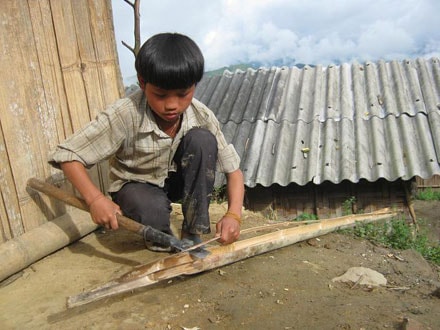
In the hut next door, brothers Lau Ba Lun and Lau Ba Leng had just returned from fetching water from the stream. If I hadn't asked, I probably wouldn't have been able to tell the difference between the older and younger brother. Small and dark-skinned, Lau Ba Leng explained: Because their family is poor, their parents only give them a little over 3 kilograms of rice and over 100,000 dong a week. They take turns going home to get food and money each week. But during the lean months, the amount of rice their parents provide is even less. To have food each day, the two brothers have to go into the forest to pick bamboo shoots and vegetables. "With such hardship, do you have the strength to study?" I asked. Lau Ba Lun smiled and replied, "We're not afraid of hunger, we're only afraid of not being able to learn to read and write."
Not only Kan and the two brothers Lun and Leng, but more than 200 boarding students here still don't want to give up their dream of education, even though the path to it is full of difficulties. Sharing with us, teacher Trinh Thi Nguyet from Huoi Tu Ethnic Boarding Secondary School said: "Most of the families of the boarding students here are poor households, so the students' living and studying conditions are very difficult. But they are very eager to learn and have a strong will to study."
To improve the quality of learning, since 2008, Huoi Tu Ethnic Boarding Junior High School has initiated a night-time study program for its students. Every day at 7:30 PM, a generator (Huoi Tu commune does not yet have grid electricity) provides power, and students flock to the classrooms, filling them to receive guidance from their teachers on their homework. Sharing about this initiative, Mr. Nguyen Van Truong, the school principal, said: “Seeing that the students lacked electricity to study at night, the school, together with the commune government, mobilized residents to contribute to buying a generator to provide electricity. With electricity, the students can study better, and the teachers have less difficulty teaching new lessons. As a result, the quality of their learning has improved significantly.”
For many years now, the percentage of students from Huoi Tu commune admitted to universities and colleges has been steadily increasing. In 2010, seven students from Huoi Tu commune were admitted to prestigious universities. A prime example is Vu Ba Trung, who was admitted to the University of Transport (Ho Chi Minh City) last year. It is known that Trung's family is among the poorest in the village, but he still strived to excel in his studies and achieved high results in the recent university entrance exam.
Huoi Tu is one of the poorest and most disadvantaged communes in the mountainous district of Ky Son (with a poverty rate exceeding 80%). The commune has over 1,376 students across three levels of education (junior high, primary, and kindergarten), including 440 junior high school students, most of whom live far from school and therefore have to stay in boarding facilities. Compared to communes located near the town, Huoi Tu's learning conditions are severely lacking. However, the achievements of the students here are truly encouraging. Mr. Truong told us: “Every year, the school consistently ranks among the top 3 in the district in the entrance exam for high school. Moreover, although Huoi Tu is a disadvantaged commune, compared to the 42 junior high schools in the district, many of our students are just as good as those in schools in the town.”
Below are some images depicting the challenging living and learning conditions of the students at Huoi Tu Ethnic Boarding Junior High School (Huoi Tu commune, Ky Son district).
;)
Pham Bang