

Kim Jong Il: Mystery and Legend
Kim Jong Il, the capricious and enigmatic leader of North Korea whose ironclad rules and nuclear ambitions dominated the world's security concerns for more than a decade, has passed away at the age of 69.
Kim's death, 17 years after inheriting power from his father, was announced on state television on Monday from the capital Pyongyang. Reports indicate that the North Korean leader enjoyed smoking cigars, drinking coke, and fine dining, and suffered from diabetes and cardiovascular disease.
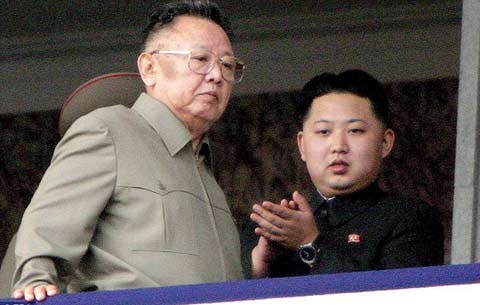
North Korea is frantically preparing for the rumored succession of Kim's third son. The young man could inherit from his father a country that is impoverished but renowned for its nuclear program. Meanwhile, following news of Kim's death, South Korea placed its military on "high alert," and President Lee Myung-bak immediately convened a national security council meeting. The two Koreas have theoretically remained at war for over 50 years after the Cold War armed conflict on the peninsula ended with an armistice agreement.
In a "special news report" on Monday, North Korean state media announced that Kim died of a heart attack on a train on Saturday due to "physical and mental stress" during an "intense inspection tour."
Kim Jong-un is believed to have suffered a stroke in 2008, but he has appeared relatively healthy and agile in photos and videos from his recent trips to China and Russia, as well as in a series of "incognito" tours around North Korea.
Kim Jong Il inherited power from his father, the founder of North Korea, Kim Il Sung, who died in 1994. He was prepared for 20 years to lead a nation founded and built by his father on the principle of self-reliance. In September 2010, Kim Jong Il revealed his third son, Kim Jong Un, then 20 years old, as his successor, placing Jong Un in high-ranking positions in the government.
Even with a successor in place, North Korea observers remain apprehensive about a power struggle behind the scenes or about nuclear instability following Kim's death. There is little solid information available regarding North Korea, one of the world's most isolated nations, and little is clear about the man known as "the beloved leader."
Korean legend holds that Kim Jong-un was born in the Paekdu Mountains, one of North Korea's most beloved places, in 1942, with a pair of rainbows appearing alongside a brightly shining new star as a premonition of his birth. However, according to Soviet records, he was born in Siberia in 1941.
When the Korean Peninsula was divided into North and South, Kim Il-sung (father of Kim Jong-il) became the first leader of North Korea in 1948, while Syngman Rhee became the first president of South Korea. War broke out in 1950, and the peninsula was separated by a Demilitarized Zone that remains one of the most heavily armed areas in the world to this day.
Kim Jong Il, who graduated from Pyongyang's Kim Il Sung University at age 33, was declared the ultimate successor by his father. But even before assuming power, there were signs that he would maintain – and perhaps even expand upon – his father's hardline policies. South Korea accused him of orchestrating the 1983 bombing that killed 17 South Korean officials visiting Myanmar. In 1987, in the bombing of a Korean Air Flight that killed all 115 people on board, a North Korean spy confessed to planting a bomb in an aide's suitcase, claiming it was ordered personally by Kim.
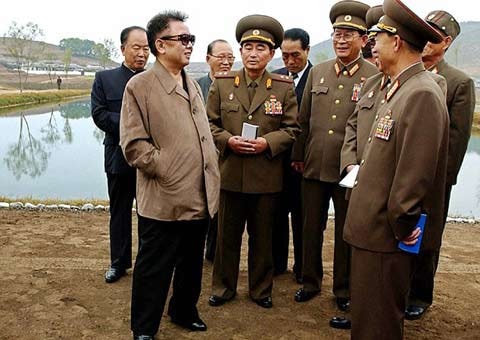
Photo: mailonline, the globe and mail
Kim Jong Il seized complete power after his father's death in 1994, assuming positions such as Chairman of the Central Military Commission, Commander-in-Chief of the North Korean army, and leader of the ruling party. He faithfully implemented his father's policy of "military first," mobilizing all resources for the military and building the world's fifth-largest army.
Kim also aimed to bolster North Korea's nuclear arsenal, culminating in North Korea's first nuclear test – an underground test in October 2006. Another test occurred three years later, in 2009. In a state of heightened alert and vigilance, regional leaders negotiated a disarmament agreement in exchange for aid, which Pyongyang signed in 2007 and began implementing a year later.
However, the disarmament process has encountered numerous impasses and delays, even as diplomats have worked to restart negotiations.
North Korea, long isolated and underdeveloped by sanctions and embargoes, has been unable to feed its people and relies heavily on aid. Floods in the 1990s destroyed much of the country's farmland and plunged millions into poverty. Kim Jong-un blames the United States for his country's troubles, and his regime often portrays Washington's ally, South Korea, as a "puppet" of the Western superpower.
In response, U.S. President George W. Bush, who took office in 2002, declared North Korea a member of the "axis of evil" that also included Iran and Iraq. In 2005, Bush described Kim as a "tyrant" who allowed his people to starve and built nuclear weapons.
Kim Jong-un is an enigmatic leader. But defectors from North Korea describe him as an eloquent and tireless orator, particularly to the military units that form the basis of his support. The world's best glimpse of this man came in 2000, when the South Korean government's "Sunshine Policy" aimed at reconciliation with North Korea reached its peak at the first inter-Korean summit, followed by unprecedented cooperation between the two sides. A second summit took place in 2007 with South Korean leader Roh Moo-hyun.
But the thawing between the two Koreas ceased in early 2008, when South Korea's conservative president Lee Myung-bak took office in Seoul and pledged a tough policy toward Pyongyang.
Expressing skepticism about Kim's perceived "eccentricity," former US Secretary of State Madeleine Albright described him as intelligent and well-informed, noting that the two sides discussed many issues during her visit to Pyongyang when Bill Clinton was US president.
Kim's marital status is unclear, but he is believed to have been married once and has three sons and one daughter. His eldest son, Kim Jong Nam, 38, lost his father's "favor" after being arrested for attempting to enter Japan with a fake passport in 2001. His other two sons, Kim Jong Chul and Kim Jong Un, are both in their 20s.
According to vietnamnet.vn