

Whale God in the beliefs of fishermen in Quynh Luu
(Baonghean) - Villages where whales (Ông Cá) return are considered lucky and prosperous. Fishermen always come to the temples and tombs dedicated to the whales to offer incense and prayers with sincerity. The worship of the whale has become a long-standing and distinctive cultural feature of the people of Quynh Luu coastal area...
(Baonghean) - Villages where whales (Ông Cá) return are considered lucky and prosperous. Fishermen always come to the temples and tombs dedicated to the whales to offer incense and prayers with sincerity. The worship of the whale has become a long-standing and distinctive cultural feature of the people of Quynh Luu coastal area...
Quynh Tho commune is one of the 14 coastal communes of Quynh Luu district. Deep within the village, near the sea dike, lies a very old temple dedicated to the Whale God, which also holds the record for the highest number of whale burials compared to other coastal communes. Behind the temple, three tombs of three Whale Gods remain intact, and according to the locals, the temple is very sacred, not only for fishermen but for everyone who comes here to pray for the Whale God's blessings.
According to Mr. Ngo Xuan Truoc, now 94 years old and the most knowledgeable person about the history of the temple, Duc Ong Temple dates back to the 13th century. In those days, people didn't worship the Whale God, but rather the Tran Dynasty kings. Later, they also worshipped General Yet Kieu, a skilled river-dwelling warrior who assisted the king in fighting the Mongol invaders.
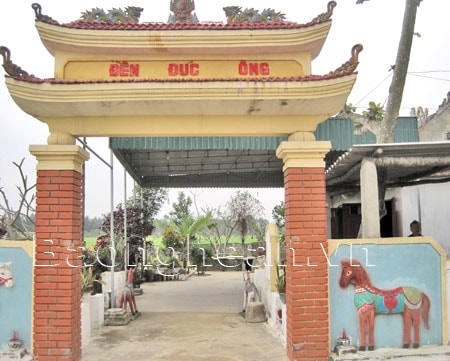
Duc Ong Temple (Quynh Luu)
During the Nguyen Dynasty (Dong Khanh's first year), the first whale (Dai Nhan Ngu Ong) washed ashore in Quynh Tho, and the locals brought it to be worshipped alongside other deities in the temple. Later, the temple was dismantled and moved into the village for the convenience of the people, leaving only the foundation out in the sea.
In the Lạch Thơi area, for reasons unknown, another whale washed ashore in 1942. At that time, the whale was still alive. The locals tried to return it to the sea, but it kept returning to the estuary, and on March 17, 1942, it passed away. The fishermen of Quỳnh Thọ village then rebuilt the temple on its old foundation near the estuary and brought the spirits of the deceased whale to be worshipped alongside it. Since then, the temple has stood peacefully in this coastal area. Twenty-five years ago (in 1987), a smaller whale also washed ashore on this land and was brought here by the people for worship.
Mr. Mai Van Nham (70 years old), who currently looks after the temple, said: "Every year, our villagers still observe March 17th, the day the second whale came here, as the collective anniversary of all the whales. In Quynh Luu, the coastal communes along the Ngang beach all have great faith in the whale, demonstrating a long-standing belief in whale worship. Not only in Quynh Tho commune, there is a temple dedicated to the whale; other communes such as Quynh Long, Quynh Tien... also have shrines and tombs dedicated to the whale. For the people of the sea, wherever the whale comes and stays, it brings good fortune, prosperity, and success. Therefore, they always organize funerals, burials, and build temples and shrines to offer incense and worship the whale."
Last August, a giant whale weighing 9.8 tons washed ashore on Tien Thuy beach, causing a stir in the entire coastal village. Mrs. Hua Thi Son (66 years old) said: "That day was truly special; I remember it vividly to this day. The whale was so huge that they couldn't bury it normally; they had to cut it up. From the moment they started cutting it up until they took it to the other village (Son Hai village, Tien Thuy commune) for burial, it rained like never before. The whole village, young and old, men and women, wept as they attended the funeral from 9 pm until 2 am."
The coastal areas where the whale is said to have washed ashore and stayed are all associated with strange stories told by the locals, as if to prove the sacredness of the fish they worship...
Ms. Ba Hua Thi Son from Tien Thuy commune said: "We fishermen have great faith in the Whale God. Since the Whale God returned, the people's businesses here have prospered much more. Now, each time a boat goes out to sea, it returns every 15 days. Large boats can earn up to 500 million VND, smaller boats 250-300 million VND, and the average is 400 million VND. I have two children who go fishing, so I often go to the temple or to the tomb out at sea to light incense and pray for the Whale God's blessings."
The "Ông" fish is actually a blue whale. When encountering people in distress at sea, the whale does not eat them but saves their lives and brings them ashore. Because of this, people believe that the "Ông" fish brings good luck, blessings, and prosperity to those who work at sea. Therefore, worshipping the "Ông" fish has become a long-standing custom, a cultural and religious practice deeply intertwined with the daily lives of the people of Quỳnh Lưu coastal area.
Mr. Ho Ngoc Cuong (Vice Chairman of the People's Committee of Tien Thuy Commune) said: "The people of the coast have always had faith in the Whale God, stemming from the fact that whales are always the ones that rescue people or ships in distress at sea. In the old days, whenever fishermen saw a whale, they would sprinkle salt and rice on it. Tien Thuy Commune has a shrine dedicated to the Whale God, where a whale bone recovered by fishermen is buried, and a whale tomb in the strait where a whale that washed ashore last year is buried. Fishermen often go to these two places to light incense and pray for the Whale God to bless them with good luck, abundant harvests, smooth sailing, and a safe return."
Ho Lai