

Land conversion - Lessons from Lang Thanh
(Baonghean.vn) - From 5-7 plots of land to only 1-2 plots, and most importantly, eliminating the need for farmers to travel 4-5 km to work in their fields as before, along with the formation of a suitable and convenient network of internal roads and irrigation systems for agricultural mechanization... these are the results of land conversion in Lang Thanh commune, Yen Thanh district.
(Baonghean.vn) - From 5-7 plots of land to only 1-2 plots, and most importantly, eliminating the need for farmers to travel 4-5 km to work in their fields as before, along with the formation of a suitable and convenient network of internal roads and irrigation systems for agricultural mechanization... these are the results of land conversion in Lang Thanh commune, Yen Thanh district.
In late December, we visited Lang Thanh commune and witnessed farmers enthusiastically working in the fields, building embankments and preparing the land for the winter-spring crop. Mr. Nguyen Xuan Cuong from Hamlet 1 confided: "My family used to have 2.5 sao (approximately 250 square meters) of rice paddies, but they were divided into five plots, each a separate field. The biggest difficulty was that some of the fields were 4-5 km from our house, making travel time and crop care inconvenient during the harvest season. Recently, the commune and hamlet implemented land redistribution. With the same area, after the redistribution, only two plots near our house remain. It's not just my family; every family is in the same situation. This land redistribution makes it easier for farmers to invest in intensive farming, and everyone is excited and enthusiastically supports it."
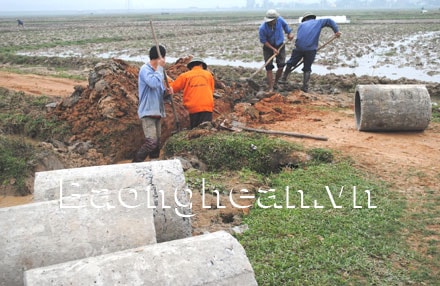
Along with land conversion and the replanning of the irrigation and transportation network, Lang Thanh also invested 150 million VND to install culverts across the road.
Mr. Cung Dinh Quang, a land administration official in the commune, said: After the land conversion was completed, the commune mobilized manpower to dig and install water pipes in the fields to facilitate irrigation. According to the design, the entire commune has nearly 100 locations requiring pipes, meaning the locality will have to spend 150 million VND to purchase them. This doesn't even include the resources that each hamlet has to mobilize from the people to buy and install pipes on the field and plot boundaries.
By doing so, farmers no longer have to dig ditches and trenches across the roads to get water for their fields as before. The commune has stipulated that the main roads within the fields are 6 meters wide, with 1-meter-wide ditches on either side; and the secondary roads are 4 meters wide, with 1-meter-wide ditches on either side. Therefore, according to the design, 100% of the internal field roads must be dug up and rebuilt because they were too narrow previously. Mobilizing the people's labor alone would be very difficult and would take many seasons, so the commune had to invest over 500 million VND to rent excavators, striving to complete the work within one year. By the end of December, the basic tasks following the land reallocation were completed.
Mr. Tran Van Giang, Chairman of the Commune People's Committee, added: Following the direction of the District People's Committee regarding the pilot commune for land conversion, and recognizing it as a difficult and complex task, Lang Thanh has focused on completing the mission since the beginning of 2011. To achieve this goal, the locality has strictly implemented the process, from gathering opinions from the council, holding meetings with the military, civilians, and officials, assigning each commune official to be responsible for each hamlet, and organizing hamlet meetings to gather people's opinions...
The biggest challenge for Lang Thanh is the uneven terrain of the rice fields, which are divided into three distinct areas. The area further north, away from residential areas, is very favorable for producing two rice crops per year; the area further north, although also having access to irrigation, only yields a reliable harvest in the winter-spring crop, while the summer-autumn crop is frequently flooded, resulting in very low rice yields and even land abandonment; the uppermost area, the flat rice paddies, faces greater irrigation difficulties but allows for the safe production of three crops per year.
In reality, the local land conditions were very difficult to manage, as no hamlet wanted to take on the most challenging plots of land. After the hamlets determined their population and based on the land area of each plot, the commune decided which hamlet would receive more land in the challenging areas, and vice versa.
That solution, when presented to the entire population, was largely supported by the farmers. Combined with land reallocation was the replanning of the internal irrigation and transportation networks. Although not yet fully paved, the initial stages of the irrigation and transportation networks across the fields have been carried out according to design, facilitating water regulation and the movement of motorized vehicles.
During the implementation process, all hamlets were generally very active, with Hamlet 1 arguably performing best in the areas of transportation and irrigation. To date, Hamlet 1 has mobilized residents to excavate and repair transportation routes, field embankments, and raised tens of millions of dong in cash to purchase and install water pipes across the field embankments.
Following the principle of dividing up the land before developing transportation and irrigation infrastructure, the land conversion and replanning of the transportation and irrigation network in Lang Thanh has been very systematic and highly effective. To date, 100% of farmers in Lang Thanh have received new land, allowing them to focus on production.
Xuan Hoang