

Visiting Ho Dynasty Citadel - Remembering the time of Van An Citadel
(Baonghean.vn) - To this day, more than 600 years later, the people around Tay Do region, in Vinh Loc district, Thanh Hoa province, still orally discuss how the Ho Dynasty (Ho Quy Ly) built strong fortifications and imposed heavy forced labor, alienating the people and being one of the reasons why the country fell into the hands of the enemy.
(Baonghean.vn) - To this day, more than 600 years later, the people around Tay Do region, in Vinh Loc district, Thanh Hoa province, still orally discuss how the Ho Dynasty (Ho Quy Ly) built strong fortifications and imposed heavy forced labor, alienating the people and being one of the reasons why the country fell into the hands of the enemy.
Conversely, the Van An citadel in Nam Dan (Nghe An), built under the leadership of Mai Thuc Loan, is praised by the people as a symbol of the entire nation's resistance against invaders, a "pretext" for the people to remember the first person to proudly declare himself emperor of our country's feudal dynasties, exactly 1290 years ago.

The author visits Ho Dynasty Citadel.
The Ho Dynasty citadel was built starting in 1397, when King Tran Thuan Tong assigned Ho Quy Ly to build a citadel, ramparts, palace, and temple in An Ton (located in the area of Vinh Long and Vinh Tien communes, Vinh Loc district, Thanh Hoa province today). Upon ascending the throne (in 1400), Ho Quy Ly named the country Dai Ngu and continued to establish the capital at this citadel. The citadel is rectangular, 870.5 meters wide and 883 meters long. The four gates are made of stone with arched bases, and the surrounding walls are also made of stone and brick, making it very sturdy. When the Ming invaders attacked Vietnam, Ho Quy Ly and his son could not resist and had to retreat to Thanh Hoa, where they were captured and taken to China. The Ho Dynasty ruled for 7 years.
The Vạn An Citadel was built by Mai Thúc Loan during his rebellion against the Tang Dynasty invaders from 722-726. Unlike Hồ Quý Ly, who came from a prominent and influential family within the court, Mai Thúc Loan was an orphan, born and raised in the Ngọc Trừng mountain region (now Nam Thái commune, Nam Đàn district, Nghệ An province). His career began with a rebellion in which he and a group of laborers carried cloth as tribute to the Tang Dynasty. After the rebellion, the people revered him as Mai Hắc Đế (Mai the Black Emperor). He, along with his army and the people of the surrounding area, built the Vạn An Citadel as a long-term base for resistance against the invaders. This citadel is over 1000 meters long, connecting the Vệ Sơn base, where the first flag was raised, with Rú Đụn, along the banks of the Lam River. The unity of the army and the people is reflected in a folk lullaby that is still preserved today.
My child, sleep well.
To allow Emperor Mai to build the Van An citadel.
With a solid base and a powerful army, Mai Thúc Loan led 300,000 troops (including 200,000 foreign allies from Lâm Ấp and Chân Lạp) to liberate Tống Bình (Hanoi). The Tang Dynasty's Protectorate (Quang Sở Khách) was forced to flee, Mai Thúc Loan declared himself emperor, named his country Vạn An, and abolished all previous Tang Dynasty regimes.
Enraged, the Tang Dynasty sent Yang Zi Xu to lead 100,000 elite troops to suppress the rebellion. Mai Thuc Loan's army, at that time only numbering 100,000 (the allied forces had already returned home) with rudimentary weapons, could not hold Tong Binh citadel and had to retreat to Van An citadel to hold out and plan for the long term. There, the rebel army and the local people fought fiercely, "blood flowed like rivers, bones piled up like mounds." After three attacks, the Tang army suffered heavy losses but eventually overtook Van An citadel. King Mai was wounded and forced to retreat to an inner base where he died. The Van An citadel defense line fell, but Mai Thuc Loan's son (Mai Thuc Huy) continued to fight valiantly around the citadel, causing sleepless nights for the enemy. It wasn't until 726 that the Tang army finally pacified the remaining rebel forces around the citadel.
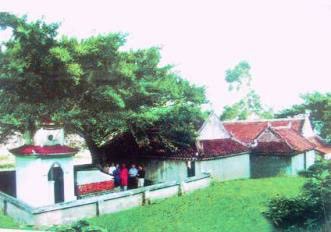
Mai Hac De Temple in Van An Citadel
After nearly 1300 years, Van An Citadel no longer retains the imposing grandeur of the Ho Dynasty citadel, but its traces remain. Whenever people pass through Nam Dan or visit the Ho Dynasty citadel, they often silently recall: There once was Van An Citadel. As long as the life and achievements of Mai Hac De live on, the name Van An Citadel will continue to be passed down through generations, primarily due to the unity of the king and his subjects in building the citadel and fighting the enemy. The four lines of the seven-word, eight-line poem still resonate:
Hung ruled over Hoan Chau, a whole region.
The Vạn An citadel is filled with the scent of incense.
The Mai Emperor's prestige and virtue spread far and wide.
In a hundred battles, Ly Duong restored his martial prowess…
Hoang Chinh